Republished by Blog Post Promoter
Are you sick of priests, politicians and profiteers? It’s ass kicking time people! They don’t have power unless we give it to them!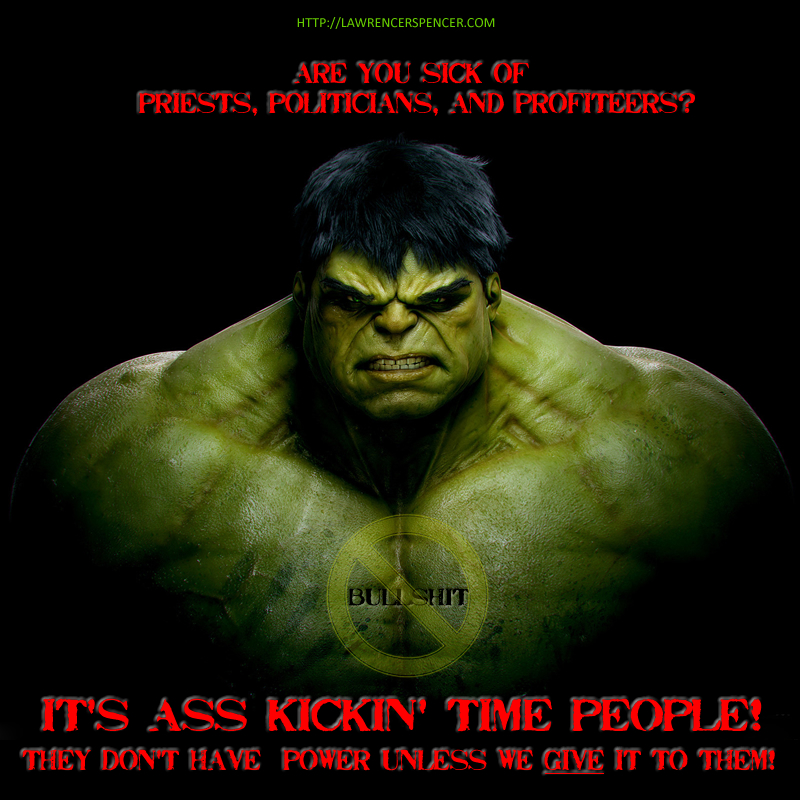

Republished by Blog Post Promoter
Are you sick of priests, politicians and profiteers? It’s ass kicking time people! They don’t have power unless we give it to them!
Republished by Blog Post Promoter

…..relax….trust us…..be calm…..we will protect you….do not ask questions….believe everything we tell you….believe…..give us your money…..trust us…..give us your love….trust us…it will be alright….give us your money…..give us your money……give us your money….we are your leaders….trust us….believe….
Republished by Blog Post Promoter

# 583 — OPERATE AN ORACLE SHRINE
“An oracle is a spirit considered to be a source of wise counsel or prophetic opinion, predictions of the future, inspired by the gods. Oracles were portals through which the gods spoke directly to man.
There are a few easy steps to opening your own oracle temple.
1) find a location. This could be a cave, a temple, a shrine, a mountain top or any other place that seems “holy”.
2) hire a priestess to intercede between you and the supplicant.
3) train the priestess to listen to you and interpret your thoughts perfectly so she can relay them without alteration. After all, you don’t want your wisdom and good advice to be ruined by a bad translator.
4) have the priestess burn some incense.
5) advertise in the “personals” columns or put 3 X 5 index cards on bulletin boards in Laundromats with the following announcement:

“I, _________, (your name) the “great god (your name)” will be making predictions and precognitions at the (oracle temple location) between the hours of (evenings and week-ends are best) for the low, introductory offering price of ( a sheep, a goat, a bowl of grain, a basket of fruit, etc.).”
Then, sit back and get ready to hand out free advice to the teaming throngs.
Of course, if you can do some magic tricks or heal a few crippled people, this will help get your ratings up. The good buzz about you will spread quickly.
Soon your name and your temple will be revered throughout the realm for thousands of years to come, or until it is outlawed and destroyed by a bunch of greedy, holier-than-thou priests.”
— Excerpt from the book 1001 THINGS TO DO WHILE YOU’RE DEAD, by Lawrence R. Spencer

Republished by Blog Post Promoter

ONE DOES NOT DISCUSS ETHICS
WITH A SNAKE WHEN IT STRIKES.
ONE DOES NOT SEEK JUSTICE
IN THE JAWS OF A SHARK.
BANKERS, SOLDIERS, POLITICIANS,
AND PRIESTS WORK TOGETHER AS A TEAM.
POWER, CONTROL AND POSSESSION
ARE THEIR NATURAL SCHEME.
BEINGS OF GOOD WILL TREAT EACH OTHER
AS THEY WOULD BE TREATED THEMSELVES.
EVERY CREATURE SURVIVES
ACCORDING TO ITS KIND.
GOOD AND EVIL ARE SEEN THROUGH
THE EYES OF PREDATORS AND PREY.
SURVIVAL IS AVOIDING PAIN.
PLEASURE IS LOVE ETERNALLY.
ONE KNOWS THAT SURVIVAL IS A GAME
THAT IMMORTAL SPIRITS CANNOT PLAY
UNLESS THEY FORGET THAT THEY ARE THEY.
______________________________
Lawrence R. Spencer. 2013.
Republished by Blog Post Promoter

A Vampire is an Immortal Spiritual Being. He or she cannot die. Yet, they cannot inhabit a living human body either. They are conceived to be dependent on beings who inhabit living bodies. Vampires worship and covet human bodies. Their depraved state of being includes the notion that “only beings who have a body can have a real life”. The idea that a disembodied spirit needs to drink the blood of a living human in order to have energy and longevity is part of the mythology about Spiritual Beings invented by priests attempting to frighten people away from disembodied spirits! PRIESTS do not want people to communicate with spirits! If you communicated with spirits directly, like gods and ghosts, priests would lose their power, wealth and control over you!
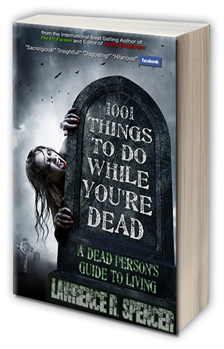
Of course, an Immortal Spirit is Immortal with or without a body. Learn more about how to live without a body in my book: 1,001 Things To Do While You’re Dead.
READ MORE ABOUT VAMPIRES ON WIKIPEDIA.ORG:
Tales of supernatural beings consuming the blood or flesh of the living have been found in nearly every culture around the world for many centuries. Today, we would associate these entities with vampires, but in ancient times, the term vampire did not exist; blood drinking and similar activities were attributed to demons or spirits who would eat flesh and drink blood; even the Devil was considered synonymous with the vampire. Almost every nation has associated blood drinking with some kind of revenant or demon, or in some cases a deity.
Ancient Greek and Roman mythology described the Empusae, the Lamia,and the Striges. Over time the first two terms became general words to describe witches and demons respectively. They were described as having the bodies of crows or birds in general, and were later incorporated into Roman mythology as strix, a kind of nocturnal bird that fed on human flesh and blood.
Vampires are mythological or folkloric beings who subsist by feeding on the life essence (generally in the form of blood) of living creatures, regardless of whether they are undead or a living person/being.Although vampiric entities have been recorded in many cultures, and may go back to “prehistoric times”,the term vampire was not popularized until the early 18th century, after an influx of vampire superstition into Western Europe from areas where vampire legends were frequent, such as the Balkans and Eastern Europe, although local variants were also known by different names, such as vrykolakas in Greece and strigoi in Romania. This increased level of vampire superstition in Europe led to mass hysteria and in some cases resulted in corpses actually being staked and people being accused of vampirism.
While even folkloric vampires of the Balkans and Eastern Europe had a wide range of appearance ranging from nearly human to bloated rotting corpses, it was interpretation of the vampire by the Christian Church and the success of vampire literature, namely John Polidori‘s 1819 novella The Vampyre that established the archetype of charismatic and sophisticated vampire; it is arguably the most influential vampire work of the early 19th century, inspiring such works as Varney the Vampire and eventually Dracula. The Vampyre was itself based on Lord Byron‘s unfinished story “Fragment of a Novel, published in 1819.
However, it is Bram Stoker‘s 1897 novel Dracula that is remembered as the quintessential vampire novel and which provided the basis of modern vampire fiction. Dracula drew on earlier mythologies of werewolves and similar legendary demons and “was to voice the anxieties of an age”, and the “fears of late Victorian patriarchy“.The success of this book spawned a distinctive vampire genre, still popular in the 21st century, with books, films, video games, and television shows.