Republished by Blog Post Promoter


Republished by Blog Post Promoter
Republished by Blog Post Promoter

If you read the book ALIEN INTERVIEW, you know that humans on Earth are given amnesia and false memories between each incarnation or lifetime.  Thanks to modern “science”, we may soon be implanted with MORE FALSE MEMORIES while we are sleeping! Earth “scientists” have now demonstrated (using laboratory mice) that they can make us all feel “happy” about being imprisoned on Earth. Remember the films “Total Recall” from 1990 or 2012? The “science” in these so-called “science fiction” films will soon to become what we call “reality”. In other words, you may be “happy”, but you won’t know who you are, where you are, when you are, why you are, or what is or isn’t real.
Read the article below, and the links to other articles on the subject published in The Guardian
“Researchers at CRNS (click here to see a list of the Global Corporations who fund the research done at The National Center for Scientific Research) in Paris create artificial positive feelings in mouse’s memory for first time during sleep, highlighting possible new treatment for depression. Scientists have succeeded in creating false but happy memories in mice, in the first demonstration of memory manipulation during sleep.
In the study, positive feelings about a particular place were artificially written into the animal’s memory, which caused them to seek out that place in search of a reward when they woke up. The discovery that emotional memory can be readily manipulated has echoes of the the film, Eternal Sunshine of the Spotless Mind, in which Jim Carey’s character has every recollection about his failed relationship wiped clean using a fictional mind-reading technology.
The scientists say that the findings could pave the way for new treatments that would allow patients to overcome depression or deeply entrenched painful memories. Karim Benchenane, the neuroscientist who led the research at the CNRS in Paris, said: “The idea is to use this as a tool for post-traumatic stress disorder.”
Steve Ramirez, a neuroscientist at Massachusetts Institute of Technology who is also working on memory manipulation, described the research as a “technical tour-de-force”. He said: “It demonstrates a little bit of mastery over how the brain works. “In future it should be possible to dampen the punch of traumatic memories in people.”
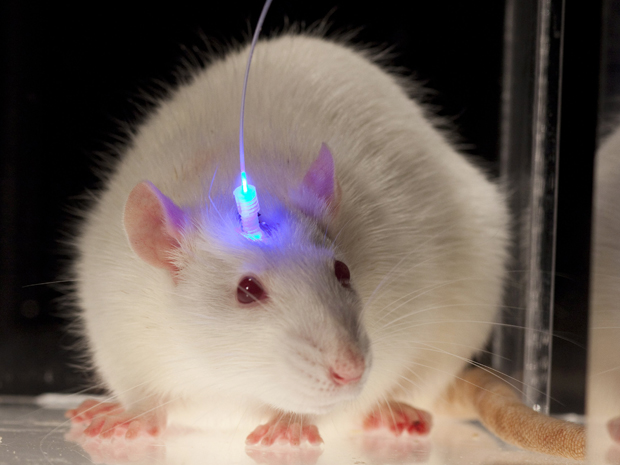 In the study, scientists implanted two electrodes in the brains of mice – one in a region of the hippocampus, the brain’s memory centre, involved in mapping locations and the second one in the brain’s reward centre.
In both mice and humans, our environment is physically mapped out in the brain by so-called “place cells”, which light up like coordinates on a grid as we move through space. The scientists picked a particular place cell neuron and observed which location it related to in real-life as the mouse roamed around a large exploration area.
During sleep, mice typically replay these sequences of place cell activity – effectively their memory replaying where they have been during waking hours. The scientists rigged up the electrodes, such that during sleep, whenever the target place cell became active it triggered the delivery of a reward stimulation in the second electrode.
Advertisement
Although the memory of the place was initially neutral, during its sleep, the mouse learned to associate it with something positive happening.
“When they woke up the mouse went straight to that place as though it was waiting for a reward,” said Benchenane.
The study demonstrates what we subjectively know to be true — that the factual content of our memories and the emotional content are stored in different brain centres and can be changed independently.
 Benchenane believes the findings could be the basis for a non-invasive tool for memory manipulation in humans. Rather than electrodes, functional MRI scans could be used to identify when a person is replaying a specific memory during sleep, he suggested.
However, the authors said they would be cautious about rushing to try and test this in PTSD patients. “It might be extremely dangerous to get a reward for something fearful,” he said.
Ramirez agreed that in future, the findings could have clinical applications. “The big thing technologically is we don’t have a good non-invasive way of manipulating brain activity. One day it should be possible though,” he said.”
http://www.theguardian.com/science/2013/jul/25/false-memory-implanted-mouse-brain
Republished by Blog Post Promoter

Republished by Blog Post Promoter
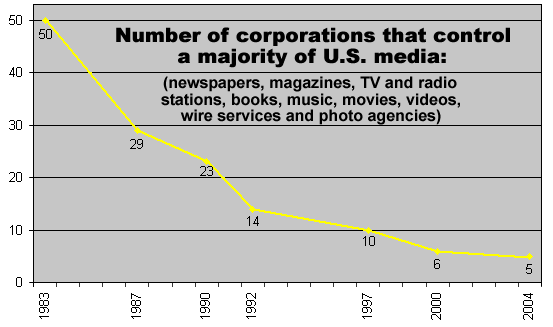 If you don’t believe mainstream media controls ALL the content you see on “the news” on television, you should watch this. All of the TV, radio, newspapers, magazines, and other mainstream media are owned and controlled by only 5 Global Corporations. They people who create the content and write the scripts are all employed by the same tiny cabal of miscreant slave masters. The CIA oversees every detail of what you are allowed to see on TV. Of course, if you don’t WANT to LOOK and see this reality, then excuse me for trying to help wake you up from your state of hypnotic slumber…. Or, you can simple turn your TV set OFF !!! Eventually, you will begin to regain consciousness.
Republished by Blog Post Promoter

It seems that we live on a “false facade” prison planet where our memories have been erased, and “truth” is a construct of lies designed to prevent us from remembering Who we really are, and where we came from.
The only way this can be “verified” is through your personal memories, observations and perceptions of what you define as “reality”. You are the source of “authenticity” for You.