Republished by Blog Post Promoter


miscellaneous postings by Lawrence R. Spencer
Republished by Blog Post Promoter
Republished by Blog Post Promoter
Beauty is a subjective perception of aesthetic in the opinion of the beholder. On Earth many people call this “Nature”.
What Is Beauty? from Spring Garden Pictures on Vimeo.
Republished by Blog Post Promoter

Republished by Blog Post Promoter
” Like a twister swirling across the plains of America, the consumption of animal protein is killing Americans who do not know enough to protect themselves from the storm of false information furnished by the vested interests who profit from the sale of animal flesh as food.
Clearing up confusions about the human body’s need for protein sheds a different light on health and diet.
The word “protein” is derived from the Greek language and means “of primary importance”. Amino Acids, the component parts of protein, are the biochemical basis for life and are required by every cell. The immune system’s antibodies are protein. Endrocine hormones are protein. The cement that holds our cells together is made of protein.
PROTEIN LIES
What do the following World Champion athletes all have in common, besides strength and endurance? They must be big meat eaters, right?
Henry Aaron–Baseball Home Run Champion
Dave Scott–six-time winner of the Ironman Triathlon (the only man to win it more than twice!)
Sixto Linares–World Record holder in the 24-hour Triathlon
Paavo Nurmi–20 World Records and nine Olympic Medals in distance running
Stan Price–World Record holder in the Bench Press
Andreas Cahling–Mr International Body Building Champion
Roy Hilligan–Mr America Body Building Champion
Ridgely Abele–Eight-Time National Champion in Karate
All of these athletes are VEGETARIANS! There are many, many more top athletes who have discovered that eating meat decreases strength and stamina.
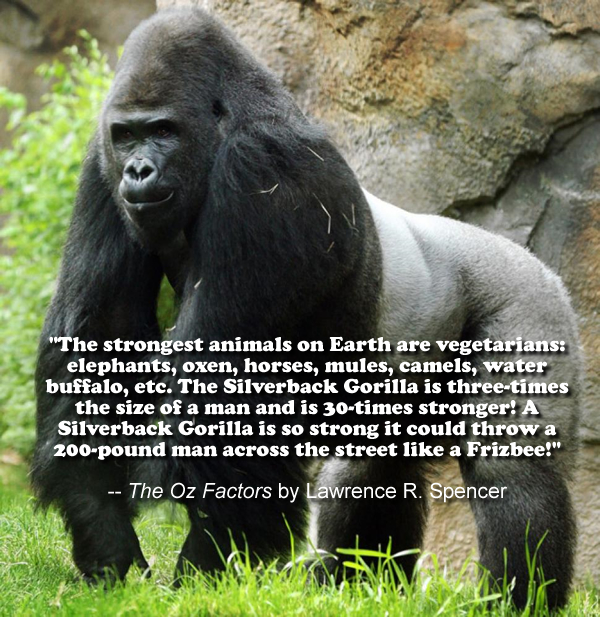
The strongest animals on Earth are also vegetarians: Elephants, oxen, horses, mules, camels, water buffalo, etc. The Silverback Gorilla is three-times the size of a man and is 30-times stronger! A Silverback Gorilla is so strong it could throw a 200-pound man across the street like a Frizbee! What does a gorilla eat? Raw fruit and vegetables.
John Robbins, in his book, ‘Diet for a New America’, reports that, “… study after study has found that protein combustion is no higher during exercise than under resting conditions.”
The Journal of the American Medical Association in 1978 warns athletes (and non-athletes) against taking protein supplements, stating, “Athletes need the same amount of protein foods as non-athletes. Protein does not increase strength. Indeed, it often takes greater energy to digest and metabolize the excess protein.”
LONGEVITY IS A LONG LIFE
It has been known for decades that populations consuming high-protein, meat-based diets have higher cancer rates and lower life-spans (averaging as low as 30 to 40 years), compared to cultures subsisting on low-protein vegetarian diets. Some of these have life spans of more than 90 years.
Dr Alexander Leaf published the findings of his research about the oldest people in the world in the January, 1973 edition of National Geographic Magazine. He found that the three most consistently disease-free and long-lived people on Earth are the Abkhazians of Russia, the Vilacabambans of Ecuador and the Hunzukuts of Pakistan. None of these people suffer from Western diseases: NO obesity, NO cancer, NO heart disease! On the average these people live to be over 100 years old. The men are physically active and still fathering children at 100 years of age.
The diet of all of these people consists of 70-80 percent high-water-content foods such as raw, uncooked fruits and vegetables. These people eat very little or no animal products.
Meat protein is the most difficult food for the body to digest. The average time for food (other than fruit) to pass through the entire gastrointestinal tract is between 25 and 30 hours. When meat is eaten, that time is more than doubled!
Research published in the New England Journal of Medicine, in September, 1982 states, “undigested protein must be eliminated by the kidneys. This unnecessary work stresses out the kidneys so much that gradually lesions are developed and tissues begin to harden.”
In the colon, this excess protein waste putrefies into toxic substances, some of which are absorbed in the bloodstream.
The University of Illinois Medical School reports that: “A high protein diet also breaks down the pancreas and lowers resistance to cancer as well as contributes to the development of diabetes.”
 HOW MUCH PROTEIN IS “ENOUGH”
Human mother’s milk contains no more than 5% protein. This is enough protein to enable an infant to double its weight and size during the first six months of life! After that, the need for protein DECREASES.
Independent researchers around the world agree that the human need for protein each day is only 25 to 35 GRAMS (about one ounce). Many nutritionists feel that only 20 grams a day are more than enough. Meanwhile, the AVERAGE AMERICAN eats more than 100 GRAMS of protein a day–five times the actual need!
Reports in the American Journal of Clinical Nutrition say that people do not need to consume more than 2.5% of their daily caloric intake from protein. Even the World Health Organization says people need no more than 4.5% of their calories from protein.
So, as an alternative to animals flesh, how many calories are provided from protein in common raw fruits and vegetables?
SPINACH = 49%
BROCCOLI = 45%
CAULIFLOWER = 40%
LETTUCE = 34%
PEAS = 30%
GREEN BEANS = 26%
CUCUMBERS = 24%
CELERY = 21%
POTATOES = 11%
SWEET POTATOES = 6%
HONEYDEW MELON = 10%
CANTALOUPE = 9%
STRAWBERRIES = 8%
ORANGES = 8%
WATERMELON = 8%
PEACHES = 6%
BANANAS = 5%
PEARS = 5%
WHERE’S THE PROTEIN IN THE BEEF?
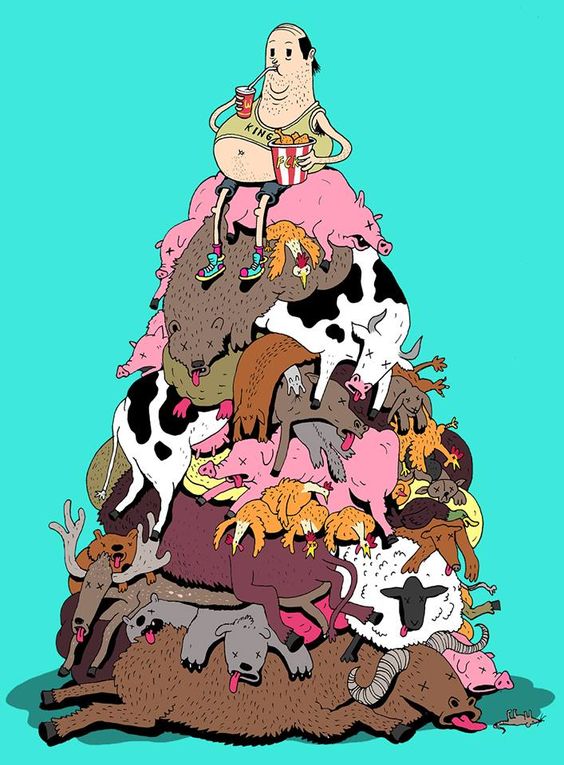
Since our bodies recycle 70% of the protein waste, we lose only about 23 grams of protein a day (there are 28.35 grams in one ounce). To replenish this lost protein, your body needs only about 24 ounces (1.5 pounds) of protein a month. So, why do we think we must eat huge amounts of meat to be healthy? Advertising. The meat and dairy industries spend vast sums of money in television and magazine advertising every year to convince Americans that we must eat huge amounts of cow meat, cheese, milk, eggs, chicken and other assorted animal products.
What’s the truth about meat as a source of protein? The Food and Nutrition Board of the National Research Council states: “One of the biggest fallacies ever perpetuated is that there is any need for so-called ‘complete protein’.”
The fact is that protein is composed of amino acids. Amino acids are the building blocks of the human body. There are a total of 23 amino acids needed by the body, of which 15 of these our bodies manufacture in the liver–provided the liver is in good working order. The other eight amino acids must come from food so the body can build a complete protein.
LIONS & TIGERS & MEN…OH, MY!
The idea that we must eat meat to supply protein for our bodies is a lie. Factually, our bodies CAN NOT directly assimilate the protein found in meat or any other food. The food must be digested and broken down into amino acids. The liver re-forms the amino acids into usable protein for our bodies.
The amazing truth is that every one of the amino acids our body requires is found in raw fruits and vegetables!
Furthermore, when meat is cooked the amino acids in the meat are coagulated or destroyed. In addition, meat releases large amounts of uric acid into our bodies when eaten. Uric acid is toxic to the human body. The bad news is that the human body does not even have the enzyme uricase to break down uric acid.
In order for humans to get any nutritional value from meat it would have to be eaten raw, like the carnivores. However, carnivorous animals, who can live on raw meat, have very little in common with humans.
Here is a list of physiological differences between carnivorous animals and humans:
Carnivore: long, sharp, pointed teeth for ripping and chewing flesh. Jaw moves up and down ONLY for tearing and biting.
Human: Have molars for crushing and grinding and jaws that move side to side for eating vegetation.
Carnivore: Saliva is acid for digesting animal protein.
Human: Saliva is alkaline and contains ptyalin for digestion of starch.
Carnivore: Stomach is a simple round sack that secretes ten times more hydrochloric acid than humans.
Human: Stomach is oblong, complex and convoluted with a duodenum.
Carnivore: Intestines are three times the length of the trunk, designed for rapid expulsion of meat, which rots quickly.
Human: Intestines are 12 times the length of our trunks, designed to keep food until all nutrients are extracted.
Carnivore: Liver will eliminate 10 to 15 times more uric acid than the human liver.
Human: Liver produces no uricase enzyme to eliminate uric acid.
Carnivore: Do not sweat through their skin and have no pores.
Human: Sweat through the skin to eliminate wastes.
Carnivore: Urine is acid.
Human: Urine is alkaline.
Carnivore: Tongue is rough for licking blood and flesh.
Human: Tongue is smooth.
WOULD YOU PREFER YOUR TOXINS ‘WELL DONE’?
The most extensive study of diet and lifestyles ever made, called the China Project, wherein the eating habits of thousands of Chinese people were studied meticulously over a period of many years, found that the eating of animal protein is linked to chronic disease.
According the John Robbins in his video, “Diet For A New America”, the average American meat eater pours 100 pounds of ANIMAL FAT into their veins and arteries EVERY YEAR. During his or her lifetime the average American will be a consumer of approximately twelve 3,000 pound cows, 6 pigs, 3,000 chicken, 3,000 FISH and 30,000 quarts of MILK, not to mention all the other meat and dairy products and by-products. (Of course these figures include the bones, skin, entrails, feathers, fur, etc of these animals, which, although we don’t eat them, are still a part of the weight of the slaughtered animals.)
The average American is 25 pounds overweight, has an unhealthy level of cholesterol, as evidenced by the number of people who die from heart disease, (average level is 200) and will have high blood pressure as a result of veins clogged with fat.
Consequently, the leading cause of death in the United States is heart disease and stroke. Nearly ONE HALF of all deaths in the United States are caused by heart disease!
According to Dr Matthias Rath, Director of the Cardiovascular Research Unit at Linus Pauling Institute, HEART DISEASE, STROKES, CANCERS, DIABETES, LIVER DISEASE and ARTERIAL SCLEROSIS CAUSE 70 PERCENT OF ALL DEATHS IN THE United States EVERY YEAR.
In addition, excessive protein consumption is directly responsible for osteoporosis, teeth and gum disease, high cholesterol, acidosis, constipation, kidney infections and weakness, liver disease, water retention, arthritis, cancer, diabetes, allergies, hypertension and weak immune system, to name a few. Here’s why:
TOXINS FOUND IN ANIMAL FOODS ARE 100 TIMES MORE CONCENTRATED than those found in fruits and vegetables. Raw egg white and rattlesnake venom are, chemically, virtually the same. Proteins that putrefy in the colon cause most of the diseases, such as cancer, and other ailments, such as headaches, affecting people today. The toxic burden to the body caused by excessive protein consumption creates the “garbage” which disease viruses and bacteria feed on. Improperly digested protein poison the lymphatic system, the bloodstream and the vital organs.
As part of this toxic scenario, the chemicals given to commercially raised animals destined for slaughter are highly dangerous. These include, but are not limited to: penicillin, tetracycline, sewage-sludge which has been decontaminated with cesium-137, radioactive nuclear waste and fattening agents.
MAN’S INHUMANITY TO BEAST
The inhumane atrocities of commercial meat production combined with the tremendous abuse and waste of our shrinking land and water resources are thoroughly documented by John Robbins in his video film and book, “Diet for a New America”.
Making his case, Robbins helps us reflect that if we conceive animals to be stupid, dirty and brutish, it may be helping to ease the moral burden of killing and eating them. But, are they all stupid, dirty and brutish?
As just one example, pigs are highly intelligent. Professor Stanley Curtis of Penn State University has taught pigs to understand complex relationships between actions and objects in order to play video games. Pigs have been proven to be focused, creative, innovative and equal in intelligence to chimpanzees.
What of the resources used and squandered to fulfill all our carnivorous desires?
The destruction of our environment caused by livestock production is a vast expense which is not calculated into the price you pay for a pound of flesh at the grocery store; for example, the huge amounts of grain and grassland which are used to sustain the world population of 1.3 billion beef cattle each year!
The Environmental Protection Agency decided that agriculture is exempt from the Clean Water Act in the United States even though 60 percent of our rivers and streams are considered “impaired” due to agricultural water wastes. Hogs, for example, excrete an amazing 32 times their own weight in feces and urine every year. In central California, 1,600 dairies produce the same amount of feces and urine as a city of 21 million people. Incredibly, five TONS of solid manure is produced by food livestock annually for every United States citizen. That’s 130 times more waste than is produced by people! This waste is dumped into, or is seeping through the soil into our fresh water supply.
On the average, it takes 16 pounds of grain to produce just one pound of beef, 6 pounds of grain to produce one pound of pork, 3 pounds of grain to produce one pound of chicken and 5.3 pounds of fishmeal to produce one pound of farmed fish. The same grain can be consumed directly by humans.
There are 1.2 billion people in the world whose daily income is less than $1.00 a day. They spend 70 percent of their income on food, yet increasing grain prices due to competition with livestock is causing increased starvation globally.
The bald-faced fact is, if we were to eliminate the consumption of meat entirely, the food resources of the world would be sufficient to feed ten billion people (as of 1998).
In 1991, the Physicians Committee for Responsible Medicine came out with the “New Four Food Groups”, which are, Fruits, Vegetables, Whole Grains and Legumes (beans & peas). Meat and dairy are termed “optional” and not considered necessary for good health.”
— excerpted from THE OZ FACTORS, by Lawrence R. Spencer (1997)
Republished by Blog Post Promoter

If you read the book ALIEN INTERVIEW, you know that humans on Earth are given amnesia and false memories between each incarnation or lifetime.  Thanks to modern “science”, we may soon be implanted with MORE FALSE MEMORIES while we are sleeping! Earth “scientists” have now demonstrated (using laboratory mice) that they can make us all feel “happy” about being imprisoned on Earth. Remember the films “Total Recall” from 1990 or 2012? The “science” in these so-called “science fiction” films will soon to become what we call “reality”. In other words, you may be “happy”, but you won’t know who you are, where you are, when you are, why you are, or what is or isn’t real.
Read the article below, and the links to other articles on the subject published in The Guardian
“Researchers at CRNS (click here to see a list of the Global Corporations who fund the research done at The National Center for Scientific Research) in Paris create artificial positive feelings in mouse’s memory for first time during sleep, highlighting possible new treatment for depression. Scientists have succeeded in creating false but happy memories in mice, in the first demonstration of memory manipulation during sleep.
In the study, positive feelings about a particular place were artificially written into the animal’s memory, which caused them to seek out that place in search of a reward when they woke up. The discovery that emotional memory can be readily manipulated has echoes of the the film, Eternal Sunshine of the Spotless Mind, in which Jim Carey’s character has every recollection about his failed relationship wiped clean using a fictional mind-reading technology.
The scientists say that the findings could pave the way for new treatments that would allow patients to overcome depression or deeply entrenched painful memories. Karim Benchenane, the neuroscientist who led the research at the CNRS in Paris, said: “The idea is to use this as a tool for post-traumatic stress disorder.”
Steve Ramirez, a neuroscientist at Massachusetts Institute of Technology who is also working on memory manipulation, described the research as a “technical tour-de-force”. He said: “It demonstrates a little bit of mastery over how the brain works. “In future it should be possible to dampen the punch of traumatic memories in people.”
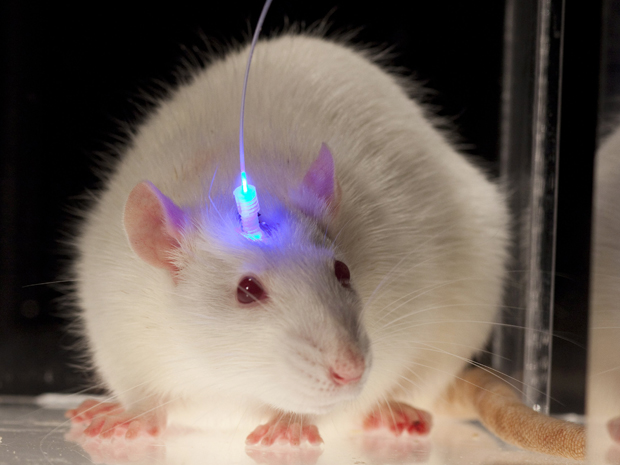 In the study, scientists implanted two electrodes in the brains of mice – one in a region of the hippocampus, the brain’s memory centre, involved in mapping locations and the second one in the brain’s reward centre.
In both mice and humans, our environment is physically mapped out in the brain by so-called “place cells”, which light up like coordinates on a grid as we move through space. The scientists picked a particular place cell neuron and observed which location it related to in real-life as the mouse roamed around a large exploration area.
During sleep, mice typically replay these sequences of place cell activity – effectively their memory replaying where they have been during waking hours. The scientists rigged up the electrodes, such that during sleep, whenever the target place cell became active it triggered the delivery of a reward stimulation in the second electrode.
Advertisement
Although the memory of the place was initially neutral, during its sleep, the mouse learned to associate it with something positive happening.
“When they woke up the mouse went straight to that place as though it was waiting for a reward,” said Benchenane.
The study demonstrates what we subjectively know to be true — that the factual content of our memories and the emotional content are stored in different brain centres and can be changed independently.
 Benchenane believes the findings could be the basis for a non-invasive tool for memory manipulation in humans. Rather than electrodes, functional MRI scans could be used to identify when a person is replaying a specific memory during sleep, he suggested.
However, the authors said they would be cautious about rushing to try and test this in PTSD patients. “It might be extremely dangerous to get a reward for something fearful,” he said.
Ramirez agreed that in future, the findings could have clinical applications. “The big thing technologically is we don’t have a good non-invasive way of manipulating brain activity. One day it should be possible though,” he said.”
http://www.theguardian.com/science/2013/jul/25/false-memory-implanted-mouse-brain