Republished by Blog Post Promoter
REMEMBER….IF YOU ARE A MEAT EATER…THAT HUMANS ARE MEAT TOO.


Republished by Blog Post Promoter
History has proven that Stupid Humans have been more devastating to Middle-Earth and Planet Earth, than a billion truckloads of Balrogs and Orcs! If Gandalf had listened to Galadriels advice, he might not have saved the Hobbits and Stupid Humans from the Balrog at the Bridge of Khazad-dum. Then, Saruman the White could have been victorious over the Stupid Humans and The Earth might have been saved from pollution and destruction by Stupid Humans! (No doubt, the Stupid Humans exterminated all the Hobbits too, just like they massacred the Native Americans and all the rest of the indigeounous people of Earth.)
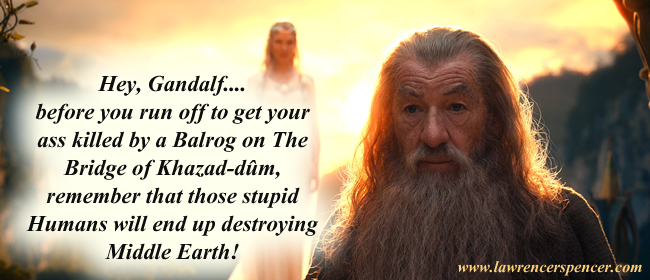
Gandalf is a character in J. R. R. Tolkien’s novels The Hobbit and The Lord of the Rings. In these stories, Gandalf appears as a wizard, member and later the head (after Saruman’s betrayal and fall) of the order known as the Istari, as well as leader of the Fellowship of the Ring and the army of the West. In The Lord of the Rings, he is initially known as Gandalf the Grey, but returns from death as Gandalf the White.
Balrogs are fictional demonic beings who appear in J. R. R. Tolkien’s Middle-earth legendarium. Such creatures first appeared in print in his novel The Lord of the Rings, though they figured in earlier writings that posthumously appeared in The Silmarillion and other books. Balrogs are described as tall and menacing with the ability to shroud themselves in fire, darkness, and shadow. They frequently appeared armed with fiery whips “of many thongs”, and occasionally used long swords. In Tolkien’s later conception, they could not be casually destroyed—significant power was required. Only dragons rivaled their capacity for ferocity and destruction,and during the First Age of Middle-earth, they were among the most feared of Morgoth’s forces.
Galadriel is a character created by J.R.R. Tolkien, appearing in his Middle-earth legendarium. She appears in The Lord of the Rings, The Silmarillion, and Unfinished Tales. She was a royal Elf of both the Noldor and the Teleri, being a grandchild of both King Finwë and King Olwë, and was also close kin of King Ingwë of the Vanyar through her grandmother Indis. She was one of the leaders in the rebellion of the Noldor and their flight from Valinor during the First Age, and she was the only prominent Noldo to return at the end of the Third Age. Towards the end of her stay in Middle-earth she was co-ruler of Lothlórien with her husband, Lord Celeborn, and was referred to variously as the Lady of Lórien, the Lady of the Galadhrim, the Lady of Light, or the Lady of the Golden Wood. Her daughter Celebrían was the wife of Elrond and mother of Arwen, Elladan and Elrohir. Tolkien describes Galadriel as “the mightiest and fairest of all the Elves that remained in Middle-earth” (after the death of Gil-galad) and the “greatest of elven women”.
Saruman the White is a fictional character and a major antagonist in J. R. R. Tolkien’s fantasy novel The Lord of the Rings. He is leader of the Istari, wizards sent to Middle-earth in human form by the godlike Valar to challenge Sauron, the main antagonist of the novel, but eventually desires Sauron’s power for himself and tries to help the Dark Lord take over Middle-earth. His schemes feature prominently in the second volume, The Two Towers, and at the end of the third volume, The Return of the King. His earlier history is given briefly in the posthumously published The Silmarillion and Unfinished Tales. Saruman is one of several characters in the book illustrating the corruption of power; his desire for knowledge and order leads to his fall, and he rejects the chance of redemption when it is offered. The name Saruman means “man of skill”;he serves as an example of technology and modernity being overthrown by forces more in tune with nature.
Orcs are a race of creatures who are used as soldiers and henchmen by both the greater and lesser villains of The Silmarillion and The Lord of the Rings — Morgoth, Sauron and Saruman. The Orcs also work independently as the common antagonists in The Hobbit, though in that work they are more often called Goblins. Although not entirely dim-witted and occasionally crafty, they are portrayed as miserable beings, hating everyone including themselves and their masters, whom they serve out of fear. They make no beautiful things, but rather design cunning devices made to hurt and destroy.
Republished by Blog Post Promoter
(According to Earth “scientists”), genes are the fundamental units of inheritance in living organisms. Together, they hold all the information necessary to reproduce a given organism and to pass on genetic traits to its offspring.
Biologists have long debated what constitutes a gene in molecular terms but one useful definition is a region of DNA that carries that code necessary to make a molecular chain called a polypeptide. These chains link together to form proteins and so are the bricks and mortar out of which all organism are constructed.
Given this crucial role, it is no surprise that an ongoing goal in biology is to work out the total number of protein-coding genes necessary to construct a given organism. Biologists think the yeast genome contains about 5300 coding genes and a nematode worm genome contains about 20,470.
But the number for humans has been the subject of constant revision since biologists first began the task of estimating them in the 1960s. Then, they believed humans could have as many as 2 million protein-coding genes. But by the time the human genome project began in the late 1990s, the highest estimates put the number at 100,000 and the number has continued to shrink.
That’s an interesting result that is partly a reflection of the state of genomics. The human genome is by no means fully defined and biologists are still in the process of refining their gene models and withdrawing genes in the process.
Indeed, in the most recent update of the genome release, geneticists have withdrawn 328 of the 2000 genes that Ezkurdia, Tress and co identify as potentially non-coding.
And on this evidence, the human genome is set to get smaller still. “Our evidence suggests that the final number of true protein coding genes in the reference genome may lie closer to 19,000 than to 20,000.”
Which means that humans have fewer protein-coding genes even than nematode worms.
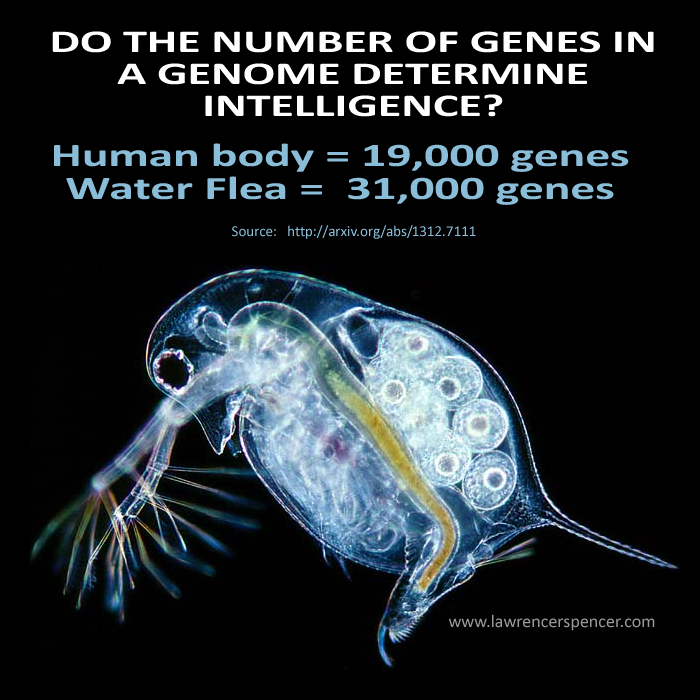
Geneticists long ago debunked the idea that more complex organisms require more genes. The water flea, for example, has 31,000 genes, the most in any animal, while the organism with the largest genome is thought to be the Paris jabonica, a rare flowering plant native to Japan.
The fact that the human genome is so parsimonious raises an interesting question. What exactly is it about the human genome that gives rise to our staggering complexity, in the brain for example, compared to other animals such as monkeys, worms or even water fleas?
A good answer to that question will win prizes!
Ref: arxiv.org/abs/1312.7111 : The Shrinking Human Protein Coding Complement: Are There Fewer Than 20,000
Republished by Blog Post Promoter