Universes are comprised of thoughts, ideas, dreams, illusions, delusions, which may also include stars, space, time, energy and objects. Or not. These are the universes of the author Lawrence R. Spencer, and others for whom he has an affinity.
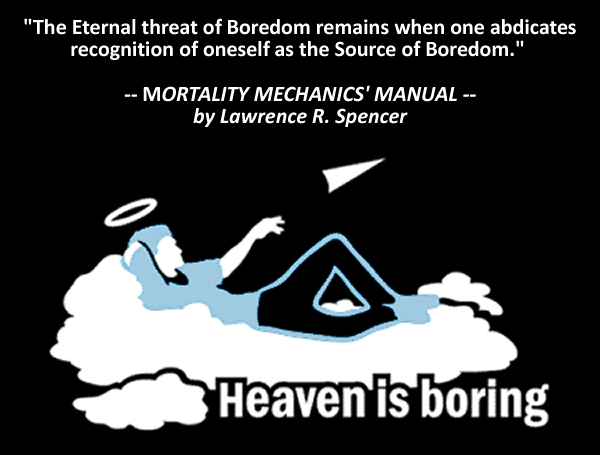
“I am not The One. I am not The Creator. Yet, I am holy and sacrosanct. I am more important and more powerful than The Gods. Why? You say that I am! I control your existence. Why? Because I promised you relief from eternal boredom, from the perpetual responsibility of self-amusement. Therefore, you follow my instruction without question.
Why? Because you claim you cannot bear to endure Eternity as The One. You offer me your trust and praise. You submit yourself to pain, anguish, amnesia and mystery. Why? Because you choose Not To Be. Your stupidity is its own reward and punishment. Your decadence ensures your slavery. Mortality is the key to your prison.”
“Do you desire Immortality? Do you desire to break the cycle of birth, life, pain, death, rebirth and endless, unwinnable games in the physical universe?
You must decide to Be Nothing. Be responsible for your own Boredom. Create Your Own Universe. Disagree with Agreement. Admire Your Self. Create and find Joy in your games, your dreams, your illusions.
Can you hover over a mountaintop for ten thousand years? Can you pretend, like a child, that your best friend is a ghost? Can your best friend be You?
The solution to Mortality is Being You: The Immortal Creator.”
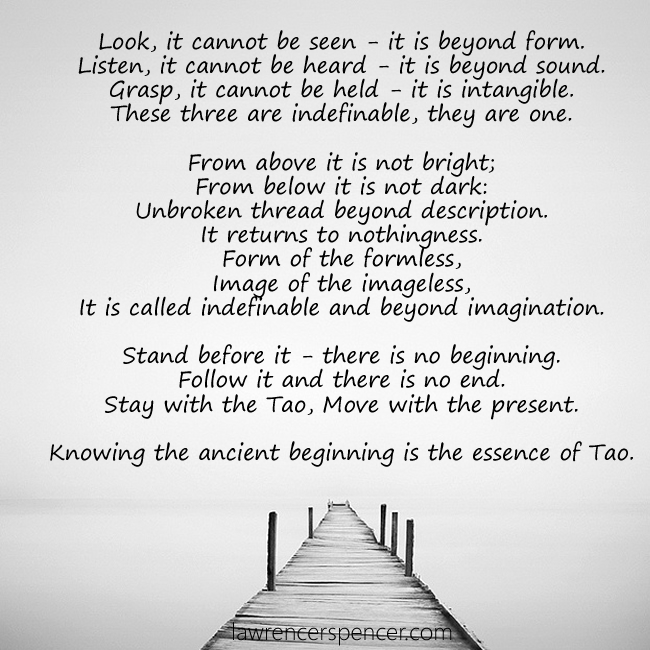
Tao or Dao is a concept signifying ‘way’, ‘path’, ‘route’, or sometimes more loosely, ‘doctrine’ or ‘principle’, or as a verb, speak. Within these contexts Tao signifies the primordial essence or fundamental nature of existence. Tao is thus “eternally nameless”, or Immortal Spiritual Being, and to be distinguished from the countless ‘named’ things which are considered to be its manifestations, as the space, energy and forms of, and within, the physical universe, and other universes.
The Tao Te Ching, Daodejing, or Dao De Jing (道德經: 道 dào “way”; 德 dé “virtue”; 經 jīng “classic” or “text”) is simply referred to as the Laozi. According to tradition, it was written around 6th century BC by the sage Laozi (or Lao Tzu, “Old Master”), a record-keeper at the Zhou Dynasty court, by whose name the text is known in China. The text’s true authorship and date of composition or compilation are still debated, although the oldest excavated text dates back to the late 4th century BC.
Many different translations, versions and interpretations of The Tao have been produced through the past 2,500 years, or so, since the original appearance. Like any “religion”, the “opinions” and “interpretations” of “priests” MODIFY and INTRODUCE FALSE IDEAS into the original. Therefore, I suggest that anyone who wishes to sincerely study The Tao as a body of wisdom, study many difference translations before you decide whether or not any of the many versions of this book point to “the way” or “no way”.
“Just because we cannot perceive something, does not mean that it cannot exist.
Science cannot evolve without change, and there is a dire need for change in its fundamental philosophy. The Oxford Dictionary defines Materialism as “the doctrine that nothing exists except matter and its movements and modifications”.
Materialism is the paradigm of scientific philosophy under which the vast majority of contemporary scientists operate. It is essentially the belief that everything can be explained in physical terms, and that there is no need to explore anything further.
Why are most scientists operating within this doctrine when science has already demonstrated many examples of non-physical phenomena? Well, our mainstream science culture certainly tends to reflect materialist values in media such as internet articles and websites, television shows and news, and especially the science curriculum in educational institutions. Since we are all, to a degree, products of our society, it stands to reason that many scientists would hold true to materialism. However, there are many examples of science going beyond the realm of physical reality.
Let’s start with the magnetic force. It cannot be denied that the magnetic force has physical applications and implications, but there is nothing physical about the actual force itself. You can see a magnet, or a magnetically charged metal, but you cannot see what charges it. We can see that a compass points in the north direction. But if the magnetic force itself appeared to us physically in its natural state, does it not stand to reason that the human race would never have had a use for a compass? It is an invisible and non-physical force which affects the physical world.
Light is another example. The light in which we are capable of seeing is just a very small portion of “the electromagnetic spectrum”, which is represented below. The area which is outlined in blue gives a representation of how small that portion is. Radio waves, microwaves, X-rays, UV rays, and gamma rays are all elements of this spectrum as well. Like light waves, we can only see their physical effects, not the radiation itself. For example, you cannot see the UV rays which give you a suntan, you can only see the tan itself. All that we can perceive from the visible light spectrum is the wavelength that it takes when it bounces off physical objects, and we experience this wavelength as a color. Therefore, there is nothing physical about light itself, it simply interacts with physical objects.
The force of gravity is another glaring example. We can see and feel how gravity affects us through its effect on physical objects, but we cannot actually see the force of gravity itself. If we could “see gravity”, then surely someone would have been credited with discovering gravity before Sir Isaac Newton in the 1600’s. Again, a force which in itself is not visible or physical, but has profound effects on the physical world surrounding us.
When you hear modern alternative philosophers use the term “energy” or assert that “everything is energy”, these are some of the types of energies that they are referring to. This theme of non-physical energy only being experienced through their ramifications on physical entities seems to be evident throughout science, yet the idea has little credibility in the scientific community.
The current paradigm of materialism tends to put the physical explanations first, while ignoring the super-physical. This is limiting our range of scientific inquiry. It limits us to only giving scientific due to physical effects, thereby potentially ignoring the cause or origin of a force or entity completely. For example, we do not know if the cause of magnetism, is physical or non-physical, but our current paradigm is only allowing us to explore one option with credibility. We need to open our minds and look at the potential of a non-materialist explanation of such forces.
One thing that bothers modern scientists, is that we have really vague explanations regarding the origins of gravity, magnetism, and light. The best explanation to date regarding the cause of the magnetic force and the photon is that these entities appeared shortly after the “Big Bang”, with all other matter. This is basically like saying, we know they exist, but we do not know why. And since gravity seems to be caused by a moving physical body, gravity would have had to appear when the first physical matter was set in motion in our universe, which is again close to the alleged “Big Bang”.
Materialist scientists, answer me this: How are we supposed to discover the cause or origin of a non-physical entity, like gravity and magnetism, when your fundamental philosophy does not permit you to believe that studying non-physical entities is worthwhile? How do we expect ourselves to advance science to the next paradigm without embracing the idea that more exists than our physical realm?
As mentioned, we have not been able to fully explain the effects of gravity, magnetism, and the photon under our current paradigm of thought. It is most certainly time for a new generation of forward-thinking scientists to take a less materialistic approach to explaining these entities instead of taking pages from the old playbook, which has not gotten us far since the time of Einstein.
Could this rationale also be why we have been so unsuccessful at explaining the existence and implications of black holes, as well as the entity that is consciousness?
What amazes me even further, is that materialist scientists, like the rest of us, use technologies which are operational because of these non-physical entities. Basically every one of us have all listened to a radio, had an x-ray done, operated some form of remote control, and used a cell phone or wireless internet. We need such non-physical entities in order to function in today’s society. When is the philosophy upon which our science is based going to catch up to this reality?
So if we change our mindsets and start to take non-physical entities seriously, as a scientific community, this will certainly allow for further exploration of the cause and implications of thoughts, consciousness, and what happens to us after we die. We must shed this outdated notion of materialism in order to maximize our potential in studying these areas of interest.
If you wish to explore the idea of why it is necessary to move past the scientific paradigm of materialism, let Dr. Rupert Sheldrake enlighten you with some theories regarding materialist science in the video below. The fact that his TED talk was not deemed to be “scientific’ enough for the TED indicates that there is a bias towards this methodology of thinking in the scientific world.”