Republished by Blog Post Promoter
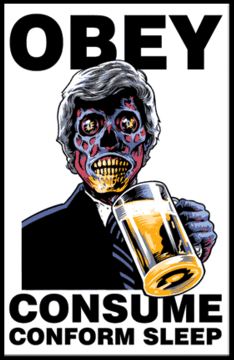 They Live is a 1988 American science fiction-horror film directed by John Carpenter. The film follows a nameless drifter referred to as “Nada”, who discovers the ruling class within the moneyed elite are in fact aliens managing human social affairs through the use of a signal on top of the TV broadcast, concealing their appearance and subliminal messages in mass media. This is a clip from the famous “sunglasses” scene: “I have come here to chew bubble gum and kick ass. And, I’m all out of bubble bum….”
The idea for They Live came from two sources: a short story called “Eight O’Clock in the Morning” by Ray Nelson, originally published in The Magazine of Fantasy and Science Fiction in the 1960s, involving an alien invasion in the tradition of Invasion of the Body Snatchers, and a story called “Nada” from the Alien Encounters comic book. John Carpenter describes Nelson’s story as “…a D.O.A. type of story, in which a man is put in a trance by a stage hypnotist. When he awakens, he realizes that the entire human race has been hypnotized, and that alien creatures are controlling humanity. He has only until eight o’clock in the morning to solve the problem.
The more political elements of the film are derived from Carpenter’s growing distaste with the ever-increasing commercialization of 1980s popular culture and politics. He remarked, “I began watching TV again. I quickly realized that everything we see is designed to sell us something… It’s all about wanting us to buy something. The only thing they want to do is take our money.” To this end, Carpenter thought of sunglasses as being the tool to seeing the truth, which “is seen in black and white. It’s as if the aliens have colorized us. That means, of course, that Ted Turner is really a monster from outer space.” (Turner had received some bad press in the 1980s for colorizing classic black-and-white movies.) The director commented on the alien threat in an interview, “They want to own all our businesses. A Universal executive asked me, ‘Where’s the threat in that? We all sell out every day.’ I ended up using that line in the film.” The aliens were deliberately made to look like ghouls according to Carpenter, who said: “The creatures are corrupting us, so they, themselves, are corruptions of human beings.”
Because the screenplay was the product of so many sources: a short story, a comic book, and input from cast and crew, Carpenter decided to use the pseudonym “Frank Armitage,” an allusion to one of the filmmaker’s favorite writers, H. P. Lovecraft (Frank Armitage is a character in Lovecraft’s The Dunwich Horror). Carpenter has always felt a close kinship with Lovecraft’s worldview and according to the director, “Lovecraft wrote about the hidden world, the “world underneath.” His stories were about gods who are repressed, who were once on Earth and are now coming back. The world underneath has a great deal to do with They Live.” — (Wikipedia.org)