Republished by Blog Post Promoter

A WISE TEACHER SHOWS YOU HOW TO LOOK, BUT DOES NOT TELL YOU WHAT TO SEE OR THINK.
Lawrence R. Spencer. 2013

Books I read & recommend
Republished by Blog Post Promoter
A WISE TEACHER SHOWS YOU HOW TO LOOK, BUT DOES NOT TELL YOU WHAT TO SEE OR THINK.
Lawrence R. Spencer. 2013
Republished by Blog Post Promoter

“The purpose of the prison planet is to keep IS-BEs (Immortal Spiritual Beings) on Earth, forever. Promoting ignorance, superstition, and war between IS-BEs helps to keep the prison population crippled and trapped behind “the wall” of electronic force screens.
Only a demonic, self-serving government would employ a “logic” or “science” to conceive that an “ultimate solution” to any problem is to murder and permanently erase the memory of every artist, genius, skilled manager, and inventor, and cast them into a planetary prison together with political opponents, killers, thieves, perverts, and disabled beings of an entire galaxy!
When an IS-BE is sent to Earth, and then tricked or coerced into operating in a biological body, they are actually in a prison, inside a prison.
…prison system is to prevent you from looking at your own soul. They fear that you will see in your own memory the slave masters who keep you imprisoned. The prison is made of shadows in your mind. The shadows are made of lies, and pain, and loss, and fear.”
— Excerpt from the book ALIEN INTERVIEW, edited by Lawrence R. Spencer
Republished by Blog Post Promoter

About the painting: “Circe Offering the Cup to Ulysses” is an oil painting in the Pre-Raphaelite style by John William Waterhouse that was created in 1891. The painting depicts a scene from Greek mythology, the sorceress Circe offering Odysseus a cup containing a potion with which she seeks to bring him under her spell as she has his crew.
In Greek mythology, Circe (pronounced “Keer-keeh” “falcon”) is a minor goddess of magic (or sometimes a nymph, witch, enchantress or sorceress). By most accounts, Circe was the daughter of Helios, the god of the sun, and Perse, an Oceanid. Her brothers were Aeetes, the keeper of the Golden Fleece and Perses, and her sister was Pasiphaë, the wife of King Minos and mother of the Minotaur. Other accounts make her the daughter of Hecate. Circe was renowned for her vast knowledge of drugs and herbs. Through the use of magical potions and a wand she transformed her enemies, or those who offended her, into animals.
Republished by Blog Post Promoter

|

|

Republished by Blog Post Promoter
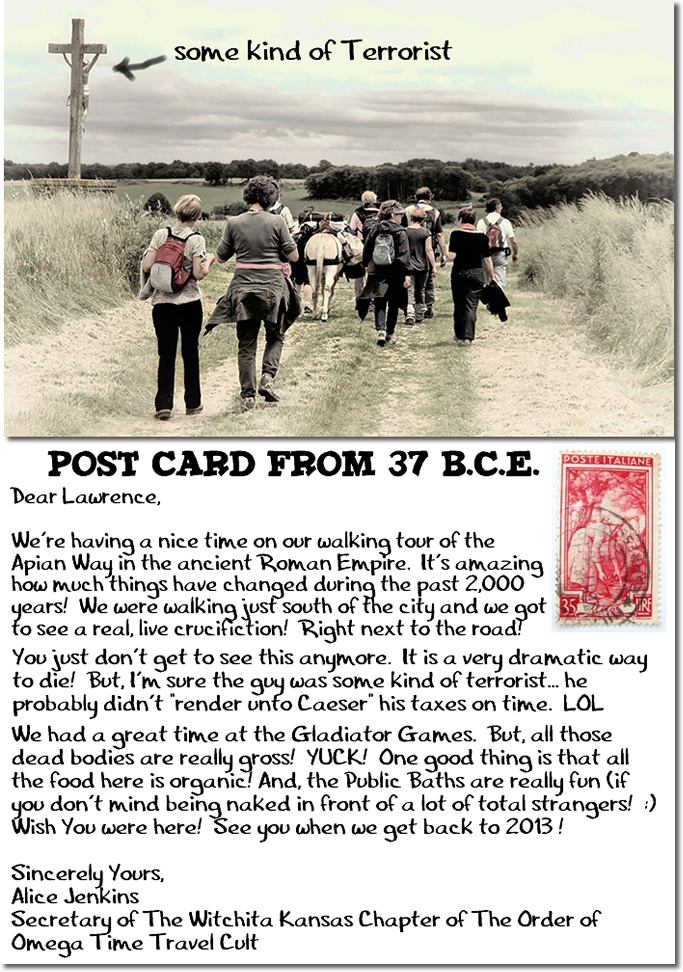
Crucifixion was often performed to terrorize and dissuade its witnesses from perpetrating particularly heinous crimes. Victims were left on display after death as warnings to others who might attempt dissent. Crucifixion was usually intended to provide a death that was particularly slow, painful (hence the term excruciating, literally “out of crucifying”), gruesome, humiliating, and public, using whatever means were most expedient for that goal. Crucifixion methods varied considerably with location and time period.
The Greek and Latin words corresponding to “crucifixion” applied to many different forms of painful execution, from impaling on a stake to affixing to a tree, to an upright pole (a crux simplex) or to a combination of an upright (in Latin, stipes) and a crossbeam (in Latin,patibulum).
In some cases, the condemned was forced to carry the crossbeam on his shoulders to the place of execution. A whole cross would weigh well over 300 pounds (135 kg), but the crossbeam would not be quite as burdensome, weighing around 100 pounds. The Roman historian Tacitus records that the city of Rome had a specific place for carrying out executions, situated outside the Esquiline Gate, and had a specific area reserved for the execution of slaves by crucifixion. Upright posts would presumably be fixed permanently in that place, and the crossbeam, with the condemned person perhaps already nailed to it, would then be attached to the post.
While a crucifixion was an execution, it was also a humiliation, by making the condemned as vulnerable as possible. Although artists have depicted the figure on a cross with a loin cloth or a covering of the genitals, writings by Seneca the Younger suggest that victims were crucified completely naked. When the victim had to urinate or defecate, they had to do so in the open, in view of passers-by, resulting in discomfort and the attraction of insects. Despite its frequent use by the Romans, the horrors of crucifixion did not escape mention by some of their eminent orators. Cicero for example, described crucifixion as “a most cruel and disgusting punishment”, and suggested that “the very mention of the cross should be far removed not only from a Roman citizen’s body, but from his mind, his eyes, his ears.”
Frequently, the legs of the person executed were broken or shattered with an iron club, an act called crurifragium, which was also frequently applied without crucifixion to slaves. This act hastened the death of the person but was also meant to deter those who observed the crucifixion from committing offenses. — REFERENCE SOURCE: Wikipedia.org