Tag Archives: time

YOUR COSMIC AGE

Republished by Blog Post Promoter

COSMIC YEARS

Time is a measurement of the motion of objects through space.

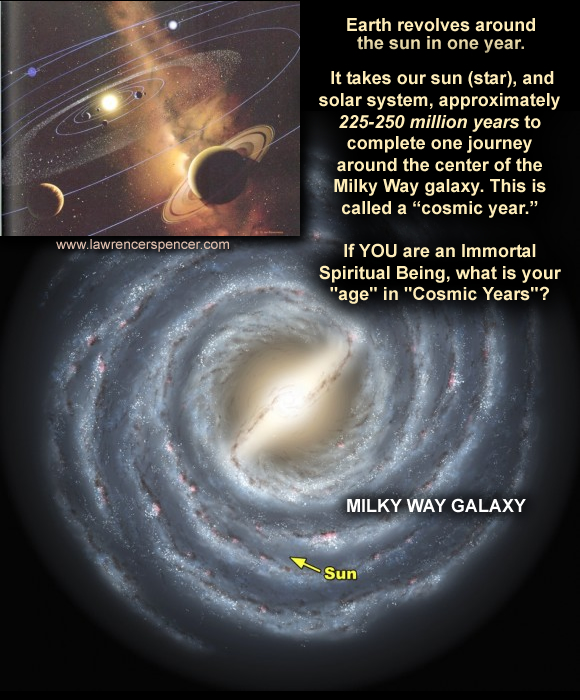
The planets in our solar system orbit around the sun. One orbit of the Earth takes one year. Meanwhile, our entire solar system orbits the center of the Milky Way galaxy. Our sun and solar system move at about 800 thousand kilometers an hour – that’s about 500 thousand miles an hour – in this huge orbit. So in 90 seconds, for example, we all move some 20,000 kilometers – or 12,500 miles – in orbit around the galaxy’s center.

Our Milky Way galaxy is a big place. Even at this blazing speed, it takes the sun approximately 225-250 million years to complete one journey around the galaxy’s center. This amount of time – the time it takes us to orbit the center of the galaxy – is sometimes called a “cosmic year.”

Revolve means “orbit around another body.” Earth revolves (or orbits) around the sun. The sun revolves around the center of the Milky Way galaxy.

On the other hand, rotate means “to spin on its axis”. The Earth rotates every 24 hours. The sun rotates, but not at a single rate across its surface. The movements of the sunspots indicate that the sun rotates once every 27 days at its equator, but only once in 31 days at its poles.

What about the Milky Way galaxy? Yes, the whole galaxy could be said to rotate, but like the sun it is spinning at different rates as you move outward from its center. At our sun’s distance from the center of the Milky Way, it’s rotating once about every 200 million years – defined by the length of time the sun takes to orbit the center of the galaxy.

If you are an Immortal Spiritual Being, how “old” are you in “Cosmic Years”?    (this is a rhetorical question…)

BEWARE THE FULL MOON IN MARCH, MAY, JULY AND OCTOBER

Republished by Blog Post Promoter

Ides of March - kill CaesarThe assassination of the first self-appointed Roman Emperor, Gaius Julius Caesar, by Roman Senators, made the Ides of March a turning point in Roman history. Although March (Martius) was the third month of the Julian calendar, in the oldest Roman calendar it was the first month of the year. The holidays observed by the Romans from the first through the Ides often reflect their origin as new year celebrations.

The Romans did not number days of a month sequentially from the first through the last day. Instead, they counted back from three fixed points of the month: the Nones (5th or 7th, depending on the length of the month), the Ides (13th or 15th), and the Kalends (1st of the following month). The Ides occurred near the midpoint, on the 13th for most months, but on the 15th for March, May, July, and October. The Ides were supposed to be determined by the full moon, reflecting the lunar origin of the Roman calendar. On the earliest calendar, the Ides of March would have been the first full moon of the new year.moonphaseMost pre-modern calendars the world over were lunisolar, combining the solar year with the lunation by means of intercalary months. The Julian calendar abandoned this method in favor of a purely solar reckoning while conversely the 7th-century Islamic calendar opted for a purely lunar one.

The Ides of each month was sacred to Jupiter, the Romans’ supreme deity. The Flamen Dialis, Jupiter’s high priest, led the “Ides sheep” (ovis Idulius) in procession along the Via Sacra to the arx, where it was sacrificed.

— excerpted and edited from Wikipedia.org