Republished by Blog Post Promoter

This 2 minute video demonstrates how a “reality” can be created using visual illusions. ( It is similar to watching the “news” on TV….. )
Republished by Blog Post Promoter

This 2 minute video demonstrates how a “reality” can be created using visual illusions. ( It is similar to watching the “news” on TV….. )
Republished by Blog Post Promoter
Mohandas Karamchand Gandhi (; 2 October 1869 – 30 January 1948) was the preeminent leader of Indian independence movement in British-ruled India. Employing nonviolent civil disobedience, Gandhi led India to independence and inspired movements for civil rights and freedom across the world. The term Indian Independence Movement encompasses activities and ideas aiming to end first the company rule (East India Company), and then the rule of the British.
Mohandas Gandhi’s storied history of resistance included many stints in jail, starting with a two-month imprisonment in 1907 in South Africa, where he was working to end discrimination against Indians living there. He was arrested for urging them to ignore a law requiring Indians to be registered and fingerprinted. While in jail, Gandhi read Henry David Thoreau’s “Civil Disobedience”, which would become a major part of his philosophy upon his return to India. Back in his home country, Gandhi was put behind bars several times for his movement to end British rule. In 1922 he was tried for the last time by the British government for “bringing or attempting to excite disaffection towards His Majesty’s Government established by law in British India.” He pleaded guilty to all charges and was sentenced to six years, of which he served two before being released for an emergency appendectomy. India achieved independence on Aug. 15, 1947, five months before Gandhi was assassinated.
Gandhi preached rebellion, launched mass civil disobedience and was repeatedly jailed. When arrested, he pleaded guilty and asked for the severest punishment. In South Africa, the charge against him and his co-workers was proved by witnesses furnished by him. The horror, shame and hardship of jail life, originally a punishment allotted to criminals, scared the Indians. Gandhi removed this fear from their hearts. He was jailed eleven times. Once he was arrested three times within four days. If he had to complete all his jail terms, he would have spent 11 years and 19 days in jail. Occasionally his punishment was reduced and and he altogether spent 6 years and 10 months in prison. At the age of 39, he first entered a jail. He came out of the prison gates for the last time when he was 75.
On 14 and 15 August 1947 the Indian Independence Act was invoked.
Republished by Blog Post Promoter
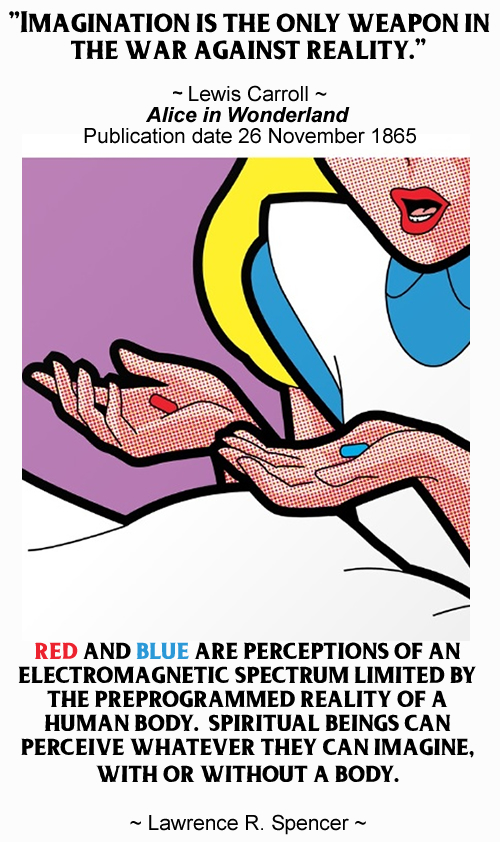
Red and blue are perceptions of an electromagnetic spectrum limited by the preprogrammed reality of a human body. Spiritual beings can perceive whatever they can imagine, with or without a body.
~ Lawrence R. Spencer ~
Republished by Blog Post Promoter

Solipsism is a philosophical theory, which asserts that nothing exists but the individual’s consciousness. At first it seems silly – and who generally got it into his head completely deny the existence of the world around us? Except when you put your mind to it, it really is impossible to verify anything but your own consciousness.Don’t you believe me? Think a moment and think of all the possible dreams that you have experienced in your life. Is it not possible that everything around you is nothing but an incredibly intricate dream? But we have people and things around us that we cannot doubt, because we can hear, see, smell, taste and feel them, right? Yes, and no. People who take LSD, for example, say that they can touch the most convincing hallucinations, but we do not claim that their visions are “reality”. Your dreams simulate sensations as well, after all, what you perceive is what different sections of your brain tell you to.
As a result, which parts of existence can we not doubt? None. Not the chicken we ate for dinner or the keyboard beneath our fingers. Each of us can only be sure in his own thoughts.
George Berkeley, the father of Idealism, argued that everything exists as an idea in someone’s mind. Berkley discovered that some of his comrades considered his theory stupid. The story goes that one of his detractors kicked a stone with his eyes closed and said, “There I’ve disproved it!”
The idea being that if the stone really only exists in his imagination, he could not have kicked it with his eyes closed. Refutation of Berkeley is hard to understand, especially in these days. He argued that there is an omnipotent and omnipresent God, who sees all and all at once. Realistic, or not?
Everybody has heard of Plato. He is the world’s most famous philosopher. Like all philosophers he had a few things to say about reality. He argued that beyond our perceived reality there lies a world of “perfect” forms. Everything that we see is just a shade, an imitation of how things truly are. He argued that by studying philosophy we have a chance of catching a glimpse of how things truly are, of discovering the perfect forms of everything we perceive.
In addition to this stunning statement, Plato, being a monist, said that everything is made of a single substance. Which means (according to him) that diamonds, gold and dog feces all consist of the same basic material, but in a different form, which, with science’s discovery of atoms and molecules, has been proven true to an extent.
Time is something that we perceive as a matter of course, if we view it at the moment, we usually divide it into past, present and future. Presentism argues that the past and the future are imagined concepts, while only the present is real.
In other words, today’s breakfast and every word of this article will cease to exist after you have read it, until you open it again. The future is just as imaginary, because time cannot exist before and after it happened, as claimed by St. Augustine.
Enternalism is the exact opposite of presentism. This is a philosophical theory that says that time is multi-layered. It can be compared to a pound cake (however, unlike the time, a biscuit is not up for philosophical debate). All time exists simultaneously, but the measurement is determined by the observer. What he sees depends on which point he is looking at.
Thus dinosaurs, World War II and Justin Bieber all exist simultaneously but can only be observed from a specific location. If one takes this view of reality then the future is hopeless and the deterministic free will is illusory.
The “brain in a jar” thought experiment is a question discussed by thinkers and scientists, who, like most people, believe that human’s understanding of reality depends solely on his subjective feelings.
So, what is the debate? Imagine that you are just a brain in a jar that is run by aliens or mad scientists. How would you know? And can you truly deny the possibility that this is your reality?
This is a modern interpretation of the Cartesian evil demon problem. This thought experiment leads to the same conclusion: we cannot confirm the actual existence of anything except our consciousness. If this seems to sound reminiscent of the movie “The Matrix“, it is only because this idea was part of the very basis of the story. Unfortunately, in reality we have no red pills…
Anyone who has not spent the last ten years on a desert island, has at least once heard of “the multiverse”, or parallel universes. As many of us have seen, parallel words, in theory, are worlds very similar to ours, with little (or in some cases, large) changes or differences. The multiverse theory speculates that there could exist an infinite number of these alternate realities.
What’s the point? In a parallel reality you have already killed the dinosaurs, and you are lying under the ground at a depth of eight feet (because that’s what happened there.) In the other you might be a powerful dictator. In another you might never have even been born since your parents never met. Now that’s a memorable image.
This is the most fascinating branch of multiverse theory. Superman is real. Yes, some of you would probably choose a different story, for argument’s sake, Harry Potter might be real too. This branch of the theory argues that given an infinite number of universes, everything must exist somewhere. So, all of our favorite fiction and fantasy may be descriptive of an alternate universe, one where all the right pieces came in to place to make it happen.
Everyone is interested in what happens to things when we aren’t looking at them. Scientists have carefully studied this problem and some of them came to a simple conclusion – they disappear. Well, not quite like this. Phenomenalist philosophers believe that objects only exist as a phenomenon of consciousness. So, your laptop is only here while you are aware of, and believe in its existence, but when you turn away from it, it ceases to exist until you or someone else interacts with it. There is no existence without perception. This is the root of phenomenalism.
_____________________________
LRS — The article above is re-posted from http://in5d.com/10-mind-blowing-theories-that-will-change-your-perception-of-the-world/
About the author:
Anna LeMind is the owner and lead editor of the website Learning-mind.com, and a staff writer for The Mind Unleashed.