Republished by Blog Post Promoter

 It is lovely to see that a Vermeer painting has been returning to Holland after being “on tour”. Personally, I am greatly saddened that Vermeer, his wife Catharina, and their children did not enjoy the immense financial rewards that art promoters have received during recent decades from his paintings, during his own lifetime! Within the context of the Eternal Now, financial rewards is irrelevant. However, acknowledgment, in the form of recognition of technical brilliance and praise of aesthetic artistry, are always welcome to any Immortal Being. (Read the article about the Vermeer painting, “Girl withe a pearl earring” being returned to Holland after two years): http://www.independent.co.uk/arts-entertainment/art/news/vermeers-girl-with-a-pearl-earring-to-return-home-to-the-netherlands-after-two-years-on-the-road-as-mauritshuis-royal-picture-gallery-reopens-9158240.html
Read MY THOUGHTS about Hollywood film, excerpted from my book VERMEER: PORTRAITS OF A LIFETIME:
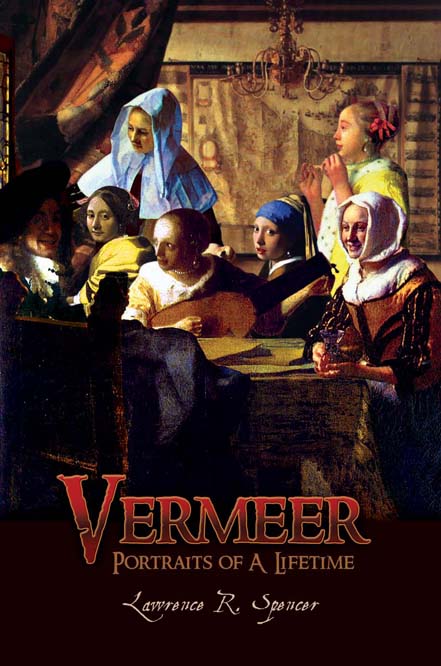 “Recasting The Girl, Spray-Painting The Pearl
will not soon forget seeing the horrendous Hollywood movie titled, “The Girl With A Pearl Earring” in 2004. It is a fictional depiction of a fictionalized relationship between Vermeer and an imagined “…young peasant maid working in the house of painter Johannes Vermeer becomes his talented assistant and the model for one of his most famous works.” It was nominated for 3 Oscars by the Academy of Motion Picture “arts” and “sciences”.
This tragically tacky spin on the life of Vermeer is classic Hollywood magic: take the true life story of a teen-age daughter of one of the finest painters in history, re-cast her as whore, and her father as an brutish ogre, spray-paint her naturally luminescent pearl earring with glitter glue and, presto! Nominate it for an Oscar!
Absurdly cliché characterizations contrived by the brain-dead writers invent a debased relationship between a fictional “peasant maid” and Vermeer that are typical of the money-motivated Hollywood swill fed to and gobbled up by an uneducated public. The socially redeeming value of this food for swine (to be polite) is a pile of steaming shit! Sexual intrigue may sell movie tickets, but pigs are stupid, and shit stinks.
The writers, producers and actors associated with this morose movie would have been more kind to Vermeer, his family and his artistic legacy if they had spent the budget for the film to visit the museums of the world, in which his priceless works hang, and spray them with graphic graffiti.
The film was written and directed without regard for historic fact or common sense. The preposterous personae of Vermeer was portrayed by the British actor, Colin Firth, with the charisma of a cardboard cereal box. Scarlett Johansson, who plays the role of the gawkish “girl”, is garish at best.
The premise of the ludicrous book and movie script, entirely ignores and abuses the obvious, and thoroughly researched historical information about Vermeer and his life. A few of the grossest omissions are:
1) All of the women in the Vermeer paintings, with one or two minor exceptions, are his wife, and daughters. To postulate that he hired a “peasant maid”, or that he had a painting assistant, much less that he had a sexual relationship with such an imaginary person, are sick, fictional contrivances.
2) That the Vermeers could afford to pay a servant, who could spare the time away from vitally needed chores, to become an artists assistant, is blatantly stupid. Household helpers were not something they could afford, except early in their marriage, at best. Some of the thoroughly researched facts about Vermeer were that he and his wife produced 15 children in 22 years! They lived in the small village of Delft, with his wife’s very Catholic mother, in her small house, to help reduce expenses. He died from overwhelming depression due to his inability to support his wife and 11 surviving children, who were left in extreme poverty at his premature death at the age of 43.
In a plea to her creditors after her husband’s death Catharina stated, in the public record, the final footnotes to Vermeer’s brief life:
“during the ruinous war he not only was unable to sell any of his art but also, to his great detriment, was left sitting with the paintings of other masters that he was dealing in.”
Catharina summarized the circumstances of his death: “as a result and owing to the great burden of his children, having no means of his own, he had lapsed into such decay and decadence, which he had so taken to heart that, as if he had fallen into a frenzy, in a day or day and a half had gone from being healthy to being dead.”
Obviously, the man she describes is the antithesis of the man portrayed in the movie.
3) That a woman would be allowed to become an artists apprentice or assistant, is an absurd fantasy. It was forbidden by the Guild of St. Luke which maintained strict, Puritanical oversight of the activities of every member.
4) It is a documented fact that Maria Thins employed a live-in servant woman in her home in the later years of her life. (Born ca. 1593 – died, December 27, 1680) Maria was 82 years old when Vermeer died in 1675 at the age of 43. Her servant’s name was Tanneke Everpoel. Maria bequeathed a small sum of money (20 guilders) to Tanneke upon her death. It is very likely that Tanneke is the servant shown in Vermeer’s painting, ” The Love Letter”.
5) The girl in the legendary painting (as well as in several other of his paintings) is his second daughter, Elizabeth! Vermeer never hired models — he painted only family and friends. It doesn’t take a cosmetic surgeon to compare the features of the women in the majority of his paintings to observe that the same women are being painted in their own home, again and again in different poses, settings, lighting and clothing. Most of his paintings feature his wife, Catharina, who was not only his constant accomplice in creating a family, she was his foremost ally in his life as an artist!
The paintings named (by others), “girl with a pearl earring”, as well as “the girl with a red hat”, and “the girl with a flute”, and others, are all of his second daughter, Elizabeth, who was a teenager when they were painted. He used her as the model for a series of very small “tronie” or facial portraits, which were popular at the time.
These miniature “head shots” were especially well suited to the use of the camera obscura to create what we know now to have a photographic quality, rendering the light and perspective differently than the unaided lens of the human eye perceives it.
The women in his family, during his lifetime, enjoyed dressing in the finest clothes and jewelry available to them, as well as exotic costumes, imitating the apparel of mysterious lands. Many of the accessories included in these paintings were borrowed. Trading vessels often brought fascinated news and relics to Delft from around the world. He and his family rarely ventured more than a short walk or boat ride from home.
That Vermeer would have an elicit affair with a maid in his own home is an insult to common sense and decency. Anyone who looks at paintings of his wife and nine daughters can plainly see his obvious love and devotion — if not obsession — for the women in the small house they shared. Vermeer’s family permeated every aspect of his life, and dominated his home.
His days were consumed with his work with the Guild of St. Luke, the militia of Delft, and interaction with other painters for whom, like his father before him, he sold their paintings to earn money to feed and clothe his 15 children. As his family grew, Vermeer barely had time work on his own paintings!
That there was ever any enmity or discord between Johannes and Catharina during their lives is a fantasy contrived by the Hollywood money machine that perverts reality to appeal to the lowest common denominator of prurient interest suitable only for soap operas, pornography, and girl-gossip magazines.
The self-proclaimed “artists” of Hollywood, driven by money mongers, like any mindless mercenary who act the part they’re paid for, notoriously devoid of ethics or integrity, are akin to any common soldier who massacres innocent civilians, and justifies their crimes in the name of war.
Vermeer, in this movie, and in his own lifetime, was a victim of brainless brutality. The stupid soldiers of Louis XIV of France who invaded Holland, together with the bloody British aristocracy combined to murder peasants, and plunder goods to enrich and glorify themselves. The net result for Vermeer was attested, after his death, by his wife, Catharina Bolnes, “during the ruinous war he not only was unable to sell any of his art but also, to his great detriment, was left sitting with the paintings of other masters that he was dealing in.” And further, “as a result and owing to the great burden of his children, having no means of his own, he had lapsed into such decay and decadence, which he had so taken to heart that, as if he had fallen into a frenzy, in a day or day and a half had gone from being healthy to being dead.”
Let us hope, sincerely, that those unfortunates who saw this “ruinous movie” can assess for themselves the denigrating massacre of an artist by Hollywood, compared with his own biographical portraits of a lifetime and the family he adored, magnificently embodied in his paintings, to judge for themselves the aesthetic intention and ethical integrity of the man, Vermeer.
— Lawrence R. Spencer

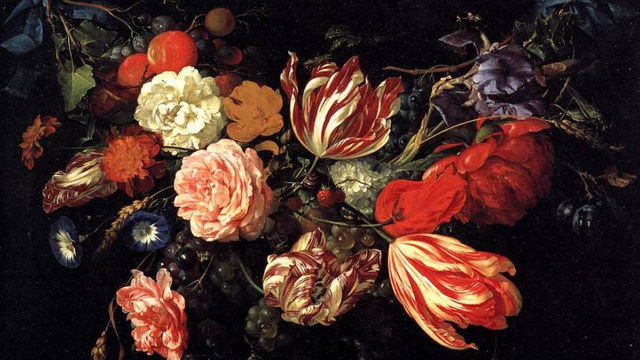
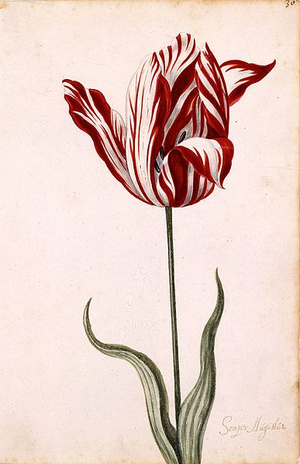 Sadly, the virus did what viruses generally do — it killed the tulip after a few blooming seasons, driving up the price for a newly-broken bulb even higher. The virus turned tulips into lottery tickets , and so it was understandable that people paid too much for them. Semper Augustus, pictured to the left, was famous for being the most expensive bulb sold during the period. It cost 13000 florins, at a time when one could get a house and garden for a third of that price. But the rampant speculation one which bulb was a winner, mocked even at the time, could only be kept up for so long. The economy collapsed, and what caused tulips to break remained a mystery until the 1900s.