Category Archives: VERMEER REVEALED

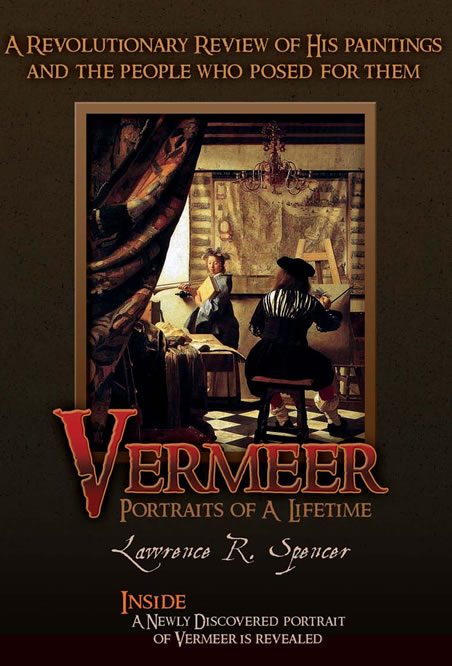
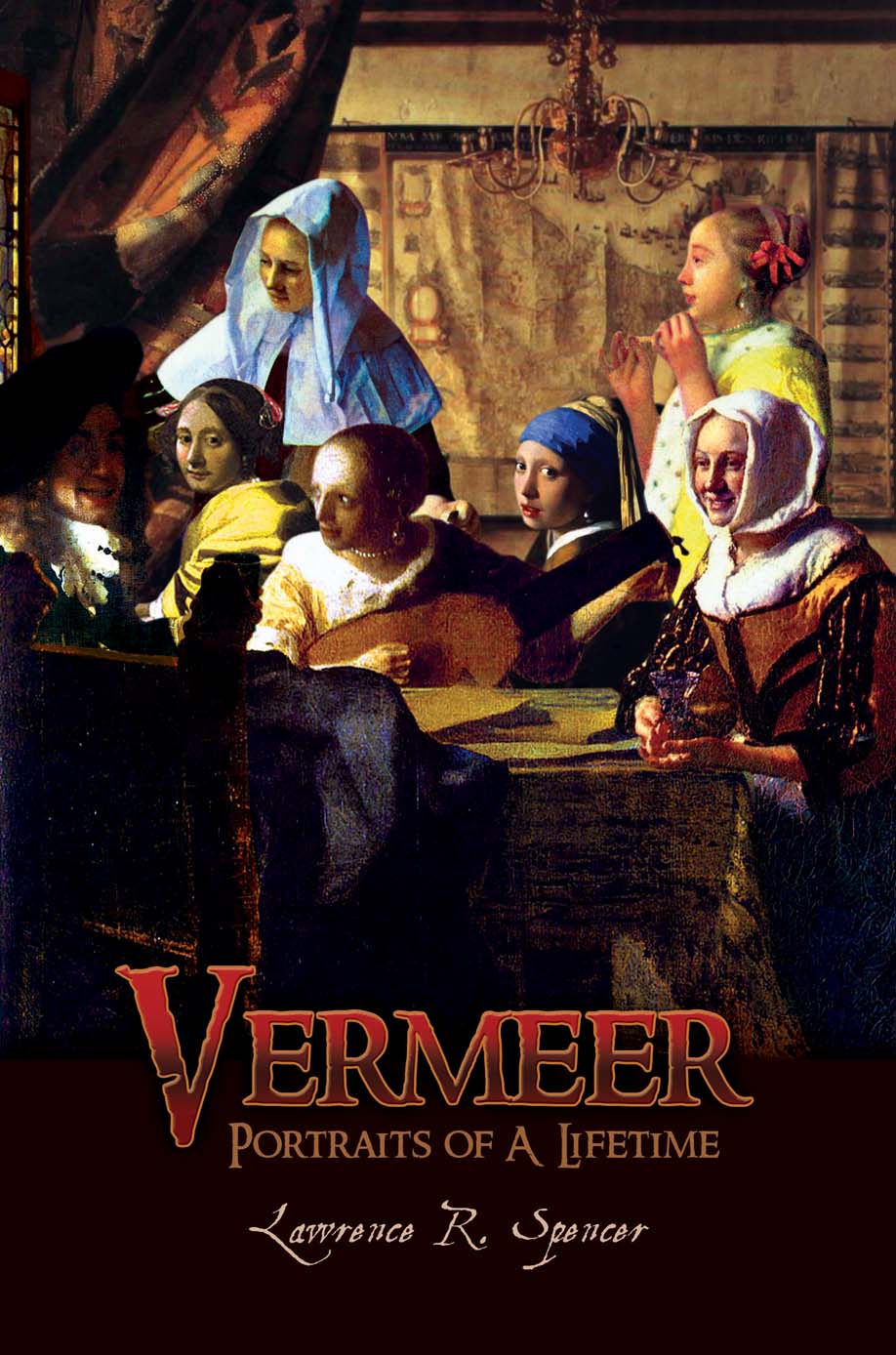
Vermeer: Portraits of A Lifetime explores the life of the world famous Dutch artist, Johannes Vermeer. This book reveals observations that have never before been made about his paintings, his life, his friends and his family. Dedicated to revealing observations about the life and paintings of Vermeer, and the women featured in his painting — his family.

FREE AUDIOBOOK

Republished by Blog Post Promoter
CLICK ON THE LINK BELOW TO LEARN HOW YOU CAN DOWNLOAD A FREE COPY OF ONE OF MY AUDIOBOOKS:

http://www.audible.com/t1/30DayGoldFT_at?source_code=PBRP0389WS110209

FREE AUDIO BOOKSHERE ARE THE LINKS TO MY AUDIOBOOKS ON AUDIBLE.COM YOU CAN DOWNLOAD FREE WHEN YOU BECOME A TRIAL MEMBER OF AUDIBLE.COM:

SHERLOCK HOLMES: MY LIFE   http://www.audible.com/pd/ref=sr_1_1?asin=B00A27BCHG&qid=1355950962&sr=1-1

VERMEER: PORTRAITS OF A LIFETIME   http://www.audible.com/pd/ref=sr_1_2?asin=B009NVX2PM&qid=1355950962&sr=1-2

HAPPY LISTENING, MY FRIENDS!

DELUSIONAL or HERETICAL?

Republished by Blog Post Promoter

Vermeer on iTunes

“I am very sure that my new book, Vermeer: Portraits of A Lifetime, will be considered by many people to be delusional or heretical.  Many will dismiss my observations and comments because they don’t follow the dictates of  “authoritative research” or the opinions of art “experts”.

This book may threaten persons who have a financial vested interest in the Vermeer paintings that still exist today, as their livelihood or financial well-being depend to some degree on the value currently assigned to the paintings.

Although the monetary value of Vermeer’s paintings have been vastly inflated, in part, due to the mystique created by authorities or speculators, it is not my intention to devaluate them. It is not my intention to invalidate property that was sold or bartered by Vermeer and his wife, Catharina, hundreds of years ago.  Quite the contrary.

My intention is to honor the lives of Johannes, Catharina, their eleven surviving children and Maria Thins, his mother-in-law and patroness.

This book does not represent or endorse any financial, spiritual, religious, political organization or practice or philosophy of any kind.  All personal observations and opinions offered by the author herein are purely and solely personal opinions, with no other source than those noted in the footnotes or appendix.

Any and all individuals or organizations from whom research and/or opinions have been borrowed or sited for referential purposes in this book are not affiliated with and do not in any way acknowledge the validity of or endorse the findings or assertions of the author or publisher of this book.

Finally, this book is not intended for people who have a vested interest, or who “know best”.  Personal observations, whether visual, empathetic or conjectural, of the author about the life and death of Vermeer, 300 years after the fact, are wholly subjective.”

Vermeer: Portraits of A Lifetime  https://itunes.apple.com/us/audiobook/vermeer-portraits-lifetime/id569744974

Paperback book —     Support independent publishing: Buy this e-book on Lulu.

AUDIOBOOK — http://www.audible.com/pd/Arts-Entertainment/Vermeer-Audiobook/B009NVX2PM/ref=a_search_c4_1_4_srTtl?qid=1392802819&sr=1-4

LISTEN CAREFULLY

Republished by Blog Post Promoter

I love to listen to audio books!  It allows me to “read” a book while doing other things, like driving, walking, shopping, washing dishes, vacuuming the floor, doing the laundry, feeding the cat, working out at the gym, sitting outside on the patio, and other “mindless” activities that require very little attention.  I listen to one audio book every week, or more.  You can get a very affordable monthly subscription from www.Audible.com.  Every month you can download one or more books and listen to them on your phone, iPod, iPad, computer, or MP3 player.

Try it for FREE for one month!

1001 things cover

Alien Interview cover

Big Bleep cover

Domain cover

MMManual cover

Sherlock Holmes cover

The Oz Factors cover

Vermeer cover


BREAD OF LIFE

Republished by Blog Post Promoter

“Much like Leonardo da Vinci, I worked intermittently on this single painting over a period of many years, never satisfied that it was finished, and continually improving upon the original.  This painting is my personal Mona Lisa, my daughter, Maria.  

We had a live-in servant for many years, named Tanneke Everpoel, hired and paid by Maria Thins.  She did all of the “heavy labor”, as it were: cooking, cleaning, washing clothes, carrying water, tending fires, and a myriad other chores, including helping with the children.  However, the expense of paying her wage and room did not include standing for endless hours, day after day, while I painted this portrait!  My daughter, Maria, was lovelier and much more readily accessible for the task of standing for this portrait.

It is argued, convincingly, that the immortal painting by Leonard was his own self-portrait as his own, feminine  reflection. What man, or woman, regardless of sexual preference in a given lifetime, has not inhabited the flesh of ten thousand bodies, some human, many not, through  a nearly infinite cascade of galaxies, stars and planets come and gone.  Is not survival a nearly infinite game, in which we interchange ourselves as the players of many parts?

Leonardo kept his portrait with him all his life.  He never considered that it was complete or perfect.  Nor did he ever intend to sell it.  How could one sell a most cherished reflection of himself?  It is more meaningful than one’s own body, which only disguises the inner self, the essence of spirit that animates the fragile flesh.  In fact, a body hides the reflection of the soul!  How can any substance, especially that as rude and fragile as meat, reveal the inherent qualities an immortal nothingness?  Indeed, it is the fundamental challenge and the most formidable task of an artist to reveal it!

The name given to this painting by others, “The Milkmaid”, is a sacrilege!   It rivals the incomprehension others have for Leonardo’s personal masterpiece.  Yet, how can anyone truly understand that a painting is meant to reflect the  essence of an immortal being, seen through the eyes of another?Vermeer on iTunes

She is painted with angelic colors: blue, gold and white, in contrast to the menial nature of her station in life.  From her issues, for me, the Milk and Bread of Life.  Life is embodied in her and through her.  Women, are the source of children, the source of energy, the source of care.  There is no more vital responsibility for any being who plays the game of life, than to confront dreary daily tasks.  To humbly make the daily loaf.  To soak that bread, mix and soften it with milk, make it warm and feed it to a teething child.  Survival is made of such things.

In those days I viewed life as idyllic.  My dreams were more real than reality.  All things were a possibility.  Tragedy could not find me.  Until it did, of course.  Even when we lost a child, which we did with several, my wife, Catharina, remained resolute in her Faith.  God guided us.  He did what was best.  We knew not why and need not question His purpose for us. 

I have no such faith in predetermination.  A loaf of grain, clean water and a bed was my fare.  Time and a place to paint, uninterrupted, were necessities.  My love, shared with wife and family, was the staple diet of my life.  I assumed, as a Fool who knows not his own mortality, that they would endure, even when I was gone.”

_______________________________________

Excerpt from the book VERMEER: PORTRAITS OF A LIFETIME, by Lawrence R. Spencer

DOWNLOAD THIS BOOK FROM
http://itunes.apple.com/us/book/vermeer/id443800993?mt=11 

VERMEER — AN EMPATHETIC EXPLORATION

Republished by Blog Post Promoter

Paintings of Johannes Vermeer exhort a mystic awe in the human soul.   Aesthetics, women and mystery are each a glue that have baited many of the most powerful traps in history.  Vermeer combines all three.  Almost nothing factual is known about the painter personally, or the bevy of enchanting women he painted.

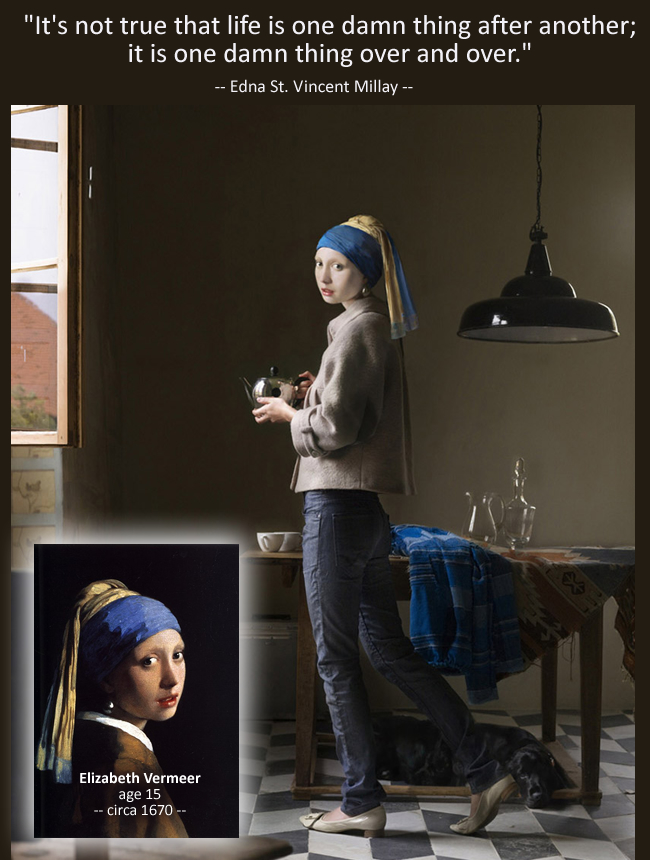
Compounding the mystery is the puzzle of identifying the people he painted so repetitively.  Apparently, they were nearly all his wife or daughters!  Moreover, they were portrayed at various ages in their lives, over a span of twenty-two years during which he and his wife produced an family of 15 children, 11 of whom survived! As a consequence of their common genetic similarities in their physical appearance, they also shared clothing, hair styles, and jewelry.   Add to this monochromatic puzzle are identical rooms, windows, lighting, furniture, fixtures and the themes surrounding them.  The resulting maelstrom of similarities make differentiating one person from another a near impossibility.

Most of his work, apart from the paintings produced during his six year apprenticeship at the Guild of St. Luke, were portraits of his wife, family and a few close friends. Vermeer never painted his family members, or his self-portrait, with the intention of selling them, any more than you and I would think of selling photographs or home videos of the members of our own family.

He painted people in his surroundings that were close at hand, familiar, and endeared to him.  Mostly he painted for the love of aesthetics, and to innovate the technology of painting — to discover new techniques to more exactly render the myriad subtleties of light, and to endow love, and life on canvas, with colors and brushes.  Like many artists before and after Vermeer, these challenges intrigued and consumed his interest, intellect and spiritual passion.

Apparently, during his own life, it never occurred to him that anyone would be interested in paying money for many of his paintings.  Most of his paintings were still in the possession of his wife when he died prematurely at the age of forty-three!  Astoundingly, they were never sold, even though he and his family were literally starving from the want of money to buy food!

According to the research of Vermeer scholar, Anthony Bailey, the value of Dutch money was as follows:  “…a Dutch cloth-worker in 1642 got eighteen stuivers a day; there were twenty stuivers to one guilder, and a 6-pound loaf of rye bread coast about four and a half stuivers…”.

Imagine his shock and dismay to discover, 300 years later, that his paintings are worth many millions of dollars!  Yet, during his own lifetime, he never earned enough from them to feed his family, and indeed, died from an overwhelming bought of depression because of it.

These facts confound comprehensive and compound the mystery of Vermeer.

In this book, I propose to travel this impossible labyrinth, to discover the long-hidden key to ancient riddles: Who were the people painted by Vermeer?  Who was Vermeer, the artist and the man?

As though this were not daunting enough, I propose to do this, in part, by leaping the abyss of 300 years from the present year of 2008, returning through my own experience as an artist, a father, a husband and a man, through my own, personal life experiences, to re-experience the life of Vermeer, as though it were my own!

I do not claim that I am or was Vermeer.  Such an assertion would be entirely subjective, impossible to prove, and irrelevant. As do myriad other people fascinated by his art and his life, I have a good deal of personal empathy and common life experiences that I share with this obscure man, as a father, as a parent, as an artist and as a spiritual being.  I intend to employ this empathy as a tool of investigation and discovery:  just as one might use a divining rod to seek out water in the desert.

As a lost dog uses native intuition to find it’s way home, I am searching for a lost self.  As a tourist in Italy feels a sense of deja vu when visiting the Coliseum in Rome: one can almost smell the roar of blood spattering on the sand, and reel at the lust for pain and death oozing from the crowd!  And thrill as a blade slashes and vomits entrails to the ground.  The spirit writhing to be free of a mangled corpse crumpled in the dust.

I yearn to recover a lost identity.  Vermeer.

Does the intervening distance of time make a difference in this investigation?  Let me propose that time is only an arbitrary measurement of the movement of objects through space that has no effect or relevance here.

Has time changed the emotions of love, lust or hatred in ten thousand years?

When struck in the heart by a spear, does a great-great grandson not bleed just as profusely now as when his ancestor was struck down on a ancient battlefield?

Were the tears shed and anguish suffered over the dead child of our mother’s, mother’s, mother any less real than our own in the eternal now?

If I experience what another man has experienced, am I not, to that degree, that man myself?  If I am willing to invade, permeate and be that experience, and to assume responsibility for it, is it not my own?

My experiment is to be Vermeer.  That is, to return to his life and time to experience his existence from the perspective of subjective emotional, artistic, and spiritual experience in present time.  To this degree, I am Vermeer.

To the degree that you re-experience his life with me, you are Vermeer.  In truth, Any Man who is willing to be Vermeer, is, to that degree, Every Man.

— Excerpted from the book, “Vermeer: Portraits of A Lifetime”, by Lawrence R. Spencer