Republished by Blog Post Promoter

Books I read & recommend
Republished by Blog Post Promoter
Republished by Blog Post Promoter

At the center of the Norse spiritual cosmos is an ash tree, Yggdrasil (pronounced “IG-druh-sill”; Old Norse Askr Yggdrasils), which grows out of the Well of Urd (Old Norse Urðarbrunnr). The Nine Worlds are held in the branches and roots of the tree. The name Askr Yggdrasils probably strikes most modern people as being awkwardly complex. It means “the ash tree of the horse of Yggr.”[1] Yggr means “The Terrible One,” and is a byname of Odin. The horse of Odin is Sleipnir. This may seem like a puzzling name for a tree, but it makes sense when one considers that the tree as a means of transportation between worlds is a common theme in Eurasian shamanism.[2] Odin rides Sleipnir up and down Yggdrasil’s trunk and through its branches on his frequent journeys throughout the Nine Worlds. “Urd” (pronounced “URD”; Old Norse Urðr, Old English Wyrd) means “destiny.” The Well of Urd could therefore just as aptly be called the Well of Destiny.
One of the poems in the Poetic Edda, Völuspá or “The Insight of the Seeress,” describes the scene thus:
There stands an ash called Yggdrasil,
A mighty tree showered in white hail.
From there come the dews that fall in the valleys.
It stands evergreen above Urd’s Well.From there come maidens, very wise,
Three from the lake that stands beneath the pole.
One is called Urd, another Verdandi,
Skuld the third; they carve into the tree
The lives and destinies of children.[3]
These three maidens are the Norns, and their carvings consist of runes, the magical alphabet of the ancient Germanic peoples.
In addition to the inhabitants of the Nine Worlds, several beings live in, on, or under the tree itself. The Eddic poem Grímnismál, “The Song of the Hooded One,” mentions many of them – but, unfortunately, only in passing. An anonymous eagle perches in the upper branches of the tree. A number of dragons or snakes, most notably Nidhogg, gnaw at the roots from below. A squirrel, Ratatosk, carries messages (presumably malicious ones) between Nidhogg and the eagle. Four deer, Dain, Dvalin, Duneyr, and Dyrathror, nibble the highest shoots.[4]
A Model of Time and Destiny
It’s important to keep in mind that the image of Yggdrasil and the Well of Urd is a myth, and therefore portrays the perceived meaning or essence of something rather than merely describing the thing’s physical characteristics. Yggdrasil and the Well of Urd weren’t thought of as existing in a single physical location, but rather dwell within the invisible heart of anything and everything.
Fundamentally, this image expresses the indigenous Germanic perspective on the concepts of time and destiny.
As Paul Bauschatz points out in his landmark study The Well and the Tree: World and Time in Early Germanic Culture, Yggdrasil and the Well of Urd correspond to the two tenses of Germanic languages. Even modern English, a Germanic language, still has only two tenses: 1) the past tense, which includes events that are now over (“It rained”) as well as those that began in the past and are still happening (“It has been raining”), and 2) the present tense, which describes events that are currently happening (“It is raining”). Unlike Romance languages such as Spanish or French, for example, Germanic languages have no true future tense. Instead, they use certain verbs in the present tense to express something similar to futurity, such as “will” or “shall” (“I will go to the party” or “It shall rain”). Rather than “futurity,” however, what these verbs express could more accurately be called “intention” or “necessity.”
The Well of Urd corresponds to the past tense. It is the reservoir of completed or ongoing actions that nourish the tree and influence its growth. Yggdrasil, in turn, corresponds to the present tense, that which is being actualized here and now.
What of intention and necessity, then? This is the water that permeates the image, flowing up from the well into the tree, dripping from the leaves of the tree as dew, and returning to the well, where it then seeps back up into the tree.[5]
Here, time is cyclical rather than linear. The present returns to the past, where it retroactively changes the past. The new past, in turn, is reabsorbed into a new present, whose originality is an outgrowth of the give-and-take between the waters of the well and the the waters of the tree.
This provides a framework within which we can understand the Germanic view of destiny. The residents of the Well of Urd, the Norns, design the earliest form of the destinies of all of the beings who live in the Nine Worlds of Yggdrasil, from humans to slugs to gods to giants. In contrast to the Greek concept of fate, however, all beings who are subject to destiny have some degree of agency in shaping their own destiny and the destinies of others – this is the dew that falls back into the well from the branches of the tree, accordingly reshaping the past and its influence upon the present. All beings do this passively; those who practice magic do it actively. (In fact, one could accurately say that, in the surviving accounts of the practice of magic in ancient Germanic societies, magic is viewed as being precisely the process of gaining a greater degree of control over destiny.) There is no absolutely free will, just as there is no absolutely unalterable fate; instead, life is lived somewhere between these two extremes. A fuller discussion of the ancient Germanic view of destiny can be found here.
Creation as an Ongoing Process
When we consider the elements of time and destiny together, we arrive at a fascinating and compelling model of the process of creation itself. While Norse mythology does contain a tale that can be considered a creation narrative, that tale only tells of the initial shaping of the cosmos. In the image of Yggdrasil and the Well of Urd, we find a continuation of this tale. Creation is an ongoing process in which everything, from a goddess to a speck of dirt, participates. In the well-known Christian model of creation, one being (God) made the world all by himself in a single act that occurred at some specific point in the past. As a result, all beings are nothing more than his “Creation,” defined and determined by his omnipotent will. By contrast, the Germanic model implicitly claims that we are all created creators, carrying forward the world’s ceaseless reinvention of itself. As the famous naturalist and conservationist John Muir wrote, “I used to envy the father of our race, dwelling as he did in contact with the new-made fields and plants of Eden; but I do so no more, because I have discovered that I also live in creation’s dawn.”[6]
Looking for more great information on Norse mythology and religion? While this site provides the ultimate online introduction to the topic, my book The Viking Spirit provides the ultimate introduction to Norse mythology and religion period. I’ve also written a popular list of The 10 Best Norse Mythology Books, which you’ll probably find helpful in your pursuit.
 References:
[1] Simek, Rudolf. 1993. Dictionary of Northern Mythology. Translated by Angela Hall. p. 375.
[2] Eliade, Mircea. 1964. Shamanism: Archaic Techniques of Ecstasy. Translated by Willard Trask. p. 37.
[3] My own translation. The original Old Norse verses are:
19.
Ask veit ek standa,
heitir Yggdrasils,
hár baðmr, ausinn
hvíta auri;
þaðan koma döggvar,
þærs í dala falla,
stendr æ yfir grænn
Urðarbrunni.20.
Þaðan koma meyjar
margs vitandi
þrjár ór þeim sæ,
er und þolli stendr;
Urð hétu eina,
aðra Verðandi,
– skáru á skíði, –
Skuld ina þriðju;
þær lög lögðu,
þær líf kuru
alda börnum,
örlög seggja.
[4] The Poetic Edda. Grímnismál, stanzas 32-34.
[5] Bauschatz, Paul C. 1982. The Well and the Tree: World and Time in Early Germanic Culture.
[6] Muir, John. 1938. John of the Mountains: The Unpublished Journals of John Muir. p. 72.the
Visit the website of the author at: http://norse-mythology.org/cosmology/yggdrasil-and-the-well-of-urd/
Republished by Blog Post Promoter
Republished by Blog Post Promoter
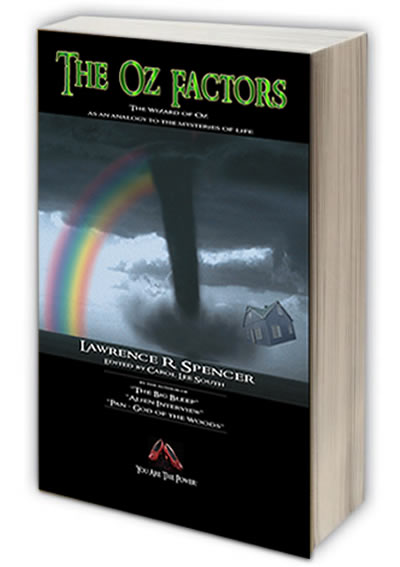
 The Oz Factors
1/ We’ve Got to Verify It
2/ Are you a good witch?
3/ The Hour Glass
4/ Which way do we go?
5/ She Fell From a Star
6/ The Ruby Slippers
7/ We’re Not In Kansas Anymore
8/ Who’s Them?
9/ Doesn’t Anybody Believe Me?
10/ You Ain’t Using Your Head
11/ Over The Rainbow
12/ Seeing Reason
__________________
” Doesn’t anybody believe me?“–Dorothy
“Of course we believe you, Dorothy…“–Uncle Henry (from the 1937 film The Wizard of Oz)
Is reality really real?
As Dorothy discovered when she returned back to Kansas, her friends and family did not agree that the Land of Oz was “reality”.
Conversely, gaining agreement from one’s friends does not guarantee that the information agreed upon is true or workable or survival. Agreement is not necessarily reality. Although Man seems to crave agreement with his fellows, the fact that “everyone agrees that the world is flat” or that “the sun revolves around the Earth”, does not make it a reality.
History has shown that agreements among people have very frequently proven to be disastrous.
Example: Adolph Hitler gained the complete, unabated agreement of the majority of the German population before he led them into total self-destruction.
Lots of people agree when fast food franchise advertisements tell them that cheeseburgers, fries and milk shakes are good for them. We were, and still are, told, based on “medical research” that these foods contain nutrients from all the “four basic food groups”. This doesn’t change the fact that you get fat, develop hardened arteries and die an early death from heart disease or cancer if you keep eating cheeseburgers, fries and shakes.
 The unprecedented multi-billion dollar profit margins earned by the beef and dairy industry and sugar growers in cooperation with the fast food restaurant cartels have a heavy influence on “truth in advertising”. In addition, the quality of information we receive, as consumers, from the American Medical Association regarding “the science of nutrition” is directly influenced by fast food commercial interests.
Only one generation ago the Japanese people were nearly free of heart disease and cancer. In just 20 short years, since they have openly adopted the Standard American Diet (SAD)–cheeseburgers/French fries/milk shakes and liquid caffeine-filled sugar water called cola–the incidence of heart disease and cancer among the Japanese people has skyrocketed. The Japanese agreement with Western lifestyles is killing them.
Reality is often heavily influenced by the Oz Factor of agreement. Agreements influence our perception of reality. A child’s perception of his environment, his religious and political ideas and viewpoints about people are often heavily influenced by agreement with his mother and father.

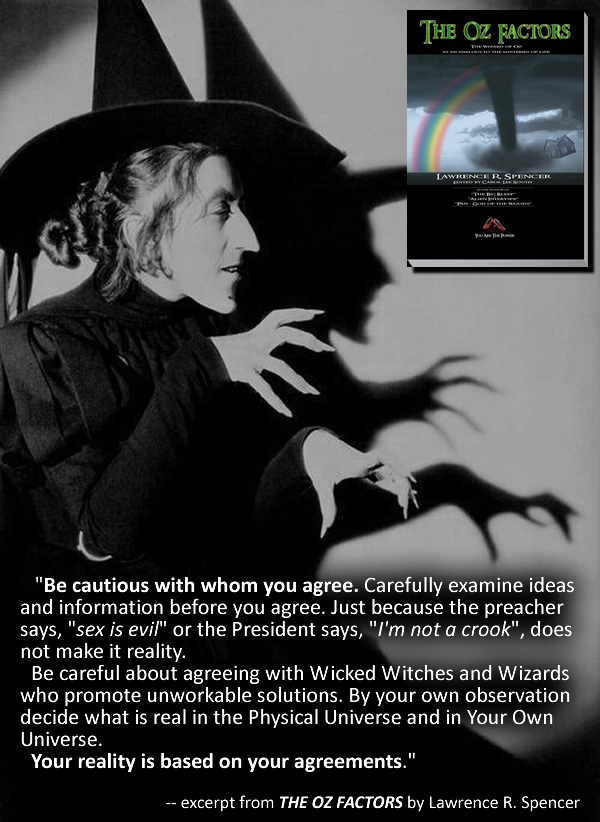
Be cautious with whom you agree. Carefully examine ideas and information before you agree. Just because the preacher says, “sex is evil” or the President says, “I’m not a crook”, does not make it reality. Be careful about agreeing with Wicked Witches and Wizards who promote unworkable solutions. By your own observation decide what is real in the Physical Universe and in Your Own Universe. Your reality is based on your agreements.”
— ExcerptED from THE OZ FACTORS, by Lawrence R. Spencer, Edited by Carol South
Republished by Blog Post Promoter
 “The Self, the Spirit, creates illusion.
The delusion of Beings is that All is not an illusion.
One creates illusion, enjoying, renewing, destroying.
Creation and Joy of Being are The Way of All-Mother.
Beings pretend to be forms to play a game.
Beings may endows forms with sensation and feels pleasure therein.
Pain is a game of suffering forms.
Without a form, can one suffer?
One may forget One’s Self and become a form.
One becomes form: One loses The Way of All-Mother.
Benevolent Creation is Pleasure.
All-Mother is The Way of Eternal Pleasure”

 LISTEN TO A SAMPLE OF THE AUDIOBOOK — Domain Expeditionary Force Rescue Mission