Republished by Blog Post Promoter
“Twin Flame / Polarity Self”: A Manifestation of “Entanglement” in Quantum Physics — by Lawrence R. Spencer
DEFINITION: “polarity” = noun: having an indicated pole (as the distinction between positive and negative electric charges)
A “Twin Flame Polarity Self” is the description of a relationship between two Immortal Spiritual Beings (Is-Bes) who each manifest the opposite, and complimentary, “polarity” (positive / negative energy) of the same spiritual “self”. The ancient principle of Ying / Yang is a common interpretation of this phenomenon from the prehistory on Earth.
Theoretically, one Is-Be possesses only ONE HALF of the total energetic ability of the combined Is-Be. When the “halves” of the “whole” Is-Be are separated they do not have the same Power and Ability they have when they are together!
The New Age “Law of Attraction” is based primarily on the observation and experience of this phenomenon. In human experience it is most often an interaction between people, especially lovers or life partners. It is common for people to search for their “true love” or “soul mate”, with a primordial, insatiable yearning that is fulfilled by only a few in one lifetime, if ever. However, when one finds and is “reunited” with their “Twin Flame” the resulting relationship is nothing less than profoundly fulfilling, gratifying and transcendent for each person!
The entire physical universe seems to be constructed of “Thought Energy”. By experiment and common observation, the “energy” in our physical universe is ALWAYS composed of a “polarity”, i.e. positive + negative (male + female) energy.
Nikola Tesla observed that “If you want to find the secrets of the universe, think in terms of energy, frequency and vibration.” And, “The day science begins to study non-physical phenomena, it will make more progress in one decade than in all the previous centuries of its existence.” . He was the first person to observe that an electric motor cannot run without BOTH positive and negative electrons. It will not generate power. Nickola Tesla discovered that the most powerful electric generators are created using “alternating current”. This is a flow of electricity that COMBINES POSITIVE and NEGATIVE electrons through a simultaneous and alternating INTERACTION which flows along the SAME PATH at the SAME TIME. His invention of the Alternating Current Generator changed the entire history of Earth by bringing electricity to the entire planet!
This “polarity” phenomenon is not only a personal, subjective, spiritual or romantic reality, but a scientific fact. In recent years proof of this reality has been proven by experiment by quantum physicists. It is called “Entanglement”.
The following article explains “Entanglement” in Quantum Physics:
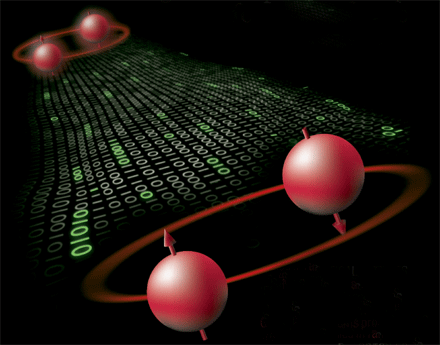 “Identical twins, it’s said, can sometimes sense when one of the pair is in danger, even if they’re oceans apart. Tales of telepathy abound. Scientists cast a skeptical eye over such claims, largely because it isn’t clear how these weird connections could possibly work. Yet they’ve had to come to terms with something that’s no less strange in the world of physics: an instantaneous link between particles that remains strong, secure, and undiluted no matter how far apart the particles may be – even if they’re on opposite sides of the universe. It’s a link that Einstein went to his grave denying, yet its existence is now beyond dispute. This quantum equivalent of telepathy is demonstrated daily in laboratories around the world. It holds the key to future hyperspeed computing and underpins the science of teleportation. Its name is “entanglement”.
The concept, but not the name of entanglement, was first put under the scientific spotlight on May 15, 1935, when a paper by Einstein and two younger associates, Nathen Rosen and Boris Podolosky, appeared in the journal Physical Review. Its title – “Can a Quantum-Mechanical Description of Physical Reality Be Considered Complete?” – leaves no doubt that the paper was a challenged to Niels Bohr and his vision of the subatomic world. On June 7, Erwin Schrödinger, himself no lover of quantum weirdness, wrote to Einstein, congratulating him on the paper and using in his letter the word entanglement – or, rather, its German equivalent verschränkung – for the first time. This new term soon found its way into print in an article – sent to the Cambridge Philosophical Society on August 14 that was published a couple of months later. In it he wrote:
When two systems … enter into temporary physical interaction … and when after a time of mutual influence the systems separate again, then they can no longer be described in the same way as before, viz. by endowing each of them with a representative of its own. I would not call that one but rather the characteristic trait of quantum mechanics, the one that enforces its entire departure from classical lines of thought. By the interaction the two representatives [the quantum states] have become entangled.
The characteristic trait of quantum mechanics … the one that enforces its entire departure from classical lines of thought – here was an early sign of the importance attached to this remarkable effect. Entanglement lay at the very heart of quantum reality – its most startling and defining feature. And Einstein would have none of it. Yet, the fact of the existence of the “entanglement” phenomenon in this universe have now been conclusively proven by numerous experiments.
Practical applications
The phenomenon of entanglement has already begun to be exploited for practical purposes. In the late 1980s, theoreticians started to see entanglement not just as a puzzle and a way to penetrate more deeply into the mysteries of the quantum world, but also as a resource. Entanglement could be exploited to yield new forms of communication and computing. It was a vital missing link between quantum mechanics and another field of explosive growth: information theory. The proof of nonlocality and the quickly evolving ability to work with entangled particles in the laboratory were important factors in the birth of a new science. Out of the union of quantum mechanics and information theory sprang quantum information science – the fast-developing field whose most important fields of development are quantum cryptography, quantum teleportation, and quantum computers.”
READ THE ENTIRE ARTICLE: http://www.daviddarling.info/encyclopedia/Q/quantum_entanglement.html