Republished by Blog Post Promoter
 “Reading a book is like being inside the mind of the author. Great writers read more books than they write.” ~ LRS

Republished by Blog Post Promoter
“Reading a book is like being inside the mind of the author. Great writers read more books than they write.” ~ LRS
Republished by Blog Post Promoter
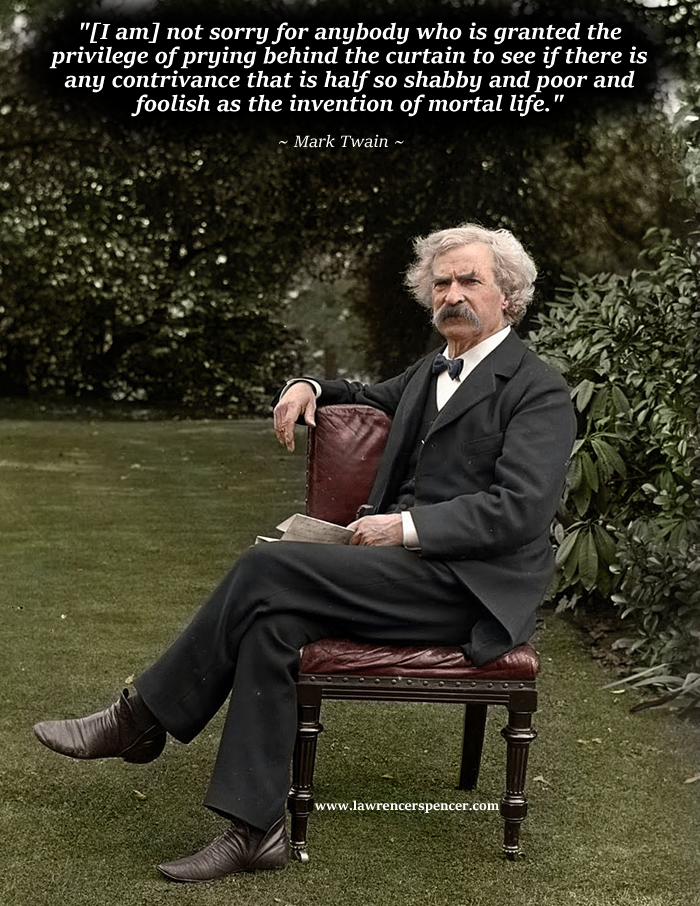
I am a great admirer of Mark Twain (Samuel Clemens).  After reading his Autobiography I discovered that Mark Twain became increasingly   cynical, depressed and disillusioned by the behavior of the human race.  His revolutionary books, Huckleberry Finn and Tom Sawyer were protests against the institution of human slavery in a time when "owning people" for commonplace.  Toward the end of his life, in his 70s, Mark Twain became reclusive and bitter about the pain and suffering he witnessed on his extensive travels around the world during lecture tours.  This was compounded by the agony and personal responsibility he felt for the death of his infant son, the death of his daughters and his beloved wife.  The accumulated tragedy of his his observations and experience as a human being overwhelmed him in the end.  He died defeated by the pain of his own compassion for humanity and from the loss of the people he loved the most-- his family.

Many men who are "dreamers" and "visionaries", like Twain, are highly empathetic.  They FEEL the pain of other beings as a personal, subjective pain.  Some beings find relief from this chronic agony in drugs or alcohol.  Or, they just stop looking and caring.  Mark Twain found a temporary relief from his own pain in tobacco, humor, and a "collection" of young girls....

This article is re-posted from the Blog "Today I Found Out":
Samuel Clemens (aka, Mark Twain) used to “collect” girls between the ages of 10-16 years old.

On February 12, 1908, Clemens said, “I suppose we are all collectors… As for me, I collect pets: young girls — girls from ten to sixteen years old; girls who are pretty and sweet and naive and innocent — dear young creatures to whom life is a perfect joy and to whom it has brought no wounds, no bitterness, and few tears.”

Okay, so it isn’t actually as creepy as it initially sounds and in some ways is kind of sweet, but Samuel Clemens did love to entertain young girls.  Towards the end of Clemens life, he suffered quite a lot of hardship. His daughter Susy died in 1896 and his wife Olivia passed away in 1904, followed by a second daughter, Jean, in 1909. Clemens fell into a depression in the early 1900s and noted that while he had reached the grandfather stage of life, he had no grandchildren to keep him company. He therefore went about befriending young girls who he treated as surrogate granddaughters.


The girls in question were the daughters of couples who ran in his same social circle. He often met them on boats carting him back and forth to England or Bermuda, as was the case with Helen Allen. Allen was just twelve years old when Clemens stayed with her family in Bermuda. Her father was the American Vice-Council in Bermuda; her grandmother had known Clemens’ wife as a child. Clemens said Allen was “perfect in character, lovely in disposition, and a captivator at sight,” everything that Clemens wanted in his collection of young girls.

The group of girls were called “Angel Fish” or “the Aquarium Club.” The name is derived from the fish that Clemens first saw in Bermuda. He decided on that name because the angelfish “is the most beautiful fish that swims.” Clemens would buy angelfish pins in Bermuda and present them to each of his girls. Out of a dozen or so original pins, at least one is still in existence. It currently resides in the Mark Twain Library in Redding, Connecticut.

So what exactly did a man in his late seventies do with a bunch of teenaged girls? All manner of innocent, grandfatherly things. Clemens invited the girls to concerts, the theatre, and to his own house for card games, billiards, and reading. While in Bermuda, several of his Angel Fish had fun riding in a donkey-pulled cart with him. Clemens initially called his estate “Innocence at Home” in honour of “his girls.” He kept in touch with them by exchanging letters when they couldn’t visit, but always kept a room available and hoped to have an Angel Fish “in it as often as Providence will permit.” Before you get too much of a “Michael Jackson” vibe, it should be noted that the girls were always accompanied by a chaperone; the room for the Angel Fish even had two beds to accommodate a mother or guardian along with a girl.

Besides the room, Clemens’ house also had a billiard room which was refashioned into a sort of shrine to the Angel Fish. Above the door was a sign that said “the Aquarium” and inside the walls were lined with framed photos of each of the Aquarium Club’s members.

As innocent as it all was, if some celebrity tried to do that today, the press would have a field day with it, insinuating all manner of disgusting things, whether there was any evidence of such acts or not. In his day, it wasn’t really much of a scandal, though Clemens’ remaining daughter, Clara, didn’t appreciate the behavior, perhaps being a tad jealous. When she returned to her father’s home from a stint in Europe to find that her father had collected a group of young girls to entertain, she made her father change the name of his house to “Stormfield” and stopped the household staff from saving letters from the Angel Fish. (Today the full collection of every surviving letter can be read in Mark Twain’s Aquarium: The Samuel Clemens-Angelfish Correspondence.)

The presence of chaperones probably should have put Clara’s mind at ease, but the letters Clemens wrote to his girls would definitely raise some eyebrows today. Shortly after Dorothy Harvey’s fourteenth birthday, he wrote to tell her “I wish I could have those free-gratis-for-nothing-voyages-&-nothing-to-do-but-look-at-you every day.” To Dorothy Quick, just eleven years old, he wrote after one of her visits, “I went to bed as soon as you departed, there being nothing left to live for after that, & all the sunshine gone. How do you suppose I am going to get along without you?” The letters showed his love and devotion to his girls and the enjoyment he experienced in spending time with them, but today parents would likely have used these letters as evidence in civil lawsuits.

Despite this, only one relationship ever looked to be somewhat improper, and that wasn’t with one of his Angel Fish; further, the inappropriate overtures didn’t come from Clemens. The girl was Gertrude Natkin. He met her when she was fifteen and he was 70 in 1905.  The two exchanged letters and Natkin developed a “school girl crush” on Clemens and went somewhat overboard in expressing her affection for him through her letters. Clemens became concerned about this and distanced himself from her- his letters growing more and more infrequent, because he didn’t want to gain a reputation for impropriety nor encourage her affections, perhaps proving that he saw his Angel Fish as nothing more than granddaughters.  Certainly, at the time, an adult male courting a 15 year old girl wouldn’t have raised eyebrows, particularly if the suitor was well-to-do and not too old.  But at 70, it would have been a scandal even in that time period.

Clemens died on April 21, 1910 of a heart attack, just a few years after establishing the Aquarium Club for his Angel Fish. All in all, there were around a dozen members of the club who visited Clemens regularly until his death, but his enthusiasm for the club waned in the last year of his life; he complained that his girls were growing up too fast, complained about their boyfriends, and cut off one girl when she turned sixteen.  In the end, his fondness for them primarily lying in their innocence, as something of a breath of fresh air in a cynical world, waned as they gradually lost that defining feature of children."
Republished by Blog Post Promoter
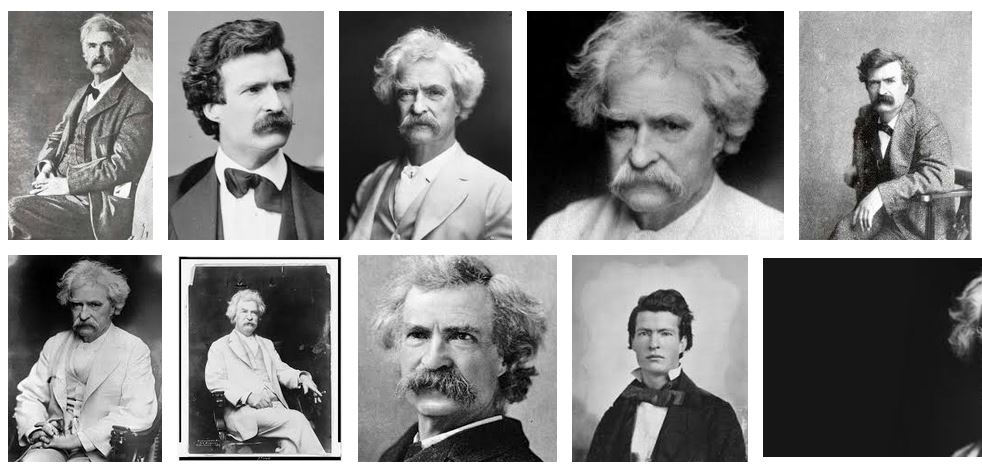
 Mark Twain (Samuel Clemens) died in 1910. It seems very likely and plausible (if you know about reincarnation) that he was reincarnated as Kurt Vonnegut in 1922. The resemblance between the two writers is uncanny in their events of their respective lives, there physical appearance, personal philosophies, writing and styles and by the fact that they were both prodigious, life-long smokers. The resemblance and affinity between Clemens / Vonnegut was not lost on Kurt Vonnegut as you will discover the in following lecture.
Kurt Vonnegut delivered the annual Clemens Lecture at the Mark Twain House in Hartford, Connecticut, An edited version of which we present here:
On Twain, Lincoln, Imperialist Wars and the Weather by Kurt Vonnegut
“Shock and awe.
What are the Conservatives doing with all the money and power that used to belong to all of us? They are telling us to be absolutely terrified, and to run around in circles like chickens with their heads cut off. But they will save us.
They are making us take off our shoes at airports. Can anybody here think of a more hilarious practical joke than that one? Smile, America. You’re on Candid Camera.
And they have turned loose a myriad of our high tech weapons, each one costing more than a hundred high schools, on a Third World country, in order to shock and awe human beings like us, like Adam and Eve, between the Tigris and Euphrates Rivers.
The other day I asked the former Yankees pitcher Jim Bouton what he thought of our great victory over Iraq, and he said, ‘Mohammed Ali versus Mr. Rogers.’ What are Conservatives? They are people who will move Heaven and Earth, if they have to, who will ruin a company or a country or a planet, to prove to us and themselves that they are superior to everybody else, except for their pals.
They take good care of their pals, keep them out of jail – and so on. Conservatives are crazy as bedbugs. They are bullies.
Shock and awe.
Class war? You bet.
 They have proved their superiority to admirers of Abraham Lincoln and Mark Twain and Jesus of Nazareth by, with an able assist from television, making inconsequential our protests against their war.
What has happened to us? We have suffered a technological calamity.
Television is now our form of government.
On what grounds did we protest their war? I could name many, but I need name only one, which is common sense.
Be that as it may, construction of the Mark Twain Museum will sooner or later be resumed. And I, the son and grandson of Indiana architects, seize this opportunity to suggest a feature which I hope will be included in the completed structure, words to be chiseled into the capstone over the main entrance.
Here is what I think would be fun to put up there, and Mark Twain loved fun more than anything. I have tinkered with something famous he said, which is:
‘Be good and you will be lonesome.’ That is from ‘Following the Equator.’OK? So envision what a majestic front entrance the Mark Twain Museum will have someday. And imagine that these words have been chiseled into the noble capstone and painted gold:
BE GOOD AND YOU WILL BE LONESOME MOST PLACES,
BUT NOT HERE, NOT HERE.
 One of the most humiliated and heartbroken pieces Twain ever wrote was about the slaughter of one hundred Moro men, women and children by our soldiers during our liberation of the people of the Philippines after the Spanish American War. Our brave commander was Leonard Wood, who now has a fort named after him. Fort Leonard Wood.
What did Abraham Lincoln have to say about such American Imperialist wars? Those are wars which, on one noble pretext or another, actually aim to increase the natural resources and pools of tame labor available to the richest Americans who have the best political connections.
And it is almost always a mistake to mention Abraham Lincoln in a speech about something or somebody else. He always steals the show. I am about to quote him.
Lincoln was only a Congressman when he said in 1848 what I am about to echo. He was heartbroken and humiliated by our war on Mexico, which had never attacked us.
We were making California our own, and a lot of other people and properties, and doing it as though butchering Mexican soldiers who were only defending their homeland against invaders weren’t murder.
What other stuff besides California? Well, Texas, New Mexico, Utah, Nevada, Arizona, and parts of Colorado and Wyoming.
The person Congressman Lincoln had in mind when he said what he said was James Polk, our President at the time. Abraham Lincoln said of Polk, his President, our armed forces’ Commander and Chief:
Trusting to escape scrutiny by fixing the public gaze upon the exceeding brightness of military glory, that attractive rainbow that rises in showers of blood – that serpent’s eye, that charms to destroy, he plunged into war.’
Holy smokes! I almost said, ‘Holy shit!’ And I thought I was a writer!
Do you know we actually captured Mexico City during the Mexican War?
Why isn’t that a national holiday? And why isn’t the face of James Polk up on Mount Rushmore, along with Ronald Reagan’s?
What made Mexico so evil back in the 1840’s, well before our Civil War, is that slavery was illegal there. Remember the Alamo?
My great grandfather’s name was Clemens Vonnegut. Small world, small world.
This piquant coincidence is not a fabrication.
Clemens Vonnegut called himself a ‘Freethinker,’ an antique word for Humanist. He was a hardware merchant in Indianapolis.
So, 120 years ago, say, there was one man who was both Clemens and Vonnegut. I would have liked being such a person a lot. I only wish I could have been such a person tonight.
I claim no blood relationship with Samuel Clemens of Hannibal, Missouri. ‘Clemens,’ as a first name, is, I believe, like the name ‘Clementine,’ derived from the adjective ‘clement.’ To be clement is to be lenient and compassionate, or, in the case of weather, perfectly heavenly.”
Republished by Blog Post Promoter

Krishna – Bhagavad Gita (5th Century B.C.E. or earlier)
“Learn thou! the Life is, spreading life through all; It cannot anywhere, by any means, Be anywise diminished, stayed, or changed. But for these fleeting frames which it informs with spirit deathless, endless, infinite, They perish. Let them perish, Prince! and fight! He who shall say, “Lo! I have slain a man!” He who shall think, “Lo! I am slain!” Those both know naught! Life cannot slay. Life is not slain!”
Socrates (469 BC–399 BC) Classical Greek philosopher.
“I am confident that there truly is such a thing as living again, that the living spring from the dead, and that the souls of the dead are in existence.”
Origen (ca. 185–ca. 254) was an early Christian scholar, theologian, and one of the most distinguished of the early fathers of the Christian Church.)
“It can be shown that an incorporeal and reasonable being has life in itself independently of the body… then it is beyond a doubt bodies are only of secondary importance and arise from time to time to meet the varying conditions of reasonable creatures. Those who require bodies are clothed with them, and contrariwise, when fallen souls have lifted themselves up to better things their bodies are once more annihilated. They are ever vanishing and ever reappearing.”
Voltaire (21 November 1694 – 30 May 1778), Enlightenment writer and philosopher
“It is not more surprising to be born twice than once; everything in nature is resurrection.”
Benjamin Franklin (January 17, 1706 – April 17, 1790) was one of the Founding Fathers of the United States of America.
“I look upon death to be as necessary to the constitution as sleep. We shall rise refreshed in the morning.” And, “Finding myself to exist in the world, I believe I shall, in some shape or other always exist.”
Ralph Waldo Emerson (May 25, 1803 – April 27, 1882) American essayist
“It is the secret of the world that all things subsist and do not die, but only retire a little from sight and afterwards return again. Nothing is dead; men feign themselves dead, and endure mock funerals…and there they stand looking out of the window, sound and well, in some strange new disguise. The soul comes from without into the human body, as into a temporary abode, and it goes out of it anew it passes into other habitations, for the soul is immortal.”
Walt Whitman (May 31, 1819 – March 26, 1892) American poet
“I know I am deathless. No doubt I have died myself ten thousand times before. I laugh at what you call dissolution, and I know the amplitude of time.”
Helena Blavatsky, Secret Doctrine, Vol. II, p. 424 (12 August 1831— May 8, 1891)
“That which is part of our souls is eternal. . . Those lives are countless, but the soul or spirit that animates us throughout these myriads of existences is the same; and though “the book and volume” of the physical brain may forget events within the scope of one terrestrial life, the bulk of collective recollections can never desert the divine soul within us. Its whispers may be too soft, the sound of its words too far off the plane perceived by our physical senses; yet the shadow of events that were, just as much as the shadow of the events that are to come, is within its perceptive powers, and is ever present before its mind’s eye.”
Herman Hesse (2 July 1877—9 August 1962)
“He saw all these forms and faces in a thousand relationships become newly born. Each one was mortal, a passionate, painful example of all that is transitory. Yet none of them died, they only changed, were always reborn, continually had a new face: only time stood between one face and another.”
Jack London, author, best known for book “Call of the Wild”
“I did not begin when I was born, nor when I was conceived. I have been growing, developing, through incalculable myriads of millenniums. All my previous selves have their voices, echoes, promptings in me. Oh, incalculable times again shall I be born.”
Albert Schweitzer (14 January, 1875 – 4 September, 1965) Alsatian theologian, who received the 1952 Nobel Peace Prize in 1953.
“Reincarnation contains a most comforting explanation of reality by means of which Indian thought surmounts difficulties which baffle the thinkers of Europe.”
Mark Twain (November 30, 1835 – April 21, 1910) American Author
“I have been born more times than anybody except Krishna.”
Mahatma Gandhi (2 October 1869 – 30 January 1948) leader of the Indian independence movement.
“I cannot think of permanent enmity between man and man, and believing as I do in the theory of reincarnation, I live in the hope that if not in this birth, in some other birth I shall be able to hug all of humanity in friendly embrace.”
Henry Ford (July 30, 1863 – April 7, 1947) Founder of the Ford Motor Company
“I adopted the theory of reincarnation when I was 26. Genius is experience. Some think to seem that it is a gift or talent, but it is the fruit of long experience in many lives. I am in exact accord with the belief of Thomas Edison that spirit is immortal, that there is a continuing center of character in each personality. But I don’t know what spirit is, nor matter either. I suspect they are forms of the same thing. I never could see anything in this reputed antagonism between spirit and matter. To me this is the most beautiful, the most satisfactory from a scientific standpoint, the most logical theory of life. For thirty years I have leaned toward the theory of Reincarnation. It seems a most reasonable philosophy and explains many things. No, I have no desire to know what, or who I was once; or what, or who, I shall be in the ages to come. This belief in immortality makes present living the more attractive. It gives you all the time there is. You will always be able to finish what you start. There is no fever or strain in such an outlook. We are here in life for one purpose—to get experience. We are all getting it, and we shall all use it somewhere.”
General George S. Patton (November 11, 1885 – December 21, 1945) U.S. Army officer
“Through the travail of the ages,
Midst the pomp and toil of war,
Have I fought and strove and perished,
Countless times upon this star.
So as through a glass, and darkly
The age long strife I see
Where I fought in many guises,
Many names, – but always me.”
________________________________________
Excerpted from the Introductory pages of the book VERMEER: PORTRAITS OF A LIFETIME, by Lawrence R. Spencer

Republished by Blog Post Promoter