Republished by Blog Post Promoter
Train of Thought from Leo Bridle on Vimeo.

Paintings, photography, aesthetic objects, beautiful communication, and anything I consider to be art, artful, artistic, artsy or whatever.
Art is subjective. It is a quality of communication can be contributed to by the viewer through empathy or agreement with its creator.
Republished by Blog Post Promoter
Train of Thought from Leo Bridle on Vimeo.
Republished by Blog Post Promoter

( Image by StefanArts )
FRIENDS ARE MADE OF MUTUAL UNDERSTANDING, STRENGTH, EMPATHY and TRUST
Lawrence R. Spencer. 2013.
Republished by Blog Post Promoter
This beautifully produced NOVA documentary reveals the Earth from the OUTSIDE, with breathtaking beauty and details which it is NOT POSSIBLE to perceive with a human body. Video and non-visual data from more than 100 satellites orbiting the Earth which measure different parts of the electromagnetic spectrum, and amalgamated into information we can “see” without the limitation of your very inadequate eyeballs! I highly recommend this film as a exercise in “consciousness expanding”. It make one aware of our VERY limited ability, inside a biological body, to perceive “reality” in the physical universe. What we actually “see” with our eyes is only a very, very tiny sliver of the entire electromagnetic spectrum of phenomena that exist in the physical universe. This film showed me a LOT more than I ever imagined! It is as though I am able to look through the “eyes” on an extraterrestrial space craft pilot, visiting Earth from another star! It makes me wonder…. what if I could perceive the ENTIRE electromagnetic spectrum? How different would my point of view of “reality” become? If I were not inhabiting a biological body, could I “see” all of this phenomena with my “disembodied eyes”? I wonder…..
Republished by Blog Post Promoter
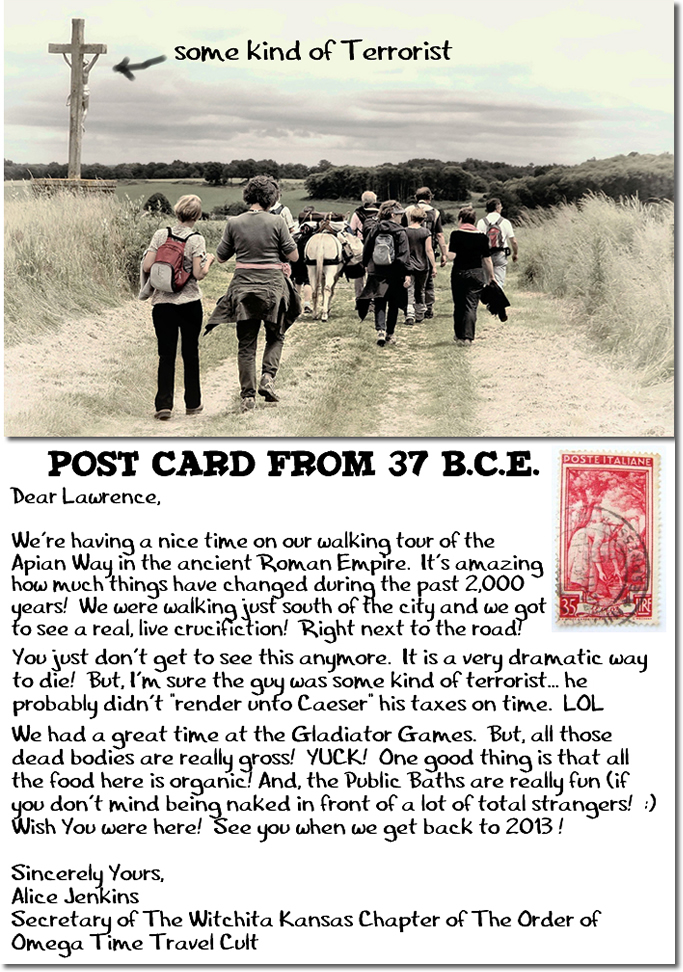
Crucifixion was often performed to terrorize and dissuade its witnesses from perpetrating particularly heinous crimes. Victims were left on display after death as warnings to others who might attempt dissent. Crucifixion was usually intended to provide a death that was particularly slow, painful (hence the term excruciating, literally “out of crucifying”), gruesome, humiliating, and public, using whatever means were most expedient for that goal. Crucifixion methods varied considerably with location and time period.
The Greek and Latin words corresponding to “crucifixion” applied to many different forms of painful execution, from impaling on a stake to affixing to a tree, to an upright pole (a crux simplex) or to a combination of an upright (in Latin, stipes) and a crossbeam (in Latin,patibulum).
In some cases, the condemned was forced to carry the crossbeam on his shoulders to the place of execution. A whole cross would weigh well over 300 pounds (135 kg), but the crossbeam would not be quite as burdensome, weighing around 100 pounds. The Roman historian Tacitus records that the city of Rome had a specific place for carrying out executions, situated outside the Esquiline Gate, and had a specific area reserved for the execution of slaves by crucifixion. Upright posts would presumably be fixed permanently in that place, and the crossbeam, with the condemned person perhaps already nailed to it, would then be attached to the post.
While a crucifixion was an execution, it was also a humiliation, by making the condemned as vulnerable as possible. Although artists have depicted the figure on a cross with a loin cloth or a covering of the genitals, writings by Seneca the Younger suggest that victims were crucified completely naked. When the victim had to urinate or defecate, they had to do so in the open, in view of passers-by, resulting in discomfort and the attraction of insects. Despite its frequent use by the Romans, the horrors of crucifixion did not escape mention by some of their eminent orators. Cicero for example, described crucifixion as “a most cruel and disgusting punishment”, and suggested that “the very mention of the cross should be far removed not only from a Roman citizen’s body, but from his mind, his eyes, his ears.”
Frequently, the legs of the person executed were broken or shattered with an iron club, an act called crurifragium, which was also frequently applied without crucifixion to slaves. This act hastened the death of the person but was also meant to deter those who observed the crucifixion from committing offenses. — REFERENCE SOURCE: Wikipedia.org
Republished by Blog Post Promoter