Republished by Blog Post Promoter
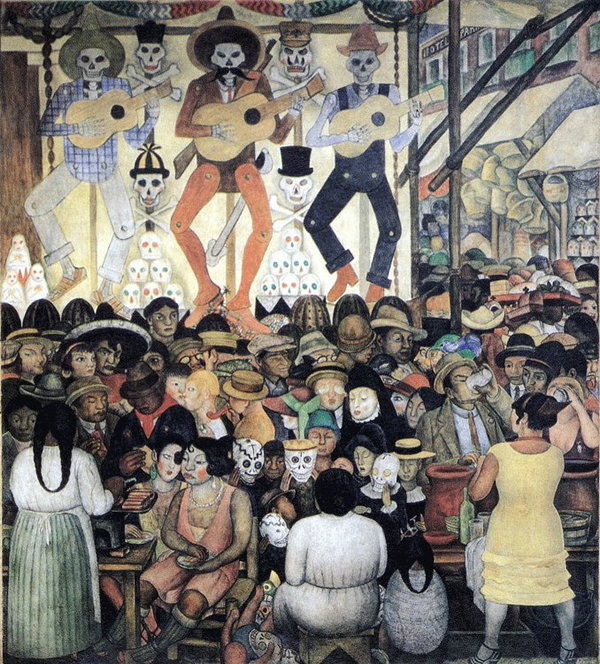
( Painting: “DAY OF THE DEAD” by Diego Rivera, 1924 )
The Day of the Dead celebrations in Mexico can be traced back to its indigenous pagan cultures. Rituals celebrating the deaths of ancestors had been observed by these civilizations perhaps for as long as 2,500–3,000 years.In the pre-Hispanic era, skulls were commonly kept as trophies and displayed during the rituals to symbolize death and rebirth.
The festival that became the modern Day of the Dead fell in the ninth month of the Aztec calendar, about the beginning of August, and was celebrated for an entire month. The festivities were dedicated to the goddessknown as the “Lady of the Dead”, corresponding to the modern Catrina.
In most regions of Mexico, November 1 is to honor children and infants, whereas deceased adults are honored on November 2. This is indicated by generally referring to November 1 mainly as Día de los Inocentes (“Day of the Innocents”) but also as Día de los Angelitos (“Day of the Little Angels”) and November 2 as Día de los Muertos or Día de los Difuntos (“Day of the Dead”)
People go to cemeteries to be with the souls of the departed and build private altars containing the favorite foods and beverages, as well as photos and memorabilia, of the departed. The intent is to encourage visits by the souls, so the souls will hear the prayers and the comments of the living directed to them. Celebrations can take a humorous tone, as celebrants remember funny events and anecdotes about the departed.
Plans for the day are made throughout the year, including gathering the goods to be offered to the dead. During the three-day period, families usually clean and decorate graves; most visit the cemeteries where their loved ones are buried and decorate their graves with ofrendas (offerings), which often include orange Mexican marigolds (Tagetes erecta) called cempasúchil (originally named cempoaxochitl, Nahuatl for “twenty flowers”).
In modern Mexico, this name is sometimes replaced with the term Flor de Muerto (Flower of the Dead). These flowers are thought to attract souls of the dead to the offerings.
Many other cultures around the world have similar traditions of a day set aside to visit the graves of deceased family members. Often included in these traditions are celebrations, food and beverages, in addition to prayers and remembrances of the departed. Some tribes of the Amazon believe the dead return as flowers.
The Bon Festival (O-bon (お盆?), or only Bon (盆?), is a Japanese Buddhist holiday in August to honor the departed spirits of one’s ancestors.
In Korea, Chuseok (추석, 秋夕) is a major traditional holiday, also called Hangawi. People go where the spirits of their ancestors are enshrined, and perform ancestral worship rituals early in the morning; they visit the tombs of immediate ancestors to trim plants, clean the area around the tomb, and offer food, drink, and crops to their ancestors.
The Qingming Festival (simplified Chinese: 清明节; traditional Chinese: 清明節; pinyin: qīng míng jié) is a traditional Chinese festival usually occurring around April 5 of the Gregorian calendar. Along with Double Ninth Festival on the 9th day of the 9th month in the Chinese calendar, it is a time to tend to the graves of departed ones. In addition, in the Chinese tradition, the seventh month in the Chinese calendar is called the Ghost Month (鬼月), in which ghosts and spirits come out from the underworld to visit earth.
During the Nepali holiday of Gai Jatra (Cow Pilgrimage), every family who has lost a family member during the previous year makes a construction of bamboo branches, cloth, paper decorations and portraits of the deceased, called a gai. Traditionally, a cow leads the spirits of the dead into the next land. Depending on local custom, either an actual live cow or a construct representing a cow may be used. The festival is also a time to dress up in costume, including costumes involving political comments and satire.
In some cultures in Africa, visits to the graves of ancestors, the leaving of food and gifts, and the asking of protection serve as important parts of traditional rituals. One example of this is the ritual that occurs just before the beginning of hunting season. (Source: WIKIPEDIA.ORG)