Republished by Blog Post Promoter

Republished by Blog Post Promoter
Republished by Blog Post Promoter
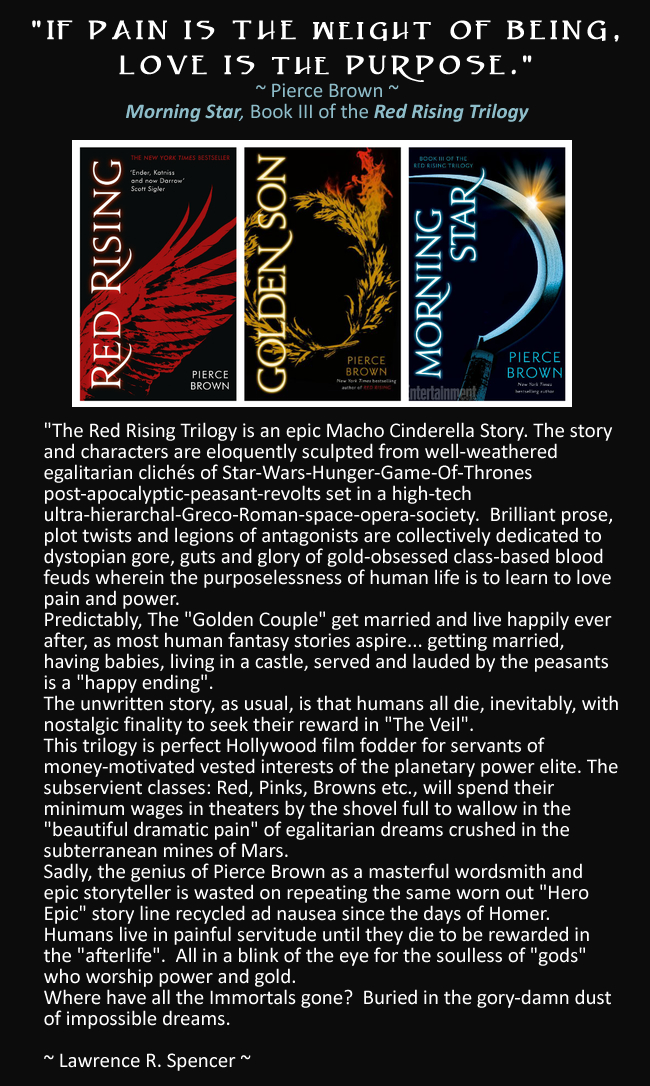 “The Red Rising Trilogy is an epic Macho Cinderella Story. The story and characters are eloquently sculpted from well-weathered egalitarian clichés of Star-Wars-Hunger-Game-Of-Thrones post-apocalyptic-peasant-revolts set in a high-tech ultra-hierarchal-Greco-Roman-space-opera-society. Brilliant prose, plot twists and legions of antagonists are collectively dedicated to dystopian gore, guts and glory of gold-obsessed class-based blood feuds wherein the purposelessness of human life is to learn to love pain and power.
Predictably, The “Golden Couple” get married and live happily ever after, as most human fantasy stories aspire… getting married, having babies, living in a castle, served and lauded by the peasants is a “happy ending”.
The unwritten story, as usual, is that humans all die, inevitably, with nostalgic finality to seek their reward in “The Veil”.
This trilogy is perfect Hollywood film fodder for servants of money-motivated vested interests of the planetary power elite. The subservient classes: Red, Pinks, Browns etc., will spend their minimum wages in theaters by the shovel full to wallow in the “beautiful dramatic pain” of egalitarian dreams crushed in the subterranean mines of Mars.
Sadly, the genius of Pierce Brown as a masterful wordsmith and epic storyteller is wasted on repeating the same worn out “Hero Epic” story line recycled ad nausea since the days of Homer. Humans live in painful servitude until they die to be rewarded in the “afterlife”. All in a blink of the eye for the soulless of “gods” who worship power and gold.
Where have all the Immortals gone? Buried in the gory-damn dust of impossible dreams.
~ Lawrence R. Spencer ~
Republished by Blog Post Promoter
Jiddu Krishnamurti — (11 May 1895 – 17 February 1986) was a speaker and writer on philosophical and spiritual subjects. In his early life he was groomed to be the new World Teacher but later rejected this mantle and withdrew from the organization behind it. He claimed allegiance to no nationality, caste, religion, or philosophy, and spent the rest of his life traveling the world, speaking to large and small groups and individuals. He wrote many books, among them The First and Last Freedom, The Only Revolution, and Krishnamurti’s Notebook.
Republished by Blog Post Promoter

“Stupidity cannot be cured.
Stupidity is the only universal capital crime; the sentence is death.
There is no appeal, and execution is carried out automatically and without pity.
Ignorance is curable. Stupid is forever.”
~ Robert A. Heinlein ~
Republished by Blog Post Promoter
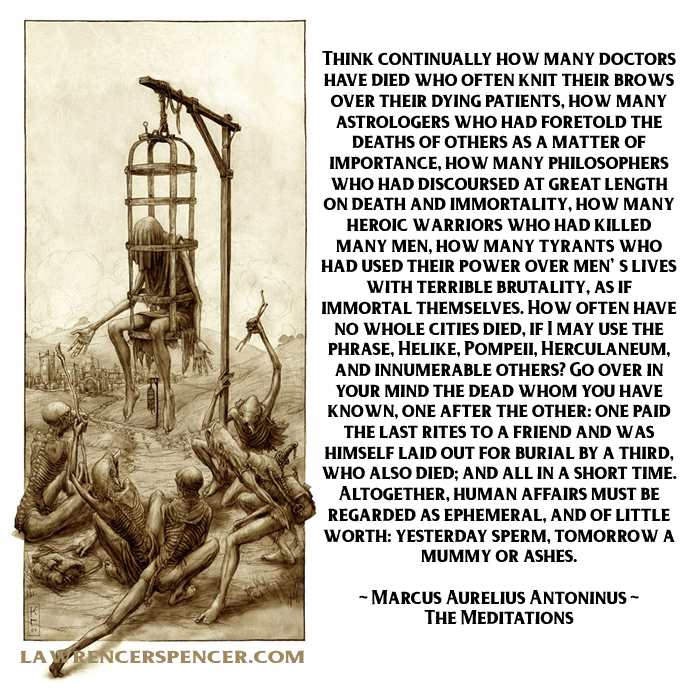 “Think continually how many doctors have died who often knit their brows over their dying patients, how many astrologers who had foretold the deaths of others as a matter of importance, how many philosophers who had discoursed at great length on death and immortality, how many heroic warriors who had killed many men, how many tyrants who had used their power over men’s lives with terrible brutality, as if immortal themselves. How often have no whole cities died, if I may use the phrase, Helike, Pompeii, Herculaneum, and innumerable others? Go over in your mind the dead whom you have known, one after the other: one paid the last rites to a friend and was himself laid out for burial by a third, who also died; and all in a short time. Altogether, human affairs must be regarded as ephemeral, and of little worth: yesterday sperm, tomorrow a mummy or ashes.”
| Marcus Aurelius Antoninus, The Meditations |
Marcus Aurelius Antoninus — 26 April 121 – 17 March 180 AD) was Roman Emperor from 161 to 180. He ruled with Lucius Verus as co-emperor from 161 until Verus’ death in 169. He was the last of the Five Good Emperors, and is also considered one of the most important Stoic philosophers.
During his reign, the Empire defeated a revitalized Parthian Empire in the East: Aurelius’ general Avidius Cassius sacked the capital Ctesiphon in 164. In central Europe, Aurelius fought the Marcomanni, Quadi, and Sarmatians with success during the Marcomannic Wars, although the threat of the Germanic tribes began to represent a troubling reality for the Empire. A revolt in the East led by Avidius Cassius failed to gain momentum and was suppressed immediately.
Marcus Aurelius’ Stoic tome Meditations, written in Greek while on campaign between 170 and 180, is still revered as a literary monument to a philosophy of service and duty, describing how to find and preserve equanimity in the midst of conflict by following nature as a source of guidance and inspiration.