Republished by Blog Post Promoter
A–“WHICH IS THE WAY BACK TO KANSAS?”
“I’d give anything to get out of Oz altogether, but which is the way back to Kansas? I can’t go the way I came.”–Dorothy
“The only person who might know would be the great and wonderful Wizard of Oz himself. He lives in the Emerald City and that’s a long journey from here. Did you bring your broomstick with you?”–Glinda, the Good Witch of the North
“No, I’m afraid I didn’t.”–Dorothy
“Well then, you’ll have to walk. It’s always best to start at the beginning and all you do is follow the Yellow Brick Road.”–Glinda in ‘The Wizard of Oz’
One of the primordial questions Dorothy was trying to answer in ‘The Wizard of Oz’ was, “which is the way back to Kansas?”
Trying to figure out the answers to the mysteries of life here on planet Earth is even harder than Dorothy trying to get back to Kansas–none of us have a broomstick to ride, we don’t have a good witch to ask for directions and there is no Yellow Brick Road to follow. So, we’re stuck here having to figure it out for ourselves, logically, using the information we have in our environment.
To begin at the beginning, the Land of Oz is a type of Universe. According to Webster’s Dictionary, a universe is defined as: “an area, province or sphere, as of thought or activity, regarded as a distinct, comprehensive system or world.”
The physical reality we all share on Earth and everything throughout the surrounding space is called the Physical Universe (PU).
On the other side of reality is your own imagination, your personal perceptions, viewpoints, dreams, hopes, desires, and creations, which comprise Your Own Universe (YOU).
The Land of Oz can be considered to be a Universe dreamed up by Dorothy, as conceived in the mind of L Frank Baum, the author of the book. (It has been speculated that the author created the “Land of Oz” after glancing at his file cabinet. The two file drawers were labeled “A-N” and “O-Z”. Dorothy could just as easily have been transported by the author’s pen into the imaginary “Land of AN”.)
In the movie version of the story, Dorothy creates the Land of Oz in a dream, induced by a knock on the head, using remnants of Kansas in the physical universe mixed together with creations from her own universe–which, for Dorothy, existed over the rainbow in the Land of Oz.
Every Universe seems to be made up of its own, peculiar set of Laws. The PHYSICAL UNIVERSE, for example, is built on a set of agreed upon Laws. A few examples of these Laws are:
The Law of Motion: “For every action, there is an equal and opposite reaction.”
The Food Chain Law: “In order for one life organism to live, another life organism must die.”
The Law of Gravity: “Whatever goes up, must come down.”
The Law of Time: “Time marches on.”
Most of us take the Laws of the Physical Universe for granted because everyone seems to agree with them. However, such laws leave a lot to be desired when compared to the Laws of a Universe we might create for ourselves!
In YOUR OWN UNIVERSE you can create any set of Laws, or have no Laws at all. You can make them, change them or break them. The Laws of YOUR OWN UNIVERSE can be anything or nothing, limited only by your imagination.
In YOUR OWN UNIVERSE, everything you wish comes true, because you are the “wizard” of YOUR OWN UNIVERSE!
In Dorothy’s universe, Scarecrows and trees can talk; witches can be beautiful and fly in magic bubbles; Munchkin girls join the “Lullaby League” and Munchkin boys have a “Lollipop Guild”; horses can change their color; and, Dorothy can dye her eyes to match her gown.
Dorothy’s first awareness of the particular universe she calls the Land of Oz is the realization that she is definitely NOT in Kansas. When she opens the door to her farmhouse, which has just crash-landed in Oz, Dorothy compares her past experience in Kansas with her present experience in Munchkinland. The Technicolor flowers, a good witch in a flying bubble, all the little brightly dressed people, a yellow brick road, etc, are definitely NOT similar to anything she has ever seen in Kansas.
The Land of Oz is an example of what Earth scientists would call an anomaly. For Dorothy, the anomaly is a departure from the usual arrangement of things as compared to her past experiences. In the universe of Oz, everything is so completely different from the universe Dorothy is familiar with in Kansas that she thinks she is lost.
How do you find the way back home when you are lost?
One way is to ask someone for directions. Of course, if you’ve ever been sent on a wild goose chase by a stranger, the experience taught you that it is a good idea to be somewhat selective as to whom you ask for directions. So, how do you know who is a reliable source of directions or information?
Perhaps it would be a good idea to find out something about the person from whom you are asking directions before you act upon what they tell you. Right? (Or, is it left?)
In our example, should Dorothy be asking for directions back to Kansas from the local natives, the Munchkins?
The main reason one would ask a local resident for directions is that one makes the assumption, otherwise known as an hypothesis (which is the first step in creating any scientific theory), that someone who lives in the area will be a reliable source of information and will give correct directions.
Well, in Dorothy’s case, the Munchkins have lots of familiarity with the Land of Oz, but they have no familiarity with Kansas. Fortunately for Dorothy, they are honest enough to tell her that they don’t have a clue where Kansas is, and they pass the buck to the Wizard of Oz, who they believe knows everything. And, based on their familiarity with the Yellow Brick Road and Munchkinland, they are certain that it leads to where the Great Oz lives.
Most would agree that a certainty is better than an assumption. When one has no familiarity based on personal experience or observation, it is best not to assume that one knows the correct directions. So, one asks for information from someone one believe knows–like a scientist, for example–who is supposed to be familiar with the area or subject in question.
Do the local Munchkins or local scientists of Oz give Dorothy the correct directions to help her get back to Kansas?
When Dorothy crash-landed her house in Munchkin City, the Munchkins cowered under the bushes and flowers in terror of retribution for the death of the Wicked Witch of the East from her mean, nasty, ugly sister, the Wicked Witch of the West.
Their benevolent, all-powerful protector, Glinda, the Good Witch of the North, who the Munchkins trust implicitly, is not much help in solving Dorothy’s problem, either. To begin with, Glinda does not have all the information regarding the situation, because she was not even there when Dorothy crashed her house into Munchkin City and inadvertently killed a wicked witch.
Undaunted by her lack of factual information, the first thing Glinda does after coaxing the Munchkins out from their hiding places, is to sing them a song about her assumption, or hypothesis, regarding Dorothy’s crash-landing. She sings: “Come out, come out, wherever you are, and meet the young lady who fell from a star. She fell from the sky, she fell very far, and ‘Kansas’ she says, is the name of the star.”
So, where did Glinda get the idea that Dorothy came from a star? Dorothy never said that she came from a star! But, somehow this all seems very logical to the Munchkins. Even Dorothy doesn’t object to Glinda’s false statement!
In our analogy, Glinda’s assumption that Dorothy fell from a star could be called a scientific theory. The theory proposed by the Good Witch of the North is that Kansas is a star! This theory is based on an assumption derived from an apparent anomaly as measured against her own personal experience and by information received from the Munchkins who are supposed to be a reliable source, but, who did not actually see the house crash because they were all in hiding. In truth, none of them have any familiarity with Kansas or cyclones or farm houses or dogs or little girls, either!
To complicate matters further, Glinda has to put on the appearance that she knows what she’s talking about in front of all her Munchkins followers, even though she is really just making a wild guess. After all, she has a very good job being the protector of the Munchkins, who appear to be utterly defenseless against their enemies, the Wicked Witch sisters. Anyway, Glinda is a good witch, which means she is probably really trying to help, so, they all believe her scientific theory that Dorothy has fallen from a star.
In their cute little minds, the Munchkins have accepted, without question, the logic, which underlies the assumption that is the basis of Glinda’s scientific theory:
SKY equals VERY FAR equals STAR equals KANSAS.
This kind of reasoning process could be called “Everything Logic”; i.e., Everything Equals Everything. This sort of logic might also be the definition of stupidity.
Example: If KANSAS equaled SKY equaled STAR, one could theoretically gaze up into the heavenly firmament to watch Kansas cattle grazing on the twinkling prairies in the stars above.
Unfortunately, much of what we call “science” on planet Earth is based on “Everything Logic”.”
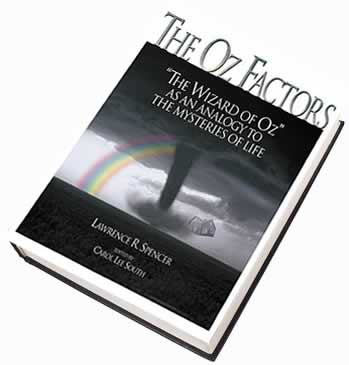
— Excerpted from THE OZ FACTORS, by Lawrence R. Spencer