Republished by Blog Post Promoter
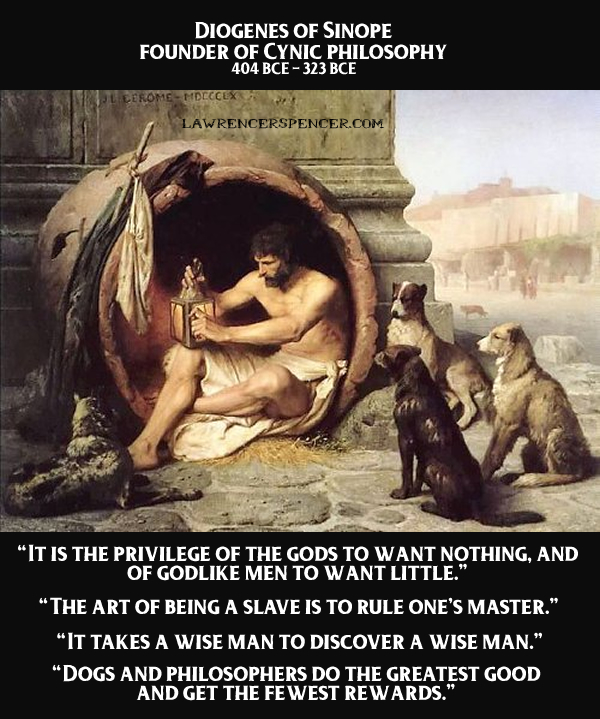 Diogenes of Sinope was a Greek philosopher and one of the founders of Cynic philosophy. The term “Cynic” itself derives from the Greek word κυνικός, “dog-like”. Later Cynics also sought to turn the word to their advantage, as a later commentator explained:
There are four reasons why the Cynics are so named. First because of the indifference of their way of life, for they make a cult of indifference and, like dogs, eat and make love in public, go barefoot, and sleep in tubs and at crossroads. The second reason is that the dog is a shameless animal, and they make a cult of shamelessness, not as being beneath modesty, but as superior to it. The third reason is that the dog is a good guard, and they guard the tenets of their philosophy. The fourth reason is that the dog is a discriminating animal which can distinguish between its friends and enemies. So do they recognize as friends those who are suited to philosophy, and receive them kindly, while those unfitted they drive away, like dogs, by barking at them.
Diogenes of Sinope he was born in Sinope (modern-day Sinop, Turkey), an Ionian colony on the Black Sea, in 412 or 404 BCE and died at Corinth in 323 BCE. He was a controversial figure. His father minted coins for a living, and when Diogenes took to debasement of currency, he was banished from Sinope.
After being exiled, he moved to Athens and criticized many cultural conventions of the city. He believed that virtue was better revealed in action than in theory. He used his simple lifestyle and behavior (which arguably resembled poverty) to criticize the social values and institutions of what he saw as a corrupt or at least confused society. In a highly non-traditional fashion, he had a reputation of sleeping and eating wherever he chose and took to toughening himself against nature.
He declared himself a cosmopolitan and a citizen of the world rather than claiming allegiance to just one place. Diogenes made a virtue of poverty. He begged for a living and often slept in a large ceramic jar in the marketplace. He became notorious for his philosophical stunts such as carrying a lamp in the daytime, claiming to be looking for an honest man. He criticized and embarrassed Plato, disputed his interpretation of Socrates and sabotaged his lectures, sometimes distracting attendees by bringing food and eating during the discussions.
Diogenes was also noted for having publicly mocked Alexander the Great:
“Alexander the Great found the philosopher looking attentively at a pile of human bones. Diogenes explained, “I am searching for the bones of your father but cannot distinguish them from those of a slave.”