Republished by Blog Post Promoter
Tag Archives: philosophy
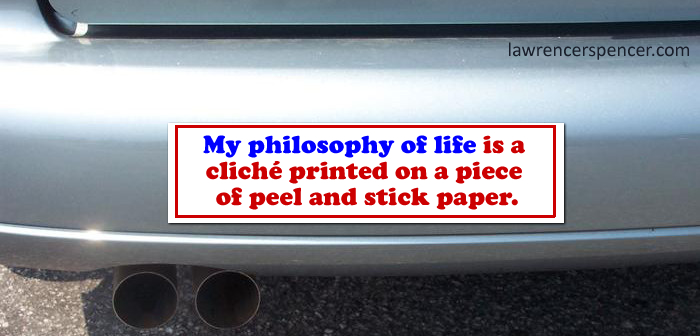
PEEL AND STICK PHILOSOPHY
Republished by Blog Post Promoter
THE ABYSS
Republished by Blog Post Promoter
(Photo by David F Sloh)
“WORSHIP THE SHRINE
TO REACH THE SUBLIME”
IS A WALL OF LIES
TOO STEEP TO CLIMB!
WE CANNOT BE FREE
WITH PRIESTS IN CONTROL
OF EMPTY PHILOSOPHY…
WHERE TRUTH IS UNKNOWN.
WE CHOSE NOT TO CLIMB
THE WALLS OF OUR MIND.
YET, WE ARE THE LIGHT
WE SEEK TO FIND!
_____________
Lawrence R. Spencer. 2013
LIGHT OF DEATH
Republished by Blog Post Promoter
Heraclitus is the first Greek philosopher to come from an aristocratic family. He became disillusioned with his fellow citizens when they chose to remove a prominent figure from office. He didn’t think that most people knew what they were doing, and were quick to accept tradition or go along with the opinions of others. For this reason, he was in favor of an aristocratic government (aristos) rather than a democracy exclaiming “One person is ten thousand to me if he is best.” His disillusionment with others, who could not understand his philosophy, led him ultimately to live a life of solitude in the mountains and to be known also as “The Weeping Philosopher.”
Heraclitus saw that the world is in a constant state of flux. He believed everything changes into it’s opposite, and that this is what maintains the world. “Cold things warm up, the hot cools off, wet becomes dry, dry becomes wet.” The philosophers before him thought there was a fundamental principle of reality (arche) and they identified it with a substance (water, air, the apeiron). For Heraclitus, the fundamental principle of the world isn’t a substance, but rather the principle that everything changes according to a divine guidance, which he called the Word (logos).
Source: http://www.philosimply.com/philosopher/heraclitus
ONTOLOGICAL CHAUTAUQUAS
Republished by Blog Post Promoter
I was interested to read “Zen and the Art of Motorcycle Maintenance” as I spent many years of my life riding motorcycles, and most of my life searching for answers to ontological and spiritual questions.
The author, Robert M. Pirsig, in first person, tells his real-life adventure of a 17-day journey on his motorcycle from Minnesota to Northern California with two friends and his 8 year old son Chris. The trip is punctuated by numerous philosophical musings and educational diatribes he refers to as “Chautauquas“, a popular method of adult teaching used in rural America during the 1800s.
Robert Pirsig was tested as having an IQ of 170 at the age of 9 years. His prodigious intellect led him to an epiphany that Western academia and science is based on unsubstantiated bullshit. Thereafter his personal philosophical investigations eventually drove him to ask questions and find answers that can only be discovered by exploring ones spiritual self.
The “dialogues” the author has with himself while riding his motorcycle across America are tied together by the story of the narrator’s own past self, who is referred to in the third person as Phaedrus (after Plato’s dialogue). Phaedrus, a teacher of creative and technical writing at a small college, became engrossed in the question of what defines good writing, and what in general defines good, or “Quality”.
The book reviews the subject of Western philosophy, touches on Eastern philosophy, including Zen. The discipline and technical skill of maintaining the motorcycle he is riding is used as an excellent analogue for his explanation of his psychic travels through the barren landscape of soulless Western world, both physically and metaphysically. Eventually, he resolves the question of “what is quality” through a subjective understanding of spiritual essence.
Fortunately, Mr. Pirsig is still living and has resolved his personal quest sufficiently to continue living in human society long enough to write this excellent book.