Republished by Blog Post Promoter


miscellaneous postings by Lawrence R. Spencer
Republished by Blog Post Promoter
Republished by Blog Post Promoter
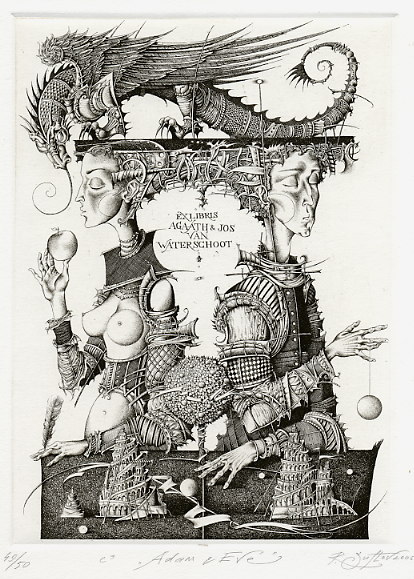
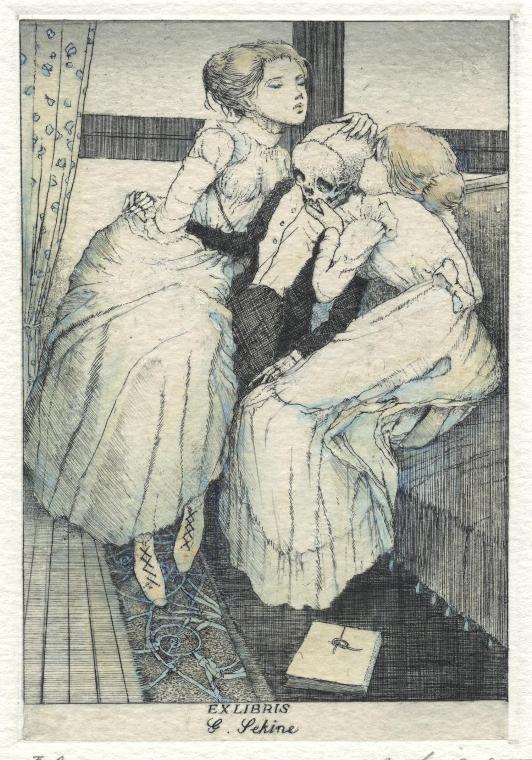
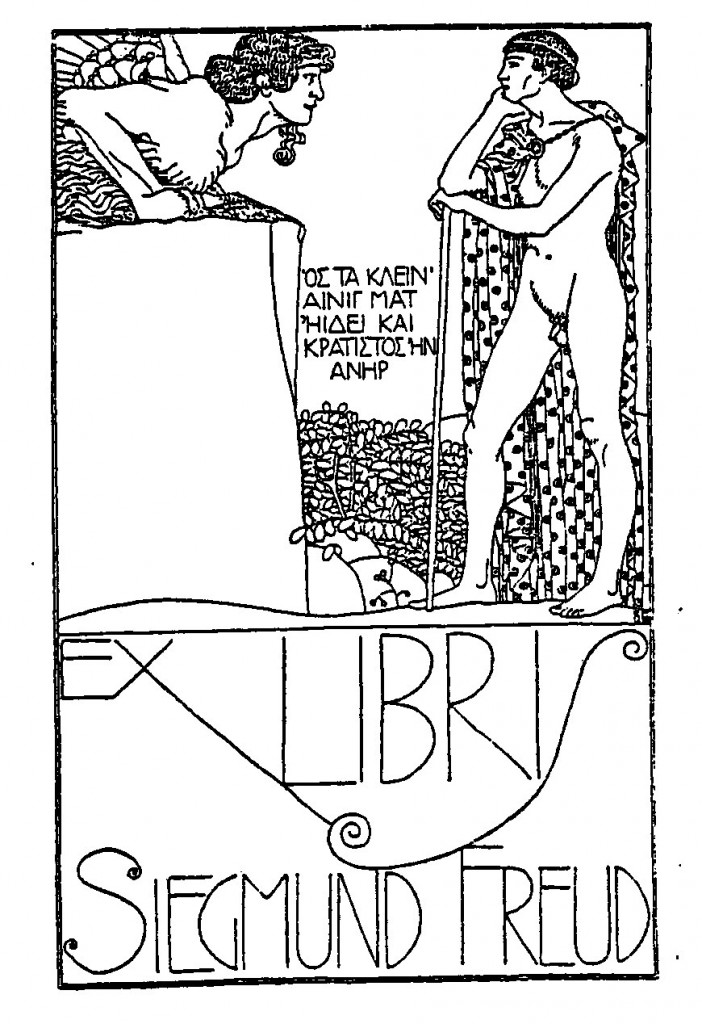
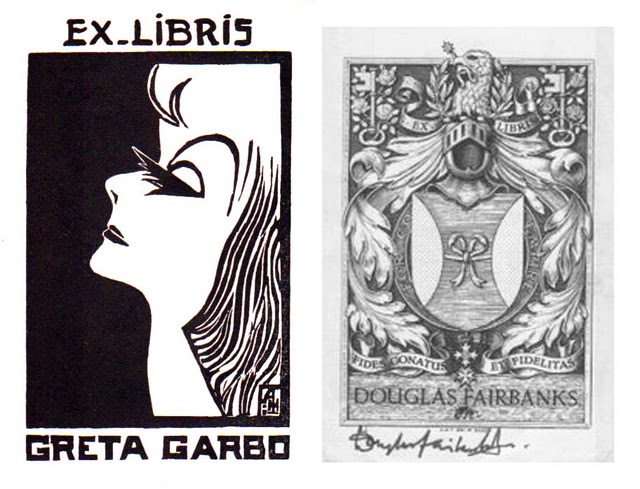
Books are valuable possessions. Books require thousands of hours, or even a lifetime to write, edit, and print. Before the advent of the printing press in the 14th century books were written by hand — one at a time — and only aristocrats and priests could read them. Historically, wealthy and educated persons collected books in private libraries. Each book had a label, or “book plate” placed on the inside front cover of the book to identify the owner. A bookplate, also known as ex-librīs [Latin, “from the books of…”], is usually a small print or decorative label pasted into a book, often on the inside front cover, to indicate its owner. Simple typographical bookplates are termed “booklabels”. Bookplates typically bear a name, motto, device, coat-of-arms, crest, badge, or any motif that relates to the owner of the book, or is requested by him from the artist or designer. The name of the owner usually follows an inscription such as “from the books of . . . ” or “from the library of . . . “, or in Latin, ex libris …. Bookplates are important evidence for the provenance of books.Here are a few examples of Book Plates for Greta Garbo, Douglas Fairbanks, Sigmund Freud, and others:
 SEE MORE FANTASITC EXLIBRIS PAGE PLATES HERE: http://blogs.yahoo.co.jp/ayu117/folder/1067532.html
HERE IS ANOTHER LINK:
http://cdm.lib.udel.edu/cdm4/browse.php?CISOROOT=/wab&CISOSTART=1,21
Republished by Blog Post Promoter

Autumn, interchangeably known as fall in North America, is one of the four temperate seasons. Autumn marks the transition from summer into winter, in September (Northern Hemisphere) or March (Southern Hemisphere), when the arrival of night becomes noticeably earlier and the temperature cools considerably. One of its main features is the shedding of leaves from deciduous trees.
Some cultures regard the autumnal equinox as “mid-autumn”, while others with a longer temperature lag treat it as the start of autumn Meteorologists (and most of the temperate countries in the southern hemisphere) use a definition based on months, with autumn being September, October and November in the northern hemisphere, and March, April and May in the southern hemisphere.
In North America, autumn is usually considered to start with the September equinox and end with the winter solstice (21 or 22 December). In traditional East Asian solar term, autumn starts on or around 8 August and ends on or about 7 November. In Ireland, the autumn months according to the national meteorological service, Met Éireann, are September, October and November. However, according to the Irish Calendar, which is based on ancient Gaelic traditions, autumn lasts throughout the months of August, September and October, or possibly a few days later, depending on tradition. In Australia and New Zealand, autumn officially begins on 1 March and ends on 31 May. — Wikipedia.org
Republished by Blog Post Promoter
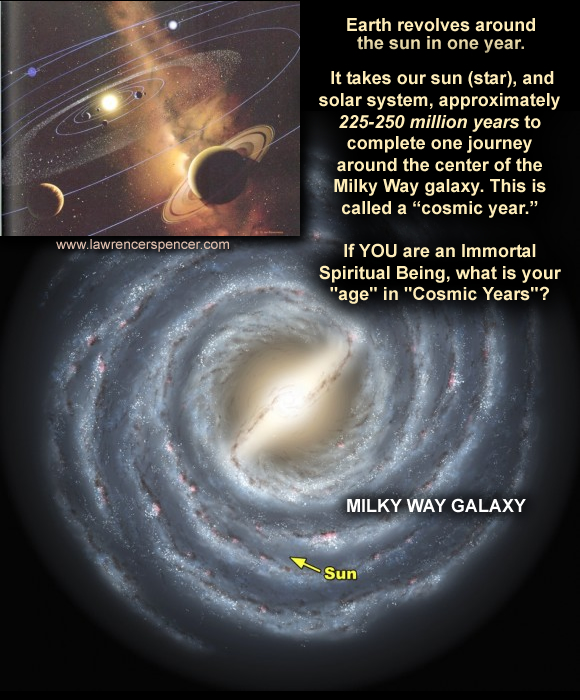
Time is a measurement of the motion of objects through space.
The planets in our solar system orbit around the sun. One orbit of the Earth takes one year. Meanwhile, our entire solar system orbits the center of the Milky Way galaxy. Our sun and solar system move at about 800 thousand kilometers an hour – that’s about 500 thousand miles an hour – in this huge orbit. So in 90 seconds, for example, we all move some 20,000 kilometers – or 12,500 miles – in orbit around the galaxy’s center.
Our Milky Way galaxy is a big place. Even at this blazing speed, it takes the sun approximately 225-250 million years to complete one journey around the galaxy’s center. This amount of time – the time it takes us to orbit the center of the galaxy – is sometimes called a “cosmic year.”
Revolve means “orbit around another body.” Earth revolves (or orbits) around the sun. The sun revolves around the center of the Milky Way galaxy.
On the other hand, rotate means “to spin on its axis”. The Earth rotates every 24 hours. The sun rotates, but not at a single rate across its surface. The movements of the sunspots indicate that the sun rotates once every 27 days at its equator, but only once in 31 days at its poles.
What about the Milky Way galaxy? Yes, the whole galaxy could be said to rotate, but like the sun it is spinning at different rates as you move outward from its center. At our sun’s distance from the center of the Milky Way, it’s rotating once about every 200 million years – defined by the length of time the sun takes to orbit the center of the galaxy.
If you are an Immortal Spiritual Being, how “old” are you in “Cosmic Years”? (this is a rhetorical question…)
Republished by Blog Post Promoter
 The Oz Factors
1/ We’ve Got to Verify It
2/ Are you a good witch?
3/ The Hour Glass
4/ Which way do we go?
5/ She Fell From a Star
6/ The Ruby Slippers
7/ We’re Not In Kansas Anymore
8/ Who’s Them?
9/ Doesn’t Anybody Believe Me?
10/ You Ain’t Using Your Head
11/ Over The Rainbow
12/ Seeing Reason
__________________
” Doesn’t anybody believe me?“–Dorothy
“Of course we believe you, Dorothy…“–Uncle Henry (from the 1937 film The Wizard of Oz)
Is reality really real?
As Dorothy discovered when she returned back to Kansas, her friends and family did not agree that the Land of Oz was “reality”.
Conversely, gaining agreement from one’s friends does not guarantee that the information agreed upon is true or workable or survival. Agreement is not necessarily reality. Although Man seems to crave agreement with his fellows, the fact that “everyone agrees that the world is flat” or that “the sun revolves around the Earth”, does not make it a reality.
History has shown that agreements among people have very frequently proven to be disastrous.
Example: Adolph Hitler gained the complete, unabated agreement of the majority of the German population before he led them into total self-destruction.
Lots of people agree when fast food franchise advertisements tell them that cheeseburgers, fries and milk shakes are good for them. We were, and still are, told, based on “medical research” that these foods contain nutrients from all the “four basic food groups”. This doesn’t change the fact that you get fat, develop hardened arteries and die an early death from heart disease or cancer if you keep eating cheeseburgers, fries and shakes.
 The unprecedented multi-billion dollar profit margins earned by the beef and dairy industry and sugar growers in cooperation with the fast food restaurant cartels have a heavy influence on “truth in advertising”. In addition, the quality of information we receive, as consumers, from the American Medical Association regarding “the science of nutrition” is directly influenced by fast food commercial interests.
Only one generation ago the Japanese people were nearly free of heart disease and cancer. In just 20 short years, since they have openly adopted the Standard American Diet (SAD)–cheeseburgers/French fries/milk shakes and liquid caffeine-filled sugar water called cola–the incidence of heart disease and cancer among the Japanese people has skyrocketed. The Japanese agreement with Western lifestyles is killing them.
Reality is often heavily influenced by the Oz Factor of agreement. Agreements influence our perception of reality. A child’s perception of his environment, his religious and political ideas and viewpoints about people are often heavily influenced by agreement with his mother and father.

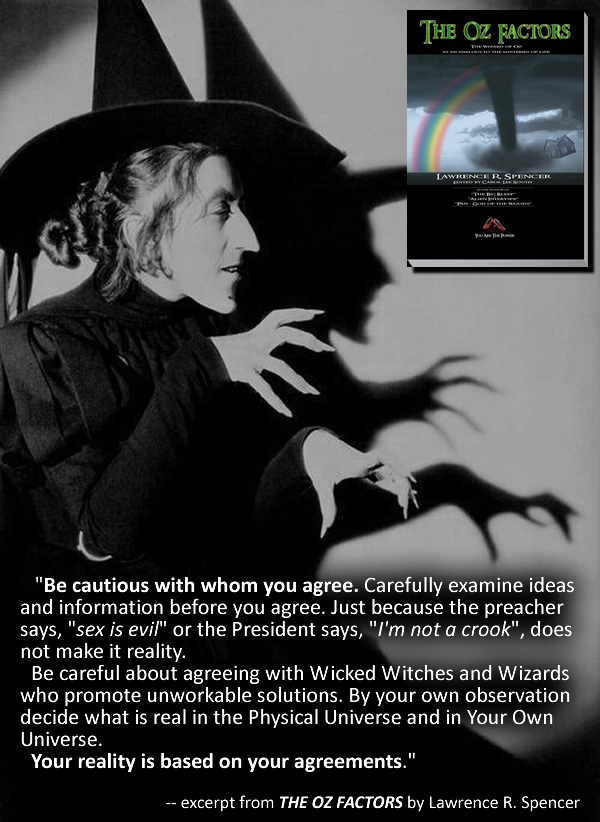
Be cautious with whom you agree. Carefully examine ideas and information before you agree. Just because the preacher says, “sex is evil” or the President says, “I’m not a crook”, does not make it reality. Be careful about agreeing with Wicked Witches and Wizards who promote unworkable solutions. By your own observation decide what is real in the Physical Universe and in Your Own Universe. Your reality is based on your agreements.”
— ExcerptED from THE OZ FACTORS, by Lawrence R. Spencer, Edited by Carol South