Republished by Blog Post Promoter
1984 has come and gone. The prophecy of George Orwell have been fulfilled. Now we know, without any doubt, that wars are started by bankers and politicians to make a financial profit and to gain personal power for themselves. In the United States there are no more wars of “defending oneself”. (False Flags propaganda notwithstanding). Since WW II the ONLY reason any war was ever fought — and factually, during the last 5,000 years human history — was for the profit of private banks and corporations. Don’t take my word for it. Study the history of warfare. Actually, there has always been a “Big Brother” in every period of history from the Egyptians to the Rockefellers. “Big Brother” is the bankers and politicians — with the blessing of the priests.
However, they are NOT the people who load the shells, fly the planes, drop the bombs and pull the triggers that kill people. They are spineless cowards who hide behind curtains and desks and rhetoric and secret police. It is each individual soldier who “is just doing his duty” that does the killing for the despicable slime we call our “leaders”. Until soldiers refuse to become soldiers there will be perpetual wars. I refused to be inducted into the military in 1969, during the Vietnam War. So can you now. All it takes is the balls to say the words: “HELL NO! I WON’T GO!”
So what can “Big Brother” do to you? Put you in prison? Shoot you in the head? So what?! Sacrificing your life is a small price to pay compared to relinquishing your personal responsibility to the whims of a pack of psychopathic power-brokers. It’s just a matter of time before the next person they’ll order you to kill is your own mother, brother and sister — in this lifetime or the next. What goes around, comes around.
Every time you “volunteer” to go out and kill people, or support the parasites who tell you it is your “duty” to murder the “enemy” they created for you, you — not anyone else — are the killer. I have heard a million reasons why it is OK to be a soldier. As a way to earn a living, almost any job is less destructive, and more honest, than helping a Gang of War Profiteers to invade entire countries so Wall Street bankers and Corporate Arms manufacturers can make another billion dollars on selling guns to your “enemies”. How many reasons can you think of to help “Big Brother” continue to slaughter millions and millions of people for their personal financial profit for the next 5,000 years? — Lawrence R. Spencer. 2012.
__________________________________________
Watch the following video with footage from the Vietnam war: notice who’s doing the killing and who’s safe back home in their offices: you guessed it, “Big Brother”.
Here is a quick less on how BIG BROTHER (“The Party”) keeps getting away with murder, theft and mayhem for their personal power and profit, at our expense:
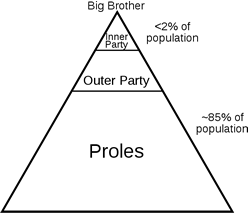 “The Party seeks power entirely for its own sake. We are not interested in the good of others; we are interested solely in power, pure power. What pure power means you will understand presently. We are different from the oligarchies of the past in that we know what we are doing. All the others, even those who resembled ourselves, were cowards and hypocrites. The German Nazis and the Russian Communists came very close to us in their methods, but they never had the courage to recognize their own motives. They pretended, perhaps they even believed, that they had seized power unwillingly and for a limited time, and that just around the corner there lay a paradise where human beings would be free and equal. We are not like that. We know what no one ever seizes power with the intention of relinquishing it. Power is not a means; it is an end. One does not establish a dictatorship in order to safeguard a revolution; one makes the revolution in order to establish the dictatorship. The object of persecution is persecution. The object of torture is torture. The object of power is power.” ― George Orwell, 1984 — published in 1949.
HERE IS A FREE ON-LINE COPY OF THE COMIC BOOK VERSION OF THE BOOK 1984