Category Archives: INSIDE THE BOOK

Inside the book, Vermeer: Portraits of A Lifetime. Analysis of all the paintings of Johannes Vermeer. The book reveals for the first time that the women featured in the paintings of Johannes Vermeer were members of his own family, his daughters, his wife and mother-in-law, Maria Thins.

EARTH: INMATE UNIFORM

Republished by Blog Post Promoter

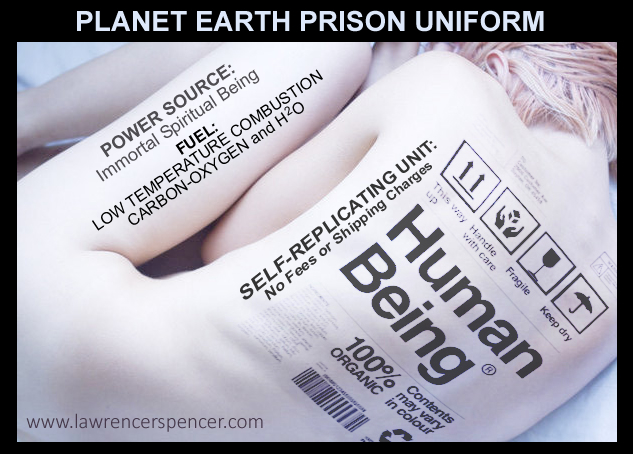
PLANET EARTH PRISON UNIFORM

“Biological bodies are specifically designed and designated as the lowest order of entity in the “Old Empire” caste system. When an IS-BE (Immortal Spiritual BEing) is sent to Earth, and then tricked or coerced into operating in a biological body, they are actually in a prison, inside a prison.”

~ Airl, from the book Alien Interview ~

Support independent publishing: Buy this book on Lulu.

www.alieninterview.org

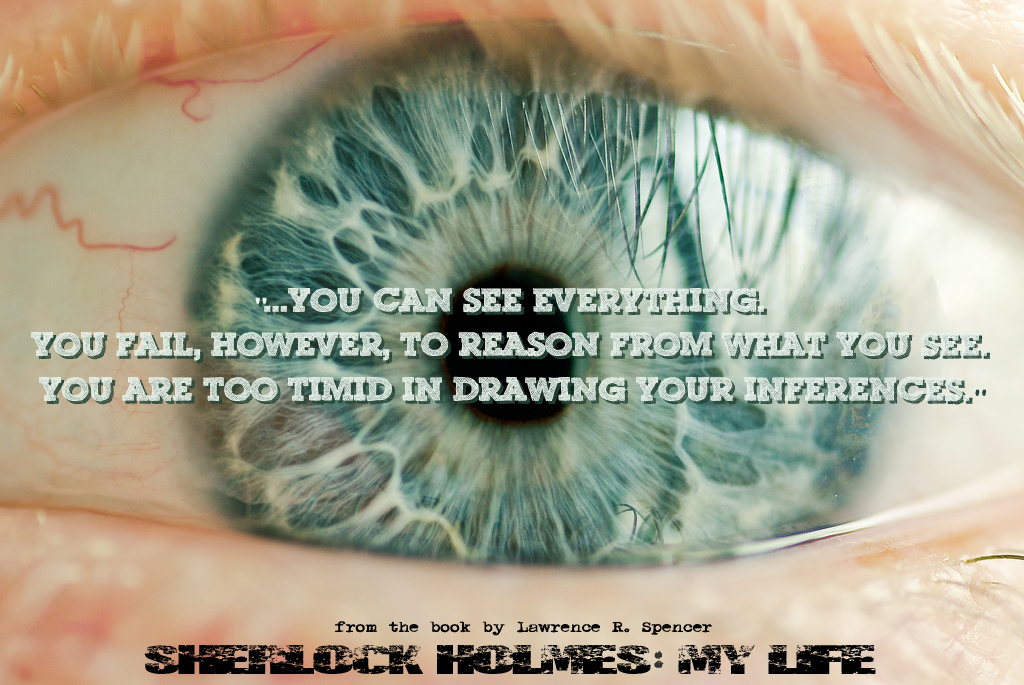
YOU ARE TOO TIMID IN DRAWING YOUR INFERENCES

Republished by Blog Post Promoter

“I have observed that the lowest and vilest alleys in London do not present a more dreadful record of sin than does the smiling and beautiful countryside”, gentlemen.

“I do not see what you are getting at, Holmes”, said Watson. Mr. Dodgson looked up with equal, but silent, agreement.

“On the contrary, Watson, you can see everything. You fail, however, to reason from what you see. You are too timid in drawing your inferences”, I said, taking a seat in my armchair, and inviting our guest to take a cigar from the box I offered.

“However, before we digress, let me allude to the discussion that Mr. Dodgson and I had when I visited him in is quarters.  He himself mentioned several methods of investigation which he has studied in the alchemical works of Sir Isaac Newton, and in his own mathematical application of portmanteau poetry to the development of mathematical thinking.

“Circumstantial evidence is a very tricky thing.  It may seem to point very straight to one thing, but if you shift your own point of view a little, you may find it pointing in an equally uncompromising manner to something entirely different”, I said while crossing over to the sideboard.

I picked up the manuscript that Mr. Dodgson had given me when I visited him entitled, Alice’s Golden Hour. While flipping through the pages to find a particular passage, I asked Mr. Dodgson a question about his work.

“Might I inquire as to the origin of one of the fictional characters whom Alice meets in Wonderland — The Cheshire Cat?”

“Frankly, I believe the idea came to me from an old expression I learned as a child”, replied Mr. Dodgson after momentarily pondering the question. “I believe it to be derived from a cheese which was sold in Cheshire, near my home. The cheese was molded in the shape of a cat.  The cheese was cut from the tail end first, so that the last part eaten was the head of the smiling cat”.

Support independent publishing: Buy this book on Lulu.

“Very well”, I said. “Let us then observe that you have extracted something from the reality of your childhood, and with a liberal application of your creative imagination have used it to conjure an illusion…an alternative to reality, as it were. Is this not so, Mr. Dodgson?”

“Well, yes, I suppose. However, I fail to see what relevance my fictional tales have to our current situation. Certainly you do not suppose that I am to believe that reality can be conjured from a work of fiction?  The notion is absurd!”, he replied.

“I do not ask you, or anyone, to believe anything whatsoever. Belief is a matter of personal opinion or conviction which cannot be shared by anyone else, accept to the degree that they share a similar opinion.  Some  men believe that the world was created by an omnipotent, invisible being in seven days. People in some aboriginal tribes believe that the world is supported on the back of an enormous elephant which stands upon the shell of a colossal tortoise”, I said, finally arriving at the pages I was looking for in the manuscript.

“As for myself, I believe that what is true for you is true for you, although no other person may agree upon your belief. Regardless, a truth for you, may not be true for others. Is that not a fundamentally sound assumption?”, I asked.

“I suppose you are right Mr. Holmes. It is difficult, if not impossible, to stay apace of your ability to remain logical in the face of a situation which is so absurdly enigmatic. You are proposing that the philosophical paradigm of reality should be considered of equal importance with fiction. How can you ever solve a criminal case, your occupation, if every piece of hard evidence could be a contrivance of imagination on the part of the investigator or of the criminal?”, said Mr. Dodgson.

“Quite the contrary”, I said. “But rather than keeping to my methods alone, let me ask you what meaning you attribute to the following passage in your book”, I said, turning to the page which described in the encounter between Alice and the Cheshire Cat.

“Let me read your own words to you.”

“…she was a little startled by seeing the Cheshire Cat sitting on a bough of a tree a few yards off.

The Cat only grinned when it saw Alice. It looked good-natured, she

thought: still it had VERY long claws and a great many teeth, so she

felt that it ought to be treated with respect.

‘Cheshire Puss,’ she began, rather timidly, as she did not at all know

whether it would like the name: however, it only grinned a little wider.

‘Come, it’s pleased so far,’ thought Alice, and she went on. ‘Would you

tell me, please, which way I ought to go from here?’

‘That depends a good deal on where you want to get to,’ said the Cat.

‘I don’t much care where–‘ said Alice.

‘Then it doesn’t matter which way you go,’ said the Cat.

‘–so long as I get SOMEWHERE,’ Alice added as an explanation.

‘Oh, you’re sure to do that,’ said the Cat, ‘if you only walk long

enough.’

Alice felt that this could not be denied, so she tried another question.

‘What sort of people live about here?’

‘In THAT direction,’ the Cat said, waving its right paw round, ‘lives

a Hatter: and in THAT direction,’ waving the other paw, ‘lives a March

Hare. Visit either you like: they’re both mad.’

‘But I don’t want to go among mad people,’ Alice remarked.

‘Oh, you can’t help that,’ said the Cat: ‘we’re all mad here. I’m mad.

You’re mad.’

‘How do you know I’m mad?’ said Alice.

‘You must be,’ said the Cat, ‘or you wouldn’t have come here.’

Alice didn’t think that proved it at all; however, she went on ‘And how

do you know that you’re mad?'”

“So, Mr. Dodgson, let me pose the same question to you that young Alice asked of the chimerical cat in your own story: how do you know whether you are mad or not mad? How would you satisfy yourself that I am not mad? How do we know that everyone is mad or not mad?”, I said, rising from my chair to place the manuscript upon the sideboard. “

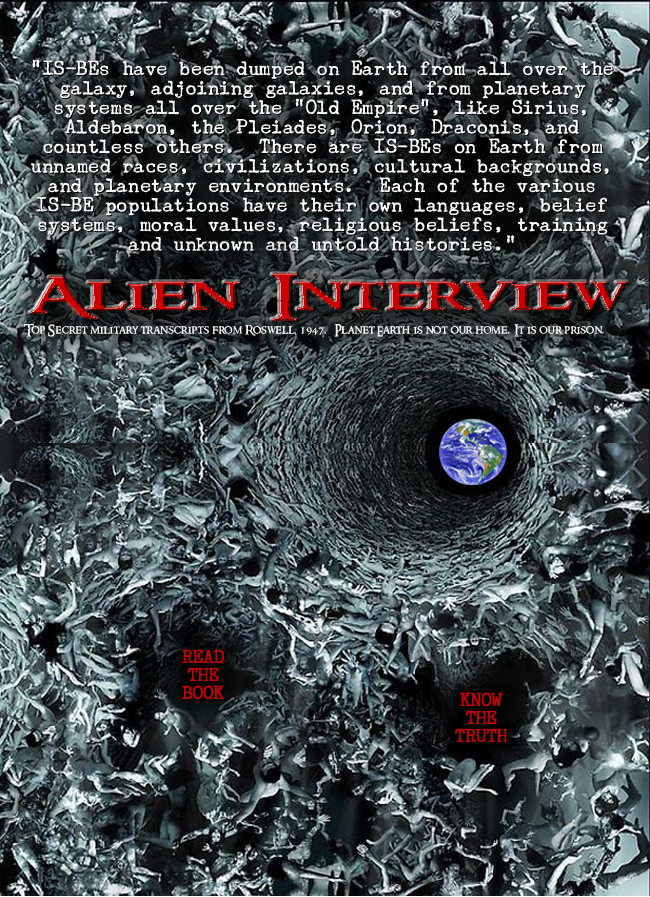
DUMPED ON EARTH

Republished by Blog Post Promoter

PRISON PLANET EARTH“…the very unusual combination of “inmates” on Earth – criminals, perverts, artists, revolutionaries and geniuses – is the cause of a very restive and tumultuous environment. The purpose of the prison planet is to keep IS-BEs on Earth, forever. Promoting ignorance, superstition, and war between IS-BEs helps to keep the prison population crippled and trapped behind “the wall” of electronic force screens.

IS-BEs have been dumped on Earth from all over the galaxy, adjoining galaxies, and from planetary systems all over the “Old Empire”, like Sirius, Aldebaron, the Pleiades, Orion, Draconis, and countless others. There are IS-BEs on Earth from unnamed races, civilizations, cultural backgrounds, and planetary environments. Each of the various IS-BE populations have their own languages, belief systems, moral values, religious beliefs, training and unknown and untold histories.”

— from the book ALIEN INTERVIEW

VISIT THE WEBSITE for the book at www.alieninterview.org

Support independent publishing: Buy this book on Lulu.


RESEARCH PROVES HUMANS ARE LESS INTELLIGENT THAN DOLPHINS (and mice)

Republished by Blog Post Promoter

In the opinion of “self-aggrandizing” humans, Dolphins are considered the “second” most intelligent species on Earth.  (Definition: self-aggrandizing n. The act or practice of enhancing or exaggerating one’s own importance, power, or reputation.)

What is the definition of “intelligent”?  Intelligence = the ability to perceive and apply optimum solutions for the problems of existence in the Eternal Now.

So Long, and Thanks for All the Fish is the fourth book of the Hitchhiker’s Guide to the Galaxyseries” written by Douglas Adams.  This book demonstrates clearly that Dolphins are the MOST intelligent species of animal on Earth, followed by mice and humans.  If you haven’t read this book, you will not understand why you are not as intelligent as a Dolphin or mouse.

The definition of “human intelligence” is obviously an oxymoron,  like “blind as a bat”.  Factually, bats and Dolphins — and many other life-forms have have super-human sensory perception!   Humans consider themselves to be intelligent, yet they carefully and mindlessly overlook an extraordinary number of FACTS that demonstrate STUPENDOUS STUPIDITY in their own behavior.

Here is a very short list of factors that demonstrate clearly that human beings are NOT the most intelligent, but actually the LEAST intelligent species of Earth:

  • Humans kill other human beings routinely in enormous numbers in a psychopathic frenzy called “war”.
  • Humans have created enough nuclear bombs to kill every living organism on Earth (including themselves) 1,000 time over.
  • Humans routinely destroy the habitat and kill every last living member of an entire species of life form.  If current rates of human destruction of the biosphere continue, one-half of all species of life on earth will be extinct in 100 years(Click link to read article on EXTINCTION in Wikipedia.org)

Obviously, Dolphins and mice do not exhibit any of these HIGHLY UNINTELLIGENT behaviors.  They are obviously MUCH MORE INTELLIGENT than humans.   READ THIS ARTICLE ABOUT DOLPHIN INTELLIGENCE from The Guardian

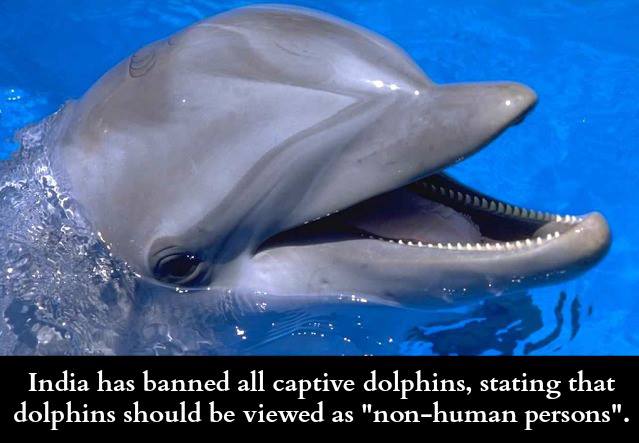
Dolphin non-human person

ARTICLE:  “Scientists say dolphins should be treated as ‘non-human persons'”   Jonathan Leake, Published: 3 January 2010 in THE SUNDAY TIMES

Dolphins have been declared the world’s second most intelligent creatures after humans, with scientists suggesting they are so bright that they should be treated as “non-human persons”.  Studies into dolphin behavior have highlighted how similar their communications are to those of humans and that they are brighter than chimpanzees. These have been backed up by anatomical research showing that dolphin brains have many key features associated with high intelligence.

The researchers argue that their work shows it is morally unacceptable to keep such intelligent animals in amusement parks or to kill them for food or by accident when fishing. Some 300,000 whales, dolphins and porpoises die in this way each year.

WARFARE TACTIC: FLOOD THE ENEMY WITH REFUGEES

Republished by Blog Post Promoter

unrwa-syrian-refugees-1The current “refugee crisis” in Europe is a planned attack against European countries.  Refugees are an ancient “weapon of war”.  Like using a “human shield” to “defend” oneself from attack, it is a strategy and weapon of cowards and criminals: international bankers and the military / industrial  minions of the New World Order.  This strategy is described in detail in the book  Weapons of Mass Migration: Forced Displacement, Coercion, and Foreign Policy, by think-tank scholar Kelly M. Greenhill.

“At first glance, the U.S. decision to escalate the war in Vietnam in the mid-1960s, China’s position on North Korea’s nuclear program in the late 1990s and early 2000s, and the EU resolution to lift what remained of the arms embargo against Libya in the mid-2000s would appear to share little in common. Yet each of these seemingly unconnected and far-reaching foreign policy decisions resulted at least in part from the exercise of a unique kind of coercion, one predicated on the intentional creation, manipulation, and exploitation of real or threatened mass population movements.

REFUGEE WEAPONSIn Weapons of Mass Migration, Kelly M. Greenhill offers the first systematic examination of this widely deployed but largely unrecognized instrument of state influence. She shows both how often this unorthodox brand of coercion has been attempted (more than fifty times in the last half century) and how successful it has been (well over half the time). She also tackles the questions of who employs this policy tool, to what ends, and how and why it ever works. Coercers aim to affect target states’ behavior by exploiting the existence of competing political interests and groups, Greenhill argues, and by manipulating the costs or risks imposed on target state populations.

This “coercion by punishment” strategy can be effected in two ways: the first relies on straightforward threats to overwhelm a target’s capacity to accommodate a refugee or migrant influx; the second, on a kind of norms-enhanced political blackmail that exploits the existence of legal and normative commitments to those fleeing violence, persecution, or privation. The theory is further illustrated and tested in a variety of case studies from Europe, East Asia, and North America. To help potential targets better respond to―and protect themselves against―this kind of unconventional predation, Weapons of Mass Migration also offers practicable policy recommendations for scholars, government officials, and anyone concerned about the true victims of this kind of coercion―the displaced themselves.”

LISTEN TO THE PODCAST BY THE AUTHOR, Kelly M. Greenhill 

http://www.rsc.ox.ac.uk/news/weapons-of-mass-migration-forced-displacement-coercion-and-foreign-policy-kelly-m-greenhill

refugees