Category Archives: ART

Paintings, photography, aesthetic objects, beautiful communication, and anything I consider to be art, artful, artistic, artsy or whatever.
Art is subjective. It is a quality of communication can be contributed to by the viewer through empathy or agreement with its creator.

DIOGENES THE CYNIC

Republished by Blog Post Promoter
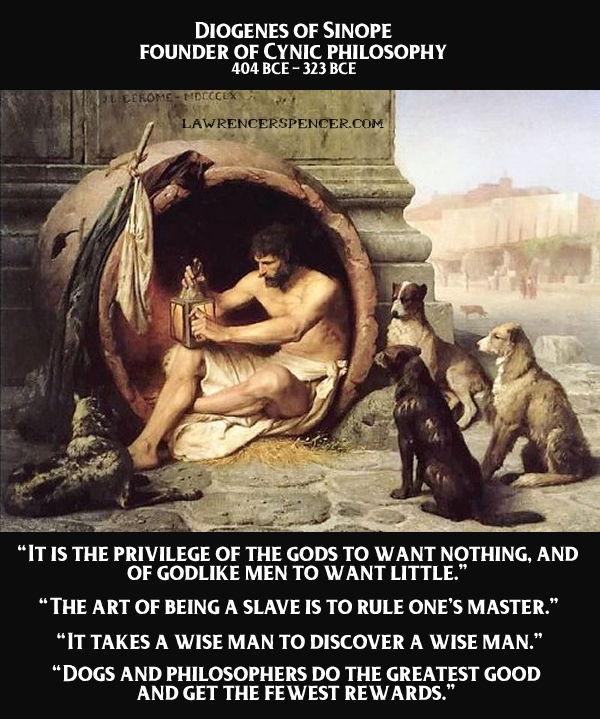
DiogenesDiogenes of Sinope  was a Greek philosopher and one of the founders of Cynic philosophy.  The term “Cynic” itself derives from the Greek word κυνικός, “dog-like”. Later Cynics also sought to turn the word to their advantage, as a later commentator explained:

There are four reasons why the Cynics are so named. First because of the indifference of their way of life, for they make a cult of indifference and, like dogs, eat and make love in public, go barefoot, and sleep in tubs and at crossroads. The second reason is that the dog is a shameless animal, and they make a cult of shamelessness, not as being beneath modesty, but as superior to it. The third reason is that the dog is a good guard, and they guard the tenets of their philosophy. The fourth reason is that the dog is a discriminating animal which can distinguish between its friends and enemies. So do they recognize as friends those who are suited to philosophy, and receive them kindly, while those unfitted they drive away, like dogs, by barking at them.

Diogenes of Sinope he was born in Sinope (modern-day Sinop, Turkey), an Ionian colony on the Black Sea, in 412 or 404 BCE and died at Corinth in 323 BCE.  He was a controversial figure. His father minted coins for a living, and when Diogenes took to debasement of currency, he was banished from Sinope. 

After being exiled, he moved to Athens and criticized many cultural conventions of the city.  He believed that virtue was better revealed in action than in theory. He used his simple lifestyle and behavior (which arguably resembled poverty) to criticize the social values and institutions of what he saw as a corrupt or at least confused society. In a highly non-traditional fashion, he had a reputation of sleeping and eating wherever he chose and took to toughening himself against nature.

He declared himself a cosmopolitan and a citizen of the world rather than claiming allegiance to just one place.  Diogenes made a virtue of poverty. He begged for a living and often slept in a large ceramic jar in the marketplace. He became notorious for his philosophical stunts such as carrying a lamp in the daytime, claiming to be looking for an honest man. He criticized and embarrassed Plato, disputed his interpretation of Socrates and sabotaged his lectures, sometimes distracting attendees by bringing food and eating during the discussions.

Diogenes was also noted for having publicly mocked Alexander the Great: 

“Alexander the Great found the philosopher looking attentively at a pile of human bones. Diogenes explained, “I am searching for the bones of your father but cannot distinguish them from those of a slave.”

EVIL

Republished by Blog Post Promoter

COUNT DRACULA - evil quote

“Human beings are too frail of body and feeble of intellect to fathom the blatant effects of Evil in the world. For Evil, is that quality which Mankind is the least willing to acknowledge and challenge!

Sherlock-Holmes-My-Life_cover300None are so deadly as the villain who remains unseen and unchallenged. It is by our own failure to reveal their sordid intentions and fight vigorously against their covert actions that the parasites are given permission to drain the blood of individuals and nations.

Count Dracula, and his kindred spirits, may be considered to be “evil” from the point of view of mankind. However, apart from the prejudice of the human victims who do not desire to serve as food for others who drink their blood, the vampire can not be considered to be anything other than an immortal spiritual being, attempting to persist and survive in a quasi-corporeal form.

I esteem that there is only one principle difference between a human being who eats a roasted chicken or pork or beef, and a vampire who drinks the living blood of a human being. That is, that the vampire, by consuming the living blood, derives a more sustainable form of energy than the man who eats the dead flesh of an animal.

The man who eats dead meat lives 65 years, his own spirit is confined inside a fragile piece of flesh, with little or no self-awareness regarding his potential capabilities as a spiritual entity. Whereas, the vampire, consuming only the living blood of its victim, maintains an extreme spiritual power and ability, as well as physical strength and longevity which borders upon immortality!

Who is to say which condition is more or less desirable? There seems to me to be absolutely no limit to the inanity and credulity of the human race. Homo Sapiens! Homo idioticus!

Yet, it is entirely understandable that men do not trouble themselves with grotesque speculations as to the nature of life beyond the grave. They have enough to do in this world. Life is a beautiful thing. The man who appreciates its beauties enjoys a sufficient understanding of life without dabbling in religions or spiritualism.

Religion is a fraud which have been exposed a hundred times and yet priests continue to find fresh crowds of foolish devotees whose insane credulity and superstitious prejudice make them impervious to all rational arguments. One can only leave them to seek destinations of their singular Fates, which they have been predetermined for them.

Unless we practice eternal vigilance against these vampires, we will continue to be afflicted and effected by the contagion of their parasitical insanity. The vitality of every civilization which has crumbled into disrepair and dust was drained of life by these diabolical beings!“

Support independent publishing: Buy this book on Lulu. Buy the printed book

or, download the audiobook from iTunes or Audible.com:

http://www.audible.com/pd/Fiction/Sherlock-Holmes-My-Life-Audiobook/B00A27BCHG/ref=a_search_c4_1_8_srImg/186-4495344-1418540?qid=1408665029&sr=1-8

https://itunes.apple.com/us/audiobook/sherlock-holmes-my-life-unabridged/id577662801

MAXIMS OF MORTALITY

Republished by Blog Post Promoter

MAXIMS OF MORTALITY

 “Be wary of the inherent errors that caused the Mortality of The Ones and The Creators, the omnipotent and omniscient sources of the physical universe:

 ∞      Omnipotence without Wisdom.

∞      Intolerance of Nothingness.

∞      The Agreement of Perpetuity.

∞      Inability to Uncreate.

∞      Becoming One’s Own Creation.

∞      Addiction to Sensation and Beauty.

∞      Valuing a creation more than a Creator.

∞      Failure to admire the Act of Creation.”

____________________________

 Passage excerpted from:

 The 423rd Standard Edition of  The Mortality Mechanic’s Maintenance Manual

Authorized by Mortality Mechanic’s Collective Press, Chaldaron II, Galaxy Prime, Ninety-Two. Reprint Rights Reserved Upon Pain of Death by Decree of The Principle Magistrate of Mortality Maintenance, His Haughty Magnificence, Lord Flemmon-Arth-Mordus III.

________________________________________

from the book by Lawrence R. Spencer — MORTALITY MECHANICS’ MANUAL

Support independent publishing: Buy this book on Lulu.