All posts by LRS

EVOLUTION DOES NOT CREATE BIODIVERSITY

Republished by Blog Post Promoter

“Biologists are still trying to count the number of different life organisms on the planet. Consider the probability that an estimated TWO BILLION SPECIES have lived on Earth, of which as many as 99.9 percent are now EXTINCT! So, there probably aren’t that many left, right?

Wrong.

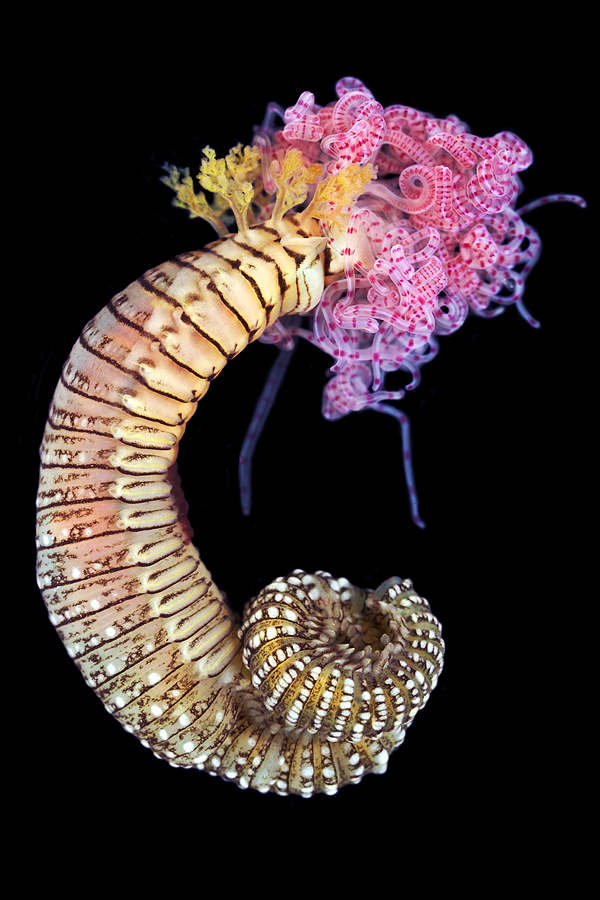
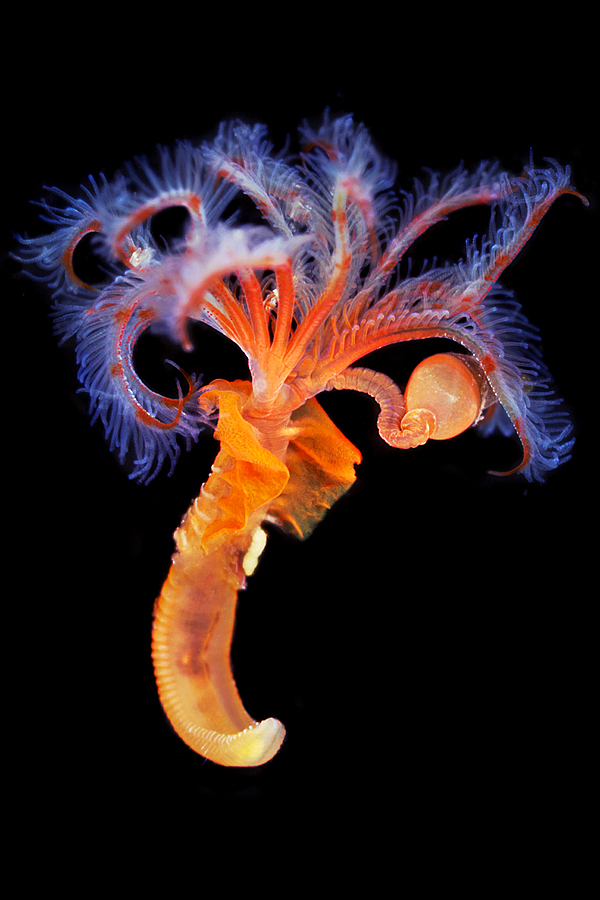
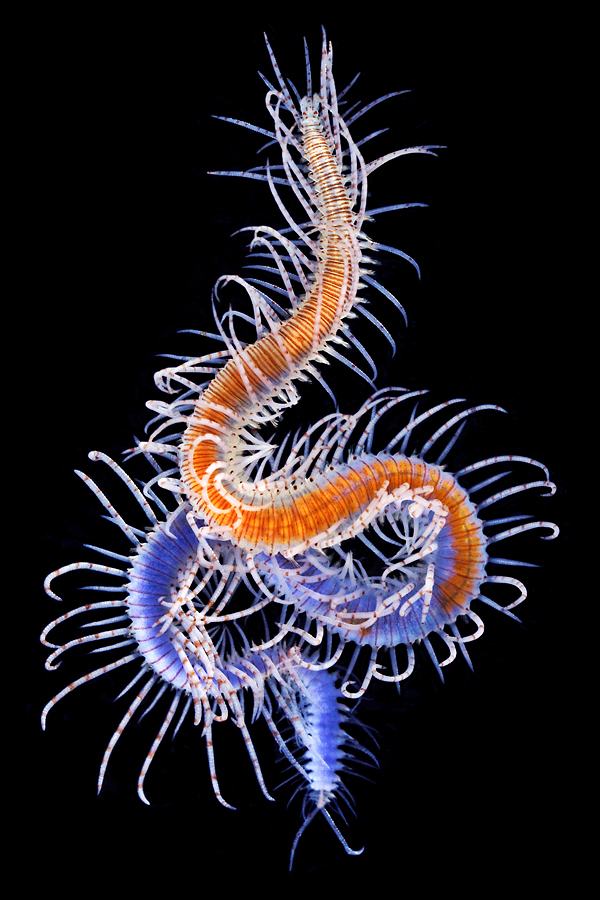
There are still estimated to be about 30,000,000 (thirty million!) different species of organisms still living on Earth. There are estimated to be more than 400,000 species of plants, alone. Do you like bugs? There are more than 1,000,000 species of insects (yes, that’s one million). There are 30,000 different subspecies of spiders! Not to mention the 30,000 species of beetles, 20,000 species of moths and 20,000 species of ants, bees and wasps. Researchers have estimated that for every human being there are one billion insects on Earth!

There are more than 9,000 species of birds, 4,000 species of mammals (1,700 are rodents), 10,000 species of roundworms, 4,000 species of amphibians, 21,000 species of bony fish and 6,000 species of reptiles. Don’t even think about the nearly unfathomable variety of invertebrate life in the oceans. Scientists will be working for a very long time to identify everything that lives in the waters of the world.

That’s just life in the macrocosm of Earth; i.e., just those life forms that we can see easily with the naked eye. How does this apply to the microcosm of relatively invisible animals?

There are 4,000 known species of bacteria. On the average human body, about 600 million bacteria live on the skin. The skin under your arms carries close to 500,000 bacteria and your forearm is a thriving metropolis that is home to over 12,000 bacteria per square inch! The bacteria population INSIDE your body is too numerous to count.

Then there are all the species of protozoa, algae, fungi and bacteria that eat carbon dioxide and hydrogen and produce methane as a byproduct.

In addition to the vast number of species, consider the fact that each individual cell in any complex organism is, in fact, a separate, distinct life entity. There are about 75 trillion cells in the average human body. The size of a single cell varies from the thickness of a few thousand atoms, to the largest single cell (an ostrich egg), measuring about 20 inches in diameter.

The sheer volume and diversity of life forms would seem to defy the probability of any coincidental, circumstantial, accidental or spontaneous development of the unthinkably vast, complex, intricately coordinated, precisely structured, cooperatively balanced, and yet, ingeniously bizarre, incongruously grotesque and downright peculiar variety of life on Earth. (Remember, we aren’t even counting the 99 percent of life forms that USED to live on the planet, which are now extinct!)

In the 150 years since Darwin and others have re-proposed the Theory of Evolution, no one has ever demonstrated it to be true. Not a single one of any of this immense number of species have ever successfully interbred and created a fertile reproductive combination of two different species.

The point is this: Darwin’s theory does not provide us with a workable solution. The missing pieces of the puzzle are still missing, namely: where did man and the other life forms on this planet come from?”

~ excerpt from THE OZ FACTORS by Lawrence R. Spencer

TRIP TO THE MOON IN 1902

Republished by Blog Post Promoter

French ambient electronica band Air impart a cosmic touch to the newly restored color edition of George Méliès’ iconic 1902 film Le Voyage dans la Lune (A Trip to the Moon). Technically innovative at the time, Méliès’ masterpiece pioneered the use of trompe l’oeil objects, papier-mâché props and double-exposure to tell the first science fiction tale in cinema. The story sees astronomer Professeur Barbenfouillis, played by Méliès, fire himself and six colleagues to the moon, explore caverns beneath the surface and escape from the indigenous insectoid Selenites. The color reel, hand-painted by Méliès, was discovered in 1993 by the Spanish film archive La Filmoteca de Catalunya and took almost two decades to restore.

The 1% = The Interconnected Companies That Rule The World

Republished by Blog Post Promoter

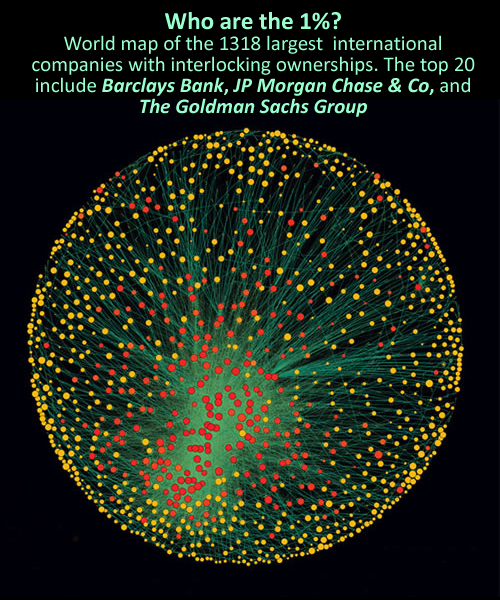
Say hello to the 1,318 highly interconnected transnational companies (with a core of 147 “super-entities”) that rule the world, as visualized by scientists at the Swiss Federal Insitute of Technology:

From Orbis 2007, a database listing 37 million companies and investors worldwide, they pulled out all 43,060 TNCs and the share ownerships linking them. Then they constructed a model of which companies controlled others through shareholding networks, coupled with each company’s operating revenues, to map the structure of economic power.

The work, to be published in PloS One, revealed a core of 1318 companies with interlocking ownerships (see image). Each of the 1318 had ties to two or more other companies, and on average they were connected to 20. What’s more, although they represented 20 per cent of global operating revenues, the 1318 appeared to collectively own through their shares the majority of the world’s large blue chip and manufacturing firms – the “real” economy – representing a further 60 per cent of global revenues.

When the team further untangled the web of ownership, it found much of it tracked back to a “super-entity” of 147 even more tightly knit companies – all of their ownership was held by other members of the super-entity – that controlled 40 per cent of the total wealth in the network. “In effect, less than 1 per cent of the companies were able to control 40 per cent of the entire network,” says Glattfelder. Most were financial institutions. The top 20 included Barclays Bank, JPMorgan Chase & Co, and The Goldman Sachs Group.

The top 50 of the 147 superconnected companies

1. Barclays plc
2. Capital Group Companies Inc
3. FMR Corporation
4. AXA
5. State Street Corporation
6. JP Morgan Chase & Co
7. Legal & General Group plc
8. Vanguard Group Inc
9. UBS AG
10. Merrill Lynch & Co Inc
11. Wellington Management Co LLP
12. Deutsche Bank AG
13. Franklin Resources Inc
14. Credit Suisse Group
15. Walton Enterprises LLC
16. Bank of New York Mellon Corp
17. Natixis
18. Goldman Sachs Group Inc
19. T Rowe Price Group Inc
20. Legg Mason Inc
21. Morgan Stanley
22. Mitsubishi UFJ Financial Group Inc
23. Northern Trust Corporation
24. Société Générale
25. Bank of America Corporation
26. Lloyds TSB Group plc
27. Invesco plc
28. Allianz SE 29. TIAA
30. Old Mutual Public Limited Company
31. Aviva plc
32. Schroders plc
33. Dodge & Cox
34. Lehman Brothers Holdings Inc*
35. Sun Life Financial Inc
36. Standard Life plc
37. CNCE
38. Nomura Holdings Inc
39. The Depository Trust Company
40. Massachusetts Mutual Life Insurance
41. ING Groep NV
42. Brandes Investment Partners LP
43. Unicredito Italiano SPA
44. Deposit Insurance Corporation of Japan
45. Vereniging Aegon
46. BNP Paribas
47. Affiliated Managers Group Inc
48. Resona Holdings Inc
49. Capital Group International Inc
50. China Petrochemical Group Company

—Read the entire  Article:

Revealed – the capitalist network that runs the world, 19 October 2011 by Andy Coghlan and Debora MacKenzie  

(Thanks to Neatorama for sharing the link to this article)