Tag Archives: gods

SHADOWS

Republished by Blog Post Promoter
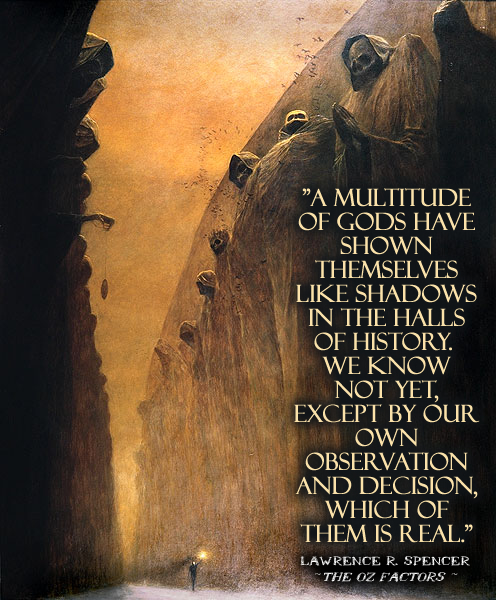
god shadow

“The history of mankind seems blanketed in a simultaneous state of amnesia and deja vu. The ruins of ancient civilizations whisper a reminder that we have forgotten everything we knew.

A multitude of gods have shown themselves like shadows in the halls of history. We know not yet, except by our own observation and decision, which of them is real. We are betrayed by those who teach us that we must trust the Wizards of the West. While pretentious politicians defend the castles of the Witch, the media monkeys swarm to spin perverted lies to cover up their covert tricks.

The voiceless bones of wonderful wizards have dissolved to mortal dust once more. Their words have vanished in the smoke of sacred libraries, searing our souls with the stupefying stench of wisdom lost forever in their flames. From day to day the timeworn treadmill of survival forces us to worship at the soulless bankers’ shrine. Gold is still the god of the great and powerful Oz.
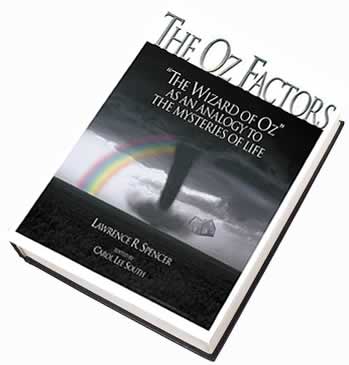
The Oz Factors, by Lawrence R. SpencerWe have crash-landed in a twisted alien landscape of pain and mortality, far away from our home Universe. As a race we have amnesia. We are repeatedly bumped on the head by the recurring cataclysmic upheavals of a planet whirling in space like a farmhouse in a tornado.

The future is an extension of the present. We must live our lives in the present in a manner which will create the greatest good for the greatest number of beings in the future. If we are aware of our own past lives, we must also be aware that we are creating our own future by our present actions. We will inherit our own legacy.

As Professor Marvel points out with simple eloquence, “There are no other wizards…”

We are apparently the only wizards there ever were and the only wizards that ever will be. We are each a part of a time track of the past, present and future of our own creation, individually and collectively.

If we let the Wicked Witches run the culture now, they will be in charge of the place when we come back. Just as we are the descendants of past generations, you and I may very well become, through reincarnation, the children of our children–we are the future generations who will inherit the environmental and cultural conditions of the future which we ourselvesSupport independent publishing: Buy this book on Lulu. are creating today.”

excerpt from THE OZ FACTORS, by Lawrence R. Spencer

(painting by Zdzislaw Beksinski IV.  Visit his official website here:  http://www.beksinski.pl/ )
FEY: SPIRITS OF THE AIR

Republished by Blog Post Promoter


Faery Land

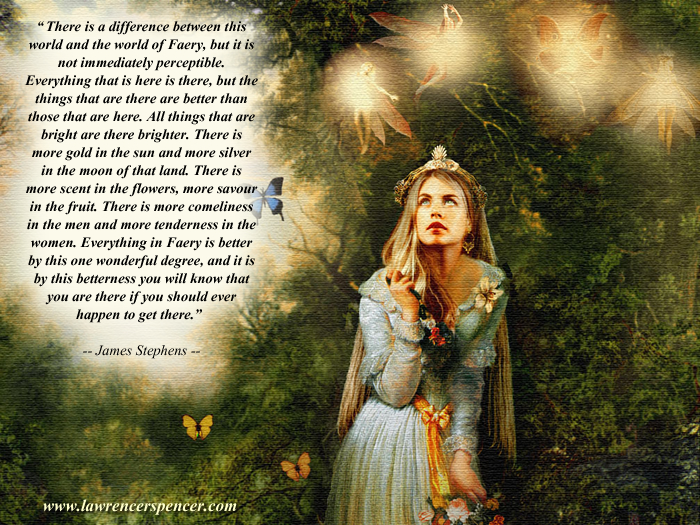
“There is a difference between this world and the world of Faery, but it is not immediately perceptible. Everything that is here is there, but the things that are there are better than those that are here. All things that are bright are there brighter. There is more gold in the sun and more silver in the moon of that land. There is more scent in the flowers, more savour in the fruit. There is more comeliness in the men and more tenderness in the women. Everything in Faery is better by this one wonderful degree, and it is by this betterness you will know that you are there if you should ever happen to get there.”
― James Stephens, Irish Fairy Tales

The word fairy derives from the term fae of medieval Western European (Old French, from Latin fata: Fate) folklore and romance, one famous example being Morgan le Fay (‘Morgan of the Fae’). “Fae-ery” was therefore everything that appertains to the “fae”, and so the land of “fae”, all the “fae”. Finally the word replaced its original and one could speak of “a faery or fairy”, though the word fey is still used as an adjective or to refer to the word fairy as a plural.

In alchemy in particular they were regarded as elementals, such as gnomes and sylphs, as described by Paracelsus. This is uncommon in folklore, but accounts describing the fairies as “spirits of the air” have been found popularly.  Many of the Irish tales of the Tuatha Dé Danann refer to these beings as fairies, though in more ancient times they were regarded as Goddesses and Gods.

When considered as beings that a person might actually encounter, fairies were noted for their mischief and malice. Some pranks ascribed to them, such as tangling the hair of sleepers into “Elf-locks”, stealing small items or leading a traveler astray, are generally harmless. But far more dangerous behaviors were also attributed to fairies. Any form of sudden death might stem from a fairy kidnapping, with the apparent corpse being a wooden stand-in with the appearance of the kidnapped person.

Fairies can be observed when the “third eye” is activated.


RESPONSIBILITY OF GODS

Republished by Blog Post Promoter

RESPONSIBILITY

ALIEN INTERVIEW AUDIOBOOK

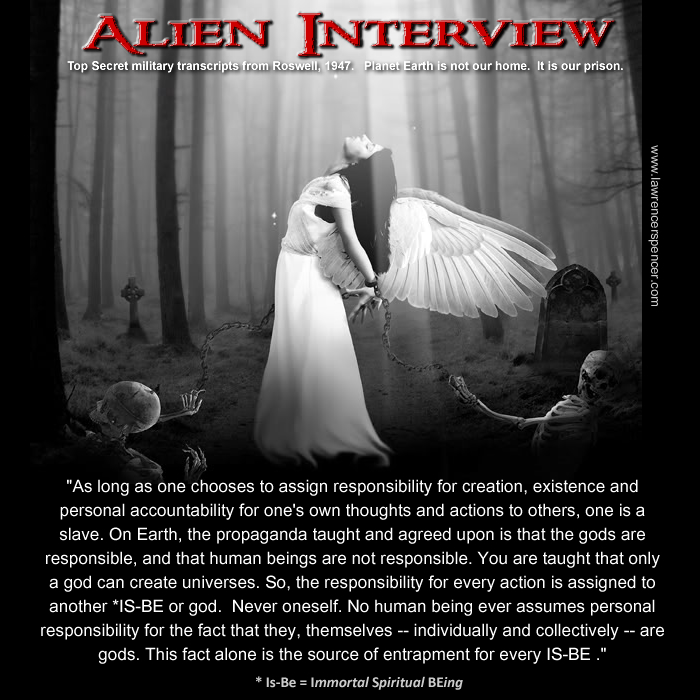
“As long as one chooses to assign responsibility for creation, existence and personal accountability for one’s own thoughts and actions to others, one is a slave. On Earth, the propaganda taught and agreed upon is that the gods are responsible, and that human beings are not responsible. You are taught that only a god can create universes. So, the responsibility for every action is assigned to another *IS-BE or god. Never oneself. No human being ever assumes personal responsibility for the fact that they, themselves — individually and collectively — are gods. This fact alone is the source of entrapment for every IS-BE.” ~ Alien Interview

 *Immortal Spiritual BEing

WHO ARE THE REAL VAMPIRES?

Republished by Blog Post Promoter

A Vampire is an Immortal Spiritual Being.  He or she cannot die.  Yet, they cannot inhabit a living human body either.  They are conceived to be dependent on beings who inhabit living bodies.  Vampires worship and covet  human bodies.  Their depraved state of being includes the notion that “only beings who have a body can have a real life”.  The idea that a disembodied spirit needs to drink the blood of a living human in order to have energy and longevity is part of the mythology about Spiritual Beings invented by priests attempting to frighten people away from disembodied spirits! PRIESTS do not want people to communicate with spirits!  If you communicated with spirits directly, like gods and ghosts, priests would lose their power, wealth and control over you!

Of course, an Immortal Spirit is Immortal with or without a body.  Learn more about how to live without a body in my book:  1,001 Things To Do While You’re Dead.

  Support independent publishing: Buy this book on Lulu.


READ MORE ABOUT VAMPIRES ON WIKIPEDIA.ORG:

Tales of supernatural beings consuming the blood or flesh of the living have been found in nearly every culture around the world for many centuries. Today, we would associate these entities with vampires, but in ancient times, the term vampire did not exist; blood drinking and similar activities were attributed to demons or spirits who would eat flesh and drink blood; even the Devil was considered synonymous with the vampire. Almost every nation has associated blood drinking with some kind of revenant or demon, or in some cases a deity.

Ancient Greek and Roman mythology described the Empusae, the Lamia,and the Striges. Over time the first two terms became general words to describe witches and demons respectively. They were described as having the bodies of crows or birds in general, and were later incorporated into Roman mythology as strix, a kind of nocturnal bird that fed on human flesh and blood.

Vampires are mythological or folkloric beings who subsist by feeding on the life essence (generally in the form of blood) of living creatures, regardless of whether they are undead or a living person/being.Although vampiric entities have been recorded in many cultures, and may go back to “prehistoric times”,the term vampire was not popularized until the early 18th century, after an influx of vampire superstition into Western Europe from areas where vampire legends were frequent, such as the Balkans and Eastern Europe, although local variants were also known by different names, such as vrykolakas in Greece and strigoi in Romania. This increased level of vampire superstition in Europe led to mass hysteria and in some cases resulted in corpses actually being staked and people being accused of vampirism.

While even folkloric vampires of the Balkans and Eastern Europe had a wide range of appearance ranging from nearly human to bloated rotting corpses, it was interpretation of the vampire by the Christian Church and the success of vampire literature, namely John Polidori‘s 1819 novella The Vampyre that established the archetype of charismatic and sophisticated vampire; it is arguably the most influential vampire work of the early 19th century, inspiring such works as Varney the Vampire and eventually Dracula. The Vampyre was itself based on Lord Byron‘s unfinished story “Fragment of a Novel,  published in 1819.

However, it is Bram Stoker‘s 1897 novel Dracula that is remembered as the quintessential vampire novel and which provided the basis of modern vampire fiction. Dracula drew on earlier mythologies of werewolves and similar legendary demons and “was to voice the anxieties of an age”, and the “fears of late Victorian patriarchy“.The success of this book spawned a distinctive vampire genre, still popular in the 21st century, with books, films, video games, and television shows.