Tag Archives: spirits

PROOF OF SPIRITS

Republished by Blog Post Promoter

PROOF WITHIN

In spite of vast numbers of “ghost sightings”, innumerable reports of “out-of-body experiences”, and “divine encounters” with gods or spirits, that pervades nearly all of prehistoric and recorded human history, I found only one underlying, unifying, indisputable, axiomatic common denominator that permeates all of this data:

Assuming that subjective reality, or beliefs, of individuals is acceptable evidence, there has been no universally agreed upon “proof” that “spirits” or gods or life-after-death based on physical evidence, circumstantial or subjective data.  There are several deductions I can infer from the lack of physical evidence that such things are real, and, if verified, may lead to a workable solution to many of the “mysteries” of Life, Universes and Other Stuff“:

deduction:
In spite of an enormous collection of subjective, circumstantial “evidence” of spiritual activity on and around Earth, the existence, intentions and the activities of spirits remain hidden and mysterious.

deduction:
Universally agreed upon proof of the existence of spirituality, based on subjective data, physical and circumstantial evidence are subject to conflicting vested interests, which has made such proof unattainable.

Collectively, these deductions beg the obvious question:
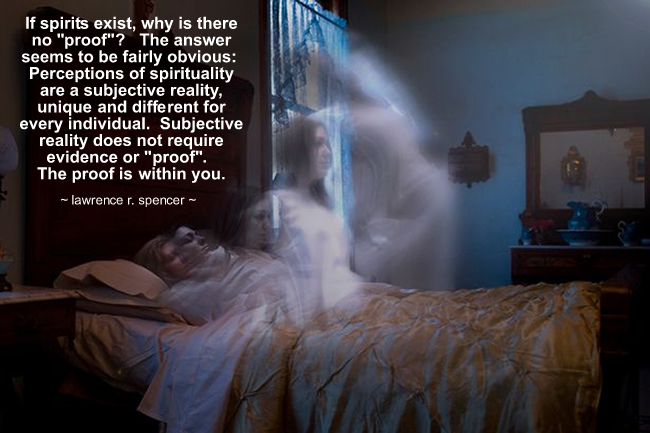
If spirits exist, why is there no “proof”?   The answer seems to be fairly obvious, at least to me:  Perceptions of spirituality are a subjective reality, unique and different for every individual.  Subjective reality does not require evidence or “proof”.  The proof is within you.

~ Lawrence R. Spencer. 2014 ~

FEY: SPIRITS OF THE AIR

Republished by Blog Post Promoter


Faery Land

“There is a difference between this world and the world of Faery, but it is not immediately perceptible. Everything that is here is there, but the things that are there are better than those that are here. All things that are bright are there brighter. There is more gold in the sun and more silver in the moon of that land. There is more scent in the flowers, more savour in the fruit. There is more comeliness in the men and more tenderness in the women. Everything in Faery is better by this one wonderful degree, and it is by this betterness you will know that you are there if you should ever happen to get there.”
― James StephensIrish Fairy Tales

The word fairy derives from the term fae of medieval Western European (Old French, from Latin fata: Fate) folklore and romance, one famous example being Morgan le Fay (‘Morgan of the Fae’). “Fae-ery” was therefore everything that appertains to the “fae”, and so the land of “fae”, all the “fae”. Finally the word replaced its original and one could speak of “a faery or fairy”, though the word fey is still used as an adjective or to refer to the word fairy as a plural.

In alchemy in particular they were regarded as elementals, such as gnomes and sylphs, as described by Paracelsus. This is uncommon in folklore, but accounts describing the fairies as “spirits of the air” have been found popularly.  Many of the Irish tales of the Tuatha Dé Danann refer to these beings as fairies, though in more ancient times they were regarded as Goddesses and Gods.

When considered as beings that a person might actually encounter, fairies were noted for their mischief and malice. Some pranks ascribed to them, such as tangling the hair of sleepers into “Elf-locks”, stealing small items or leading a traveler astray, are generally harmless. But far more dangerous behaviors were also attributed to fairies. Any form of sudden death might stem from a fairy kidnapping, with the apparent corpse being a wooden stand-in with the appearance of the kidnapped person.

Fairies can be observed when the “third eye” is activated.


STEAM PUNK FAERIE

Republished by Blog Post Promoter

STEAMPUNK

Steampunk is a genre which came into prominence during the 1980s and early 1990s and incorporates elements of science fiction, fantasy, alternate history, horror, and speculative fiction. It involves a setting where steam power is widely used—whether in an alternate history such as Victorian era Britain or “Wild West”-era United States, or in a post-apocalyptic time —that incorporates elements of either science fiction or fantasy. Works of steampunk often feature anachronistic technology, or futuristic innovations as Victorians might have envisioned them, based on a Victorian perspective on fashion, culture, architectural style, and art. This technology includes such fictional machines as those found in the works of H. G. Wells and Jules Verne, or the contemporary authors Philip Pullman, Scott Westerfeld and China Mieville.

Other examples of steampunk contain alternative history-style presentations of such technology as lighter-than-air airships, analog computers, or such digital mechanical computers as Charles Babbage and Ada Lovelace’sAnalytical Engine.

Steampunk also refers to art, fashion, and design that are informed by the aesthetics of Steampunk literature. Various modern utilitarian objects have been modded by individual artisans into a pseudo-Victorian mechanical “steampunk” style, and a number of visual and musical artists have been described as steampunk.  Steampunk is most directly influenced by, and often adopts the style of, the 19th century scientific romances of Jules Verne, H.G. Wells, and Mary Shelley.

FAERIE

The word fairy derives from Middle English faierie (also fayeryefeiriefairie), a direct borrowing from Old French faerie (Modern French féerie) meaning the land, realm, or characteristic activity (i.e. enchantment) of the legendary people of folklore and romance called (in Old French) faie or fee (Modern French fée). This derived ultimately from Late Latin fata (one of the personified Fates, hence a guardian or tutelary spirit, hence a spirit in general); cf. Italian fata, Portuguese fada, Spanish hada of the same origin.

Fata, although it became a feminine noun in the Romance languages, was originally the neuter plural (“the Fates”) of fatum, past participle of the verb fari to speak, hence “thing spoken, decision, decree” or “prophetic declaration, prediction”, hence “destiny, fate”. It was used as the equivalent of the Greek Μοῖραι Moirai, the personified Fates who determined the course and ending of human life.

To the word faie was added the suffix -erie (Modern English -(e)ry), used to express either a place where something is found (fishery, heronry, nunnery) or a trade or typical activity engaged in by a person (cookery, midwifery, thievery). In later usage it generally applied to any kind of quality or activity associated with a particular sort of person, as in English knavery, roguery, witchery, wizardry.

Faie became Modern English fay “a fairy”; the word is, however, rarely used, although it is well known as part of the name of the legendary sorceress Morgan le Fay of Arthurian legend. Faierie became fairy, but with that spelling now almost exclusively referring to one of the legendary people, with the same meaning as fay. In the sense “land where fairies dwell”, the distinctive and archaic spellings Faery and Faerie are often used. Faery is also used in the sense of “a fairy”, and the back-formation fae, as an equivalent or substitute for fay is now sometimes seen.

The word fey, originally meaning “fated to die” or “having forebodings of death” (hence “visionary”, “mad”, and various other derived meanings) is completely unrelated, being from Old English fæge, Proto-Germanic *faigja- and Proto-Indo-European *poikyo-, whereas Latin fata comes from the Indo-European root *bhã- “speak”. Due to the identical pronunciation of the two words, “fay” is sometimes misspelled “fey”.

Fairies are generally described as human in appearance and having magical powers. Their origins are less clear in the folklore, being variously dead, or some form of demon, or a species completely independent of humans or angels.[3] Folklorists have suggested that their actual origin lies in a conquered race living in hiding,[4] or in religious beliefs that lost currency with the advent of Christianity. These explanations are not necessarily incompatible, and they may be traceable to multiple sources.

Much of the folklore about fairies revolves around protection from their malice, by such means as cold iron (iron is like poison to fairies, and they will not go near it) or charms of rowan and herbs, or avoiding offense by shunning locations known to be theirs.[6] In particular, folklore describes how to prevent the fairies from stealing babies and substituting changelings, and abducting older people as well. Many folktales are told of fairies, and they appear as characters in stories from medieval tales of chivalry, to Victorian fairy tales, and up to the present day in modern literature.  ( Reference:  Wikipedia.org)