Category Archives: UNIVERSES

Universes are comprised of thoughts, ideas, dreams, illusions, delusions, which may also include stars, space, time, energy and objects. Or not. These are the universes of the author Lawrence R. Spencer, and others for whom he has an affinity.

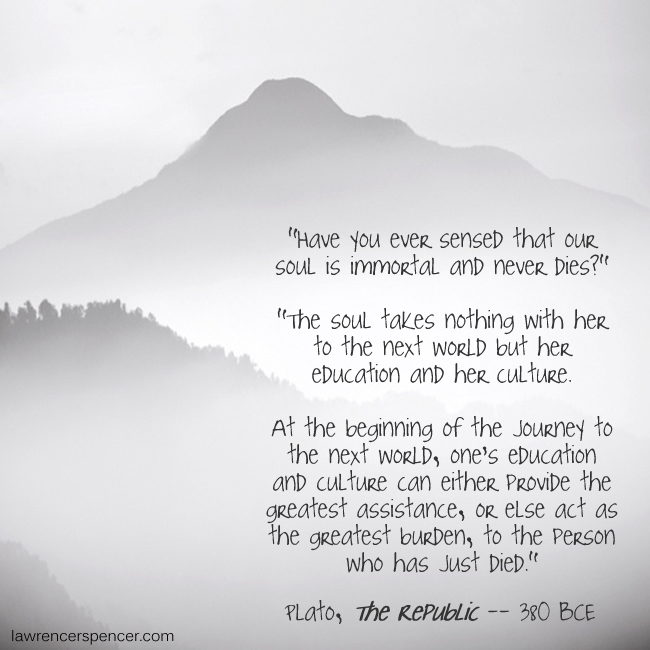
THE NEXT WORLD

Republished by Blog Post Promoter
PLATO — 348/347 BC) was a Classical Greek philosopher, mathematician, student of Socrates, writer of philosophical dialogues, and founder of the Academy in Athens, the first institution of higher learning in the Western world. Along with his mentor, Socrates, and his student, Aristotle, Plato helped to lay the foundations of Western philosophy and science.[3] In the words of A. N. Whitehead:

“The safest general characterization of the European philosophical tradition is that it consists of a series of footnotes to Plato. I do not mean the systematic scheme of thought which scholars have doubtfully extracted from his writings. I allude to the wealth of general ideas scattered through them.“

Plato’s sophistication as a writer is evident in his Socratic dialogues; thirty-six dialogues and thirteen letters have been ascribed to him. Plato’s writings have been published in several fashions; this has led to several conventions regarding the naming and referencing of Plato’s texts.[5] Plato’s dialogues have been used to teach a range of subjects, including philosophy, logic, ethics, rhetoric, and mathematics. Plato is one of the most important founding figures in Western philosophy. — Wikipedia.org


THE MILKY WAY GALAXY

Republished by Blog Post Promoter

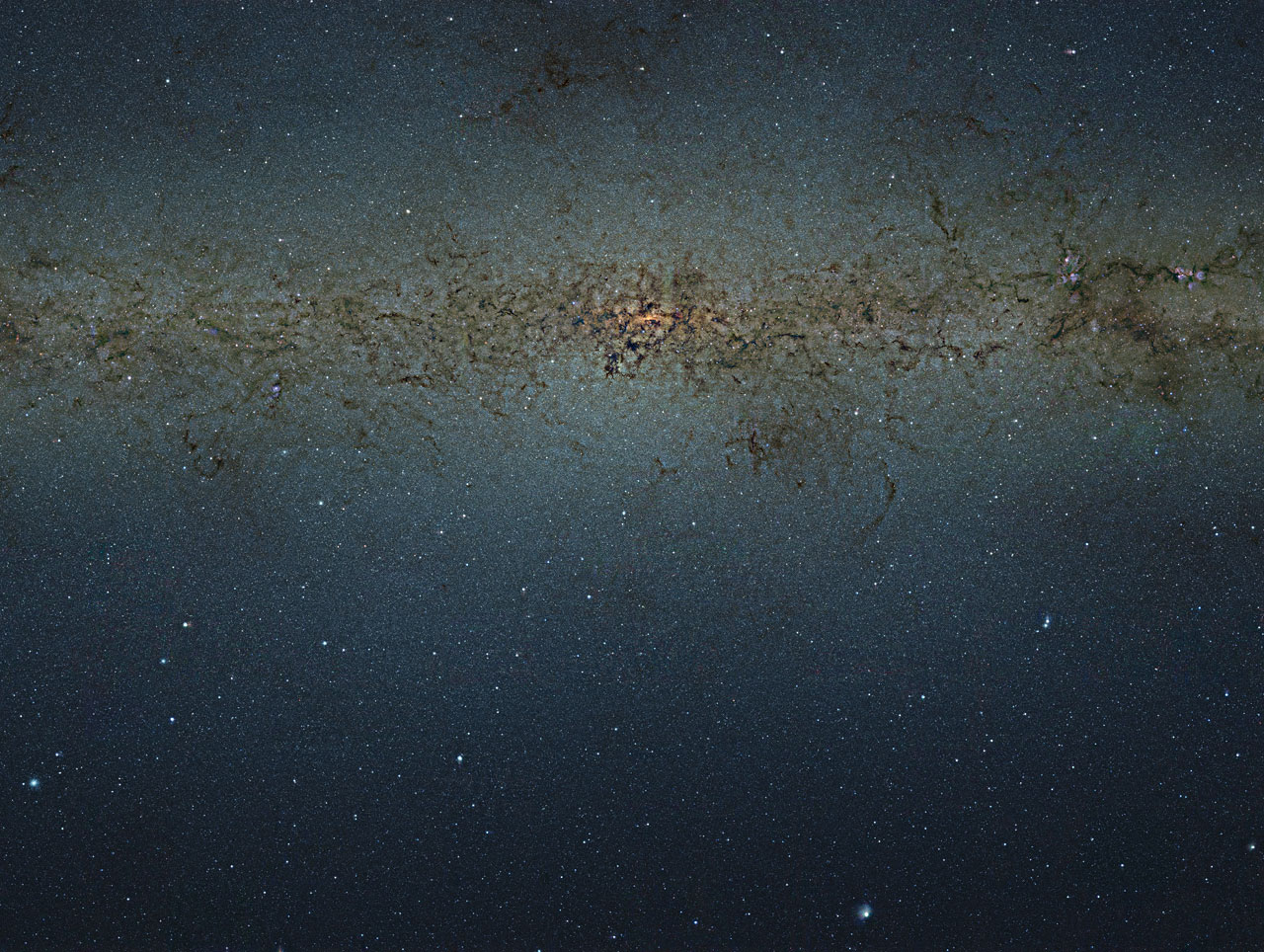
Here’s a photo of the Milky Way Galaxy.  If you look carefully, you may be able to locate the star you came from before being dumped on Earth.  Or, perhaps you didn’t come from the Milky Way Galaxy?  If you came to Earth from another galaxy, or universe, you’ll have to find your own photo.  Good Luck!

CLICK THE IMAGE TO ZOOM IN


This  striking view of the central parts of the Milky Way was obtained with  the VISTA survey telescope at ESO’s Paranal Observatory in Chile. This  huge picture is 108 500 by 81 500 pixels and contains nearly nine billion  pixels. It was created by combining thousands of individual images from  VISTA, taken through three different infrared filters, into a single  monumental mosaic. These data form part of the VVV public survey and  have been used to study a much larger number of individual stars in the  central parts of the Milky Way than ever before. Because VISTA has a  camera sensitive to infrared light it can see through much of the dust  blocking the view for optical telescopes, although many more opaque dust  filaments still show up well in this picture. This image is too large to be easily displayed at full resolution and is best appreciated using the zoom tool.