Republished by Blog Post Promoter
“ILLUSION IS THE FIRST OF ALL PLEASURES.”
— Oscar Wilde —
( Painting “Innerworld”, by Michael Parkes )

Books I read & recommend
Republished by Blog Post Promoter
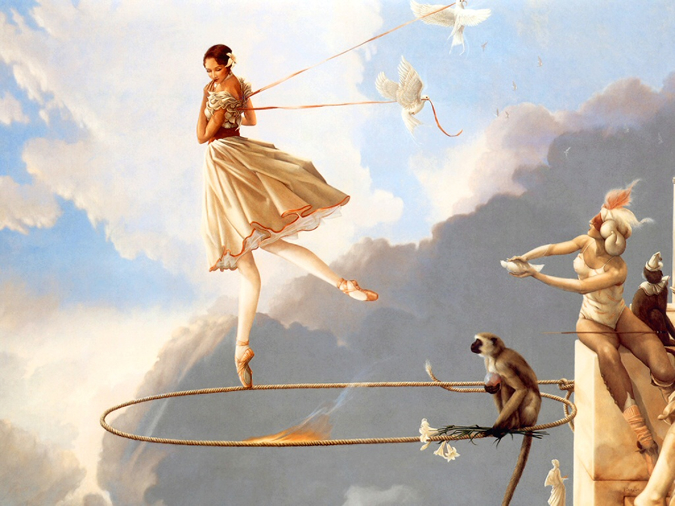
( Painting “Innerworld”, by Michael Parkes )
Republished by Blog Post Promoter
 “Much like Leonardo da Vinci, I worked intermittently on this single painting over a period of many years, never satisfied that it was finished, and continually improving upon the original. This painting is my personal Mona Lisa, my daughter, Maria.
 We had a live-in servant for many years, named Tanneke Everpoel, hired and paid by Maria Thins. She did all of the “heavy labor”, as it were: cooking, cleaning, washing clothes, carrying water, tending fires, and a myriad other chores, including helping with the children. However, the expense of paying her wage and room did not include standing for endless hours, day after day, while I painted this portrait! My daughter, Maria, was lovelier and much more readily accessible for the task of standing for this portrait.
It is argued, convincingly, that the immortal painting by Leonard was his own self-portrait as his own, feminine reflection. What man, or woman, regardless of sexual preference in a given lifetime, has not inhabited the flesh of ten thousand bodies, some human, many not, through a nearly infinite cascade of galaxies, stars and planets come and gone. Is not survival a nearly infinite game, in which we interchange ourselves as the players of many parts?
Leonardo kept his portrait with him all his life. He never considered that it was complete or perfect. Nor did he ever intend to sell it. How could one sell a most cherished reflection of himself? It is more meaningful than one’s own body, which only disguises the inner self, the essence of spirit that animates the fragile flesh. In fact, a body hides the reflection of the soul! How can any substance, especially that as rude and fragile as meat, reveal the inherent qualities an immortal nothingness? Indeed, it is the fundamental challenge and the most formidable task of an artist to reveal it!
The name given to this painting by others, “The Milkmaid”, is a sacrilege! It rivals the incomprehension others have for Leonardo’s personal masterpiece. Yet, how can anyone truly understand that a painting is meant to reflect the essence of an immortal being, seen through the eyes of another?
She is painted with angelic colors: blue, gold and white, in contrast to the menial nature of her station in life. From her issues, for me, the Milk and Bread of Life. Life is embodied in her and through her. Women, are the source of children, the source of energy, the source of care. There is no more vital responsibility for any being who plays the game of life, than to confront dreary daily tasks. To humbly make the daily loaf. To soak that bread, mix and soften it with milk, make it warm and feed it to a teething child. Survival is made of such things.
In those days I viewed life as idyllic. My dreams were more real than reality. All things were a possibility. Tragedy could not find me. Until it did, of course. Even when we lost a child, which we did with several, my wife, Catharina, remained resolute in her Faith. God guided us. He did what was best. We knew not why and need not question His purpose for us.
I have no such faith in predetermination. A loaf of grain, clean water and a bed was my fare. Time and a place to paint, uninterrupted, were necessities. My love, shared with wife and family, was the staple diet of my life. I assumed, as a Fool who knows not his own mortality, that they would endure, even when I was gone.”
_______________________________________
Excerpt from the book VERMEER: PORTRAITS OF A LIFETIME, by Lawrence R. Spencer
DOWNLOAD THIS BOOK FROM
http://itunes.apple.com/us/book/vermeer/id443800993?mt=11

Republished by Blog Post Promoter
Human beings can perceive less than 1% of the entire electromagnetic spectrum of energy in the physical universe. This makes us virtually “blind”, compared to the amount of information surrounding us in our environment. Now, technology is being perfected to enable human beings to perceive many parts of the electromagnetic spectrum using biotechnology. This lecture by David Eagleman demonstrates how humans physical sense perceptions can be enhanced to expand our “reality”!
Republished by Blog Post Promoter

Republished by Blog Post Promoter
“…there are millions of species [i] (Footnote) of insects. About 350,000 of these are species of beetles. [ii] (Footnote) There may be as many as 100 million species of life forms on Earth at any given time. In addition, there are many times more extinct species of life on Earth than there are living life forms. Some of these will be rediscovered in the fossil or geological records of Earth.
The current “theory of evolution” of life forms on Earth does not consider the phenomena of biological diversity. Evolution by natural selection is science fiction. One species does not accidentally, or randomly evolve to become another species, as the Earth textbooks indicate, without manipulation of genetic material by an IS-BE. [iii] (Footnote)
 A simple example of IS-BE intervention is the selective breeding of a species [iv] (Footnote) on Earth. Within the past few hundred years several hundred dog breeds and hundreds of varieties of pigeons and dozens of Koi fish have been “evolved” in just a few years, beginning with only one original breed. Without active intervention by IS-BEs, biological organisms rarely change.
The development of an animal like the ‘duck-billed platypus’ required a lot of very clever engineering to combine the body of a beaver with the bill of a duck and make a mammal that lays eggs. Undoubtedly, some wealthy client placed a “special order” for it as a gift or curious amusement. I am sure the laboratory of some biotechnical company worked on it for years to make it a self-replicating life form!
The notion that the creation of any life form could have resulted from a coincidental chemical interaction moldering up from some primordial ooze is beyond absurdity! Factually, some organisms on Earth, such as Proteobacteria, [v] (Footnote) are modifications of a Phylum [vi] (Footnote) designed primarily for “Star Type 3, Class C” planets. In other words, The Domain designation for a planet with an anaerobic atmosphere nearest a large, intensely hot blue star, [vii] (Footnote) such as those in the constellation of Orion’s Belt in this galaxy.
Creating life forms is very complex, highly technical work for IS-BEs who specialize in this field. Genetic anomalies are very baffling to Earth biologists who have had their memory erased. Unfortunately, the false memory implantations of the “Old Empire” prevent Earth scientists from observing obvious anomalies.”
–Excerpted from the book ALIEN INTERVIEW
[i] “…species…”
“In biology, a species is one of the basic units of biological classification and a taxonomic rank. A species is often defined as a group of organisms capable of interbreeding and producing fertile offspring. While in many cases this definition is adequate, more precise or differing measures are often used, such as based on similarity of DNA or morphology. Presence of specific locally-adapted traits may further subdivide species into subspecies.
The commonly used names for plant and animal taxa sometimes correspond to species: for example, “lion,” “walrus,” and “Camphor tree,” each refers to a species. In other cases common names do not: for example, “deer” refers to a family of 34 species, including Eld’s Deer, Red Deer and Wapiti (Elk). The last two species were once considered a single species, illustrating how species boundaries may change with increased scientific knowledge.
Each species is placed within a single genus. This is a hypothesis that the species is more closely related to other species within its genus than to species of other genera. All species are given a binomial name consisting of the generic name and specific name (or specific epithet). For example, Pinus palustris (commonly known as the Longleaf Pine).
A usable definition of the word “species” and reliable methods of identifying particular species are essential for stating and testing biological theories and for measuring biodiversity. Traditionally, multiple examples of a proposed species must be studied for unifying characters before it can be regarded as a species. Extinct species known only from fossils are generally difficult to give precise taxonomic rankings to. A species which has been described scientifically can be referred to by its binomial names.
Nevertheless, as Charles Darwin remarked,
‘I look at the term species as one arbitrarily given for the sake of convenience to a set of individuals closely resembling each other …. it does not essentially differ from the term variety, which is given to less distinct and more fluctuating forms. The term variety, again in comparison with mere individual difference, is also applied arbitrarily, and for mere convenience sake.’
Because of the difficulties with both defining and tallying the total numbers of different species in the world, it is estimated that there are anywhere between 2 million and 100 million different species.” — Reference: Wikipedia.org
[ii] “…species of beetle…”
“Beetles are a group of insects which have the largest number of species. They are placed in the order Coleoptera, which means “sheathed wing” and contains more described species than in any other order in the animal kingdom, constituting about twenty-five percent of all known life-forms. Forty percent of all described insect species are beetles (about 350,000 species), and new species are frequently discovered. Estimates put the total number of species, described and undescribed, at between 5 and 8 million.
Beetles can be found in almost all habitats, but are not known to occur in the sea or in the polar regions. They interact with their ecosystems in several ways. They often feed on plants and fungi, break down animal and plant debris, and eat other invertebrates. Some species are prey of various animals including birds and mammals. Certain species are agricultural pests, such as the Colorado potato beetle Leptinotarsa decemlineata, the boll weevil Anthonomus grandis, the red flour beetle Tribolium castaneum, and the mungbean or cowpea beetle Callosobruchus maculatus, while other species of beetles are important controls of agricultural pests. For example, coccinellidae (“ladybirds” or “ladybugs”) consume aphids, scale insects, thrips, and other plant-sucking insects that damage crops.” –– Reference: Wikipedia.org
[iii] “One species does not evolve to become another species, as the Earth textbooks indicate, without the intervention and manipulation of genetic material by an IS-BE.”
“Genetic engineering, recombinant DNA technology, genetic modification / manipulation (GM) and gene splicing are terms applied to the direct manipulation of an organism’s genes. Genetic engineering is not to be confused with traditional breeding where the organism’s genes are manipulated indirectly. Genetic engineering uses the techniques of molecular cloning and transformation. Genetic engineering endeavors have found some success in improving crop technology, the manufacture of synthetic human insulin through the use of modified bacteria, the manufacture of erythropoietin in Chinese hamster ovary cells, and the production of new types of experimental mice such as the oncomouse (cancer mouse) for research.
Since a protein sequence is specified by a segment of DNA called a gene, novel versions of that protein can be produced by changing the DNA sequence of the gene. The companies that own the modified genome are able to patent it. In the case of basic crops, the companies gain control of foodstuffs, controlling food production on a large scale and reducing agrobidiversity to a few varieties. The only apparent interest in promoting this tecnology appears to be purely economic, despite the claims of seed companies such as Monsanto and Novartis to solve the world food scarcity. It is now popularly understood that it is not the lack of food on a wholewide scale that is the main problem, but its distribution, aggravated by prohibitive tariffs by rich nations. Genetically modified crops do not reduce hunger. The majority of genetically crops are destined for animal food to meet the high demand for meat in developed countries. No genetic modification have yet to serve the needs of mankind despite all the promises in this direction.
However, even with regard to this technology’s great potential, some people have raised concerns about the introduction of genetically engineered plants and animals into the environment and the potential dangers of human consumption of GM foods. They say that these organisms have the potential to spread their modified genes into native populations thereby disrupting natural ecosystems. This has already happened.” — Reference: Wikipedia.org
[iv] “…genetic manipulation of a species…”
“How much genetic variation is there? Historical debate: Classical school held that there was very little genetic variation, most individuals were homozygous for a “wild-type” allele. Rare heterozygous loci due to recurrent mutation; natural selection purges populations of their “load” of mutations. Balance school held that many loci will be heterozygous in natural populations and heterozygotes maintained by “balancing selection” (heterozygote advantage). Selection thus plays a role in maintaining variation.
How do we measure variation? To show that there is a genetic basis to a continuously varying character one can study 1) resemblance among relatives: look at the offspring of individuals from parents in different parts of the distribution; can estimate heritability (more later). 2) artificial selection: pigeons and dogs show that there is variation present; does not tell how much variation.” — Reference: http://biomed.brown.edu/Courses/BIO48/5.Geno.Pheno.HTML
[v] “… Proteobacteria…”
“The Proteobacteria are a major group (phylum) of bacteria. They include a wide variety of pathogens, such as Escherichia, Salmonella, Vibrio, Helicobacter, and many other notable genera. Others are free-living, and include many of the bacteria responsible for nitrogen fixation. The group is defined primarily in terms of ribosomal RNA (rRNA) sequences, and is named for the Greek god Proteus (also the name of a bacterial genus within the Proteobacteria), who could change his shape, because of the great diversity of forms found in this group.
All Proteobacteria are Gram-negative, with an outer membrane mainly composed of lipopolysaccharides. Many move about using flagella, but some are non-motile or rely on bacterial gliding. The last include the myxobacteria, a unique group of bacteria that can aggregate to form multicellular fruiting bodies. There is also a wide variety in the types of metabolism. Most members are facultatively or obligately anaerobic and heterotrophic, but there are numerous exceptions. A variety of genera, which are not closely related to each other, convert energy from light through photosynthesis. These are called purple bacteria, referring to their mostly reddish pigmentation.”
— Reference: Wikipedia.org
[vi] “…Phylum…”
“In biological taxonomy, a ‘phylum’ is a taxonomic rank at the level below Class and above Kingdom. “Phylum” is adopted from the Greek φυλαί phylai, the clan-based voting groups in Greek city-states.” — Reference: Wikipedia.org
[vii] “…intensely hot blue star…”
“Blue stars are very hot and very luminous; in fact, most of their output is in the ultraviolet range. These are the rarest of all main sequence stars, constituting as few as 1 in 3,000,000 in the solar neighborhood. (Blue) stars shine with a power over a million times our Sun’s output. Examples: Zeta Orionis, Zeta Puppis, Lambda Orionis, Delta Orionis”.. — Reference: Wikipedia.org