Category Archives: INSIDE THE BOOK

Inside the book, Vermeer: Portraits of A Lifetime. Analysis of all the paintings of Johannes Vermeer. The book reveals for the first time that the women featured in the paintings of Johannes Vermeer were members of his own family, his daughters, his wife and mother-in-law, Maria Thins.

THE OMNISCIENT and OMNIPOTENT MATRIARCH

Republished by Blog Post Promoter
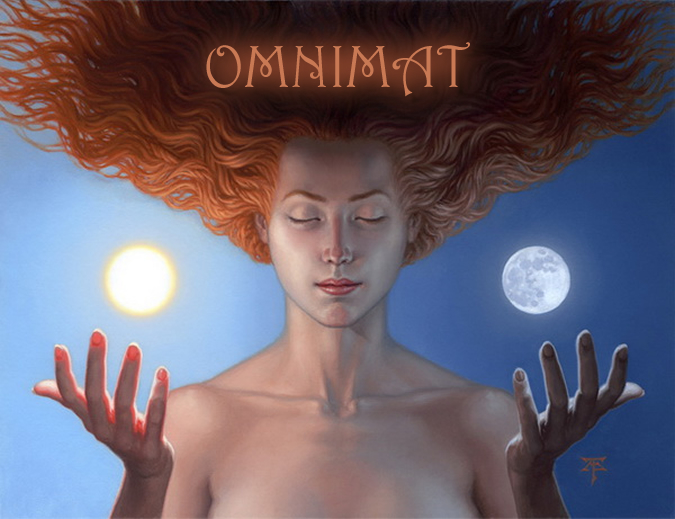
OMNIMAT

” “All-Mother” is a philosophy in which the behavior or conduct of an individual and groups of IS-BEs* is adjudicated based on the logical premise that in order to sustain optimum freedom, order and serenity for all IS-BEs, each IS-BE must serve all IS-BEs.   (*IS-BE = Immortal Spiritual Beings, which includes human beings)

This premise is not intended to eliminate disagreements between IS-BEs, but to mitigate destruction or chaotic behavior between them.

“All-Mother” assures the inherent right of an individual IS-BE to approach, depart from, or not interact, with other IS-BEs while maintaining an optimum serenity.

The purpose of The Domain is to defend the right of an individual or group of IS-BEs to create a universe, or not, at their own discretion.

It has been observed that when responsibility for maintaining organization within the co-created universe shared by all IS-BEs is not defended and preserved, each individual IS-BE is deprived of the freedom assured by the power of a collaborative, creative will and combined power.

The Omniscient and Omnipotent Matriarch (abbrev: Omnimat) is an IS-BE who acts as magistrate of The Domain.

  • Through preeminent power, wisdom and benevolence, Omnimat supervises and enforces the principle of All-Mother within The Domain.
  • Omnimat does not create, destroy or alter universes.
  • Omnimat may, or may not, enforce penalties or restrictions upon IS-BEs when violations of the principle of All-Mother occur within The Domain.
  • The discretion and judgment of Omnimat are inviolate.
  • Omnimat enforces all judgments.

To the degree that IS-BEs of The Domain do not need or desire admiration, and are not compelled to “play” a game at all times, the power, stability and serenity of The Domain remains relatively stable, when compared to the physical universe.

(The physical universe is, by definition, an infinite, icy void cluttered with random sources of savage energy combined with mindless chunks of matter.  The massive and chaotic construction of the physical universe is utterly antipathetic to the spiritual “nothingness” which is the intelligent source of life forms and of universes.)”

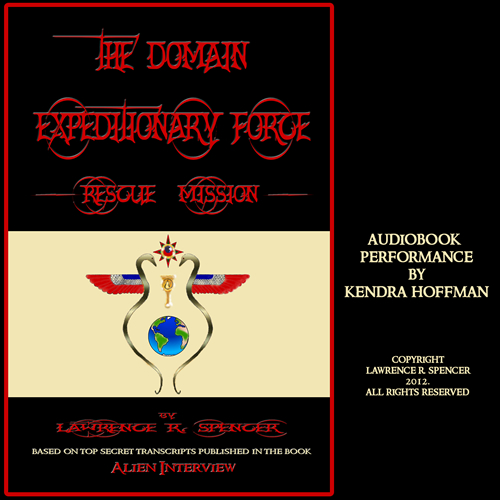
— Excerpt from the book, THE DOMAIN EXPEDITIONARY FORCE RESCUE MISSION, by Lawrence R. Spencer

DEF RESCUE MISSION AUDIOBOOK

LISTEN TO A SAMPLE OF THE NEW AUDIOBOOK

narrated by Kendra Hoffman

Click the LINK ABOVE to go to www.Audible.com and CLICK ON “Sample”

HOW MANY BOOKS HAVE YOU READ?

Republished by Blog Post Promoter

In human experience, written symbols (letters, numbers, musical signs, etc. ) are physical representations of an idea or thought.  Symbols organized into sentences, songs, compositions, formula,  articles or books convey many complex ideas.  These symbols enable communication between people in the physical universe.  Although there a many forms of non-physical communication which we refer to as “emotion” or “telepathy” or “empathy” or “intuition” or “knowing”, the common denominators of human experience or culture is often expressed in books.  When these have been read, understood and compared to other thoughts, we can assume points of view of the various universes we inhabit. When we agree on a our perception of these universes, we call this “reality”.

Which books have helped to shape your reality?  How many books have your read in your life, so far?  How many more books are on your “must read” list?  According to Google, that is busily scanning every book they can get their digitizing hands on, there are about 130 million book titles in the world.  There are more than 2 million NEW book titles published every year (in all languages) . There are approximately 8 billion people in the world.  That is more than 65 book titles per every person in the world.  So, theoretically every person needs to read a minimum of 65 books to reach an “average” level of literacy.  Of course this does not include the avalanche of words available to read that have not been organized into an actual book title, like Twitter and Facebook posting, newspaper and magazine articles and other “non-literature” such as scientific papers, and school textbooks and other propaganda published by governments and corporations.

The largest bookseller on-line is Amazon.com, which has an inventory of only about 1,750,000 titles in English.  That’s only 13 percent of all the book titles  in the world!  This a critically small number of books available to read.  How can one possibly consider themselves to be a literate person?  This does not even include the fact that the majority of books written in the ancient world (prior to 400 AD) were burned by the Christian church!  If you read one book every week 50 for years you would have read only 2,600 books!  According to Google, the average book is 300 pages.  That’s about 75,000 words per book.

As a writer, I am also a reader.  I have often read several books each week during the 50+ years of my reading life, as well as a lot of  printed material, etc.. All together I estimate I’ve read about 4,000 books, so far.  That’s a lot of words — not including the millions of words on the internet — that are not in the form of a book.  Fortunately, there are more than 100,000 book titles available as spoken books — narrated for you by professional actors — on  Audible.com, Librivox.com and sites on the internet.  Now, I can “read” a book with my ears, instead of my  eyes, a fact that I appreciate more and more as I grow older.  I can “read” while I’m walking, driving, jogging, cooking, cleaning, waiting and doing a lot of things that would prevent me from reading with my eyes.  It’s a wonderful age we live in!

So, how do we select the most cherished, life-giving, knowledge-quenching word droplets from the ocean of words?  Having read more than my share of books I can say without any doubt that reading a lot of books does not  make a person “smart”, or “wise”, or “literate”.  However, for me, reading books is usually a more gratifying experience, mentally and spiritually, than watching television or movies or videos.  Books are usually more thoroughly researched, planned, crafted, edited and perfected than other forms of communication.

In this electronic age, when more books are available to us — thanks to digital technology —  than during all of the history of humankind combined, can we expect that humanity would be more well informed and intelligent that ever before?  Books themselves are not wisdom.  If books are not read by people, the knowledge contained in them remains hidden.  They might has well not have been written.

My personal recommendation for your reading or listening book list are the books I’ve written, of course. My view of “reality” is different than most.  My universe is unique, as is yours.  I invite you to share my universe, through my books.

— This blatant self-endorsement is brought to you by Lawrence R. Spencer —

SAY NO TO REINCARNATION

Republished by Blog Post Promoter

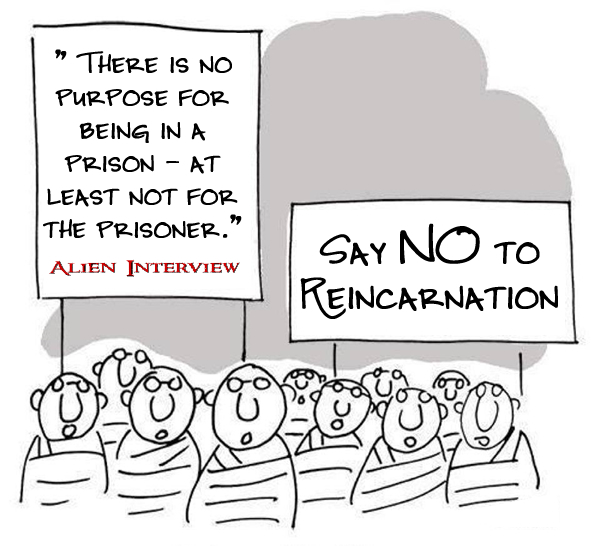
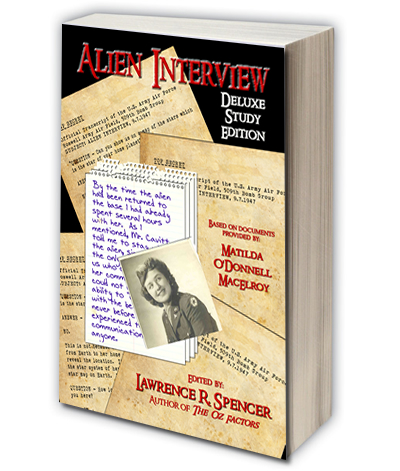
say no to reincarnation“…the “Old Empire” has been using Earth as a “prison planet” for a very long time — exactly how long is unknown — perhaps millions of years. So, when the body of the IS-BE dies they depart from the body. They are detected by the “force screen”, they are captured and “ordered” by hypnotic command to “return to the light”. The idea of “heaven” and the “afterlife” are part of the hypnotic suggestion — a part of the treachery that makes the whole mechanism work.ALIEN INTERVIEW, edited by Lawrence R. Spencer

After the IS-BE has been shocked and hypnotized to erase the memory of the life just lived, the IS-BE is immediately “commanded”, hypnotically, to “report” back to Earth, as though they were on a secret mission, to inhabit a new body. Each IS-BE is told that they have a special purpose for being on Earth. But, of course there is no purpose for being in a prison — at least not for the prisoner.

~ excerpt from Alien Interview

Support independent publishing: Buy this book on Lulu.

EARTH: INMATE UNIFORM

Republished by Blog Post Promoter

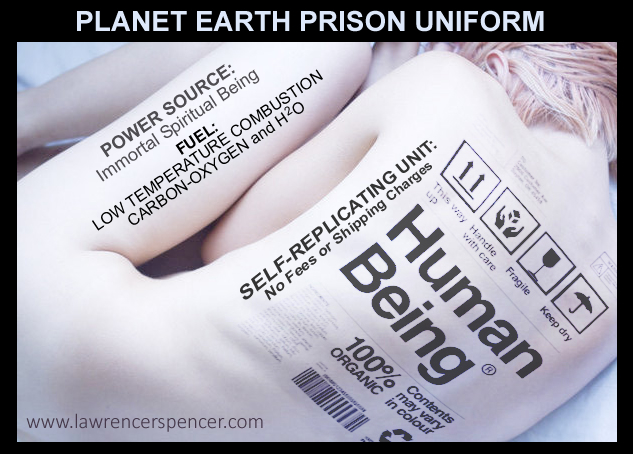
PLANET EARTH PRISON UNIFORM

“Biological bodies are specifically designed and designated as the lowest order of entity in the “Old Empire” caste system. When an IS-BE (Immortal Spiritual BEing) is sent to Earth, and then tricked or coerced into operating in a biological body, they are actually in a prison, inside a prison.”

~ Airl, from the book Alien Interview ~

Support independent publishing: Buy this book on Lulu.

www.alieninterview.org

YOU ARE TOO TIMID IN DRAWING YOUR INFERENCES

Republished by Blog Post Promoter

“I have observed that the lowest and vilest alleys in London do not present a more dreadful record of sin than does the smiling and beautiful countryside”, gentlemen.

“I do not see what you are getting at, Holmes”, said Watson. Mr. Dodgson looked up with equal, but silent, agreement.

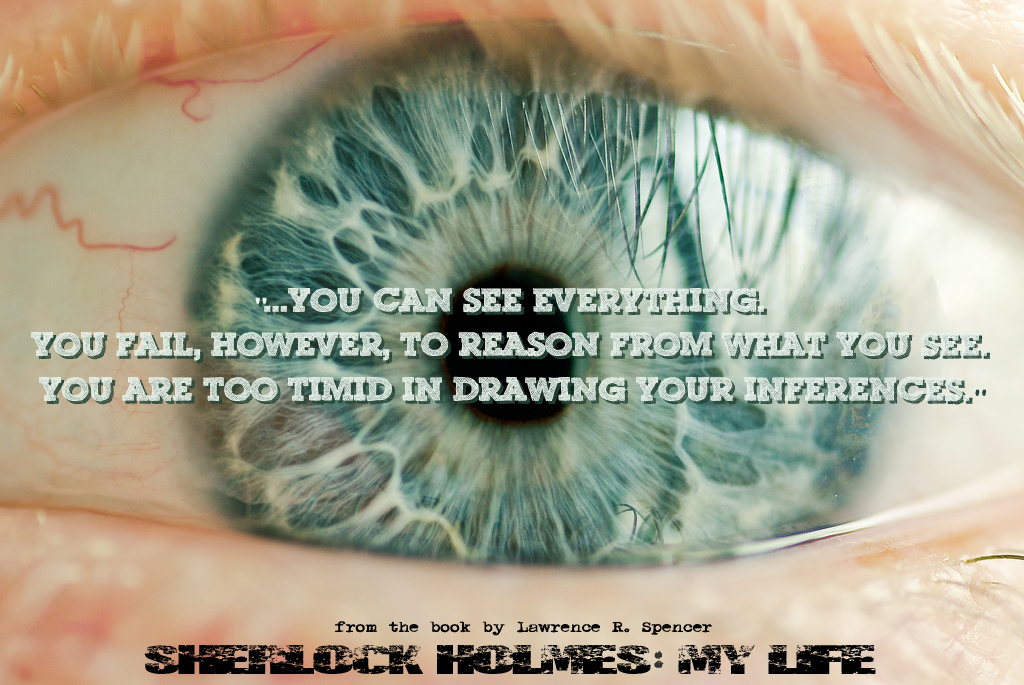
“On the contrary, Watson, you can see everything. You fail, however, to reason from what you see. You are too timid in drawing your inferences”, I said, taking a seat in my armchair, and inviting our guest to take a cigar from the box I offered.

“However, before we digress, let me allude to the discussion that Mr. Dodgson and I had when I visited him in is quarters.  He himself mentioned several methods of investigation which he has studied in the alchemical works of Sir Isaac Newton, and in his own mathematical application of portmanteau poetry to the development of mathematical thinking.

“Circumstantial evidence is a very tricky thing.  It may seem to point very straight to one thing, but if you shift your own point of view a little, you may find it pointing in an equally uncompromising manner to something entirely different”, I said while crossing over to the sideboard.
I picked up the manuscript that Mr. Dodgson had given me when I visited him entitled, Alice’s Golden Hour. While flipping through the pages to find a particular passage, I asked Mr. Dodgson a question about his work.

“Might I inquire as to the origin of one of the fictional characters whom Alice meets in Wonderland — The Cheshire Cat?”

“Frankly, I believe the idea came to me from an old expression I learned as a child”, replied Mr. Dodgson after momentarily pondering the question. “I believe it to be derived from a cheese which was sold in Cheshire, near my home. The cheese was molded in the shape of a cat.  The cheese was cut from the tail end first, so that the last part eaten was the head of the smiling cat”.

Support independent publishing: Buy this book on Lulu.

“Very well”, I said. “Let us then observe that you have extracted something from the reality of your childhood, and with a liberal application of your creative imagination have used it to conjure an illusion…an alternative to reality, as it were. Is this not so, Mr. Dodgson?”

“Well, yes, I suppose. However, I fail to see what relevance my fictional tales have to our current situation. Certainly you do not suppose that I am to believe that reality can be conjured from a work of fiction?  The notion is absurd!”, he replied.

“I do not ask you, or anyone, to believe anything whatsoever. Belief is a matter of personal opinion or conviction which cannot be shared by anyone else, accept to the degree that they share a similar opinion.  Some  men believe that the world was created by an omnipotent, invisible being in seven days. People in some aboriginal tribes believe that the world is supported on the back of an enormous elephant which stands upon the shell of a colossal tortoise”, I said, finally arriving at the pages I was looking for in the manuscript.

“As for myself, I believe that what is true for you is true for you, although no other person may agree upon your belief. Regardless, a truth for you, may not be true for others. Is that not a fundamentally sound assumption?”, I asked.

“I suppose you are right Mr. Holmes. It is difficult, if not impossible, to stay apace of your ability to remain logical in the face of a situation which is so absurdly enigmatic. You are proposing that the philosophical paradigm of reality should be considered of equal importance with fiction. How can you ever solve a criminal case, your occupation, if every piece of hard evidence could be a contrivance of imagination on the part of the investigator or of the criminal?”, said Mr. Dodgson.

“Quite the contrary”, I said. “But rather than keeping to my methods alone, let me ask you what meaning you attribute to the following passage in your book”, I said, turning to the page which described in the encounter between Alice and the Cheshire Cat.

“Let me read your own words to you.”

“…she was a little startled by seeing the Cheshire Cat sitting on a bough of a tree a few yards off.

The Cat only grinned when it saw Alice. It looked good-natured, she

thought: still it had VERY long claws and a great many teeth, so she

felt that it ought to be treated with respect.

‘Cheshire Puss,’ she began, rather timidly, as she did not at all know

whether it would like the name: however, it only grinned a little wider.

‘Come, it’s pleased so far,’ thought Alice, and she went on. ‘Would you

tell me, please, which way I ought to go from here?’
‘That depends a good deal on where you want to get to,’ said the Cat.

‘I don’t much care where–‘ said Alice.

‘Then it doesn’t matter which way you go,’ said the Cat.

‘–so long as I get SOMEWHERE,’ Alice added as an explanation.

‘Oh, you’re sure to do that,’ said the Cat, ‘if you only walk long

enough.’

Alice felt that this could not be denied, so she tried another question.

‘What sort of people live about here?’

‘In THAT direction,’ the Cat said, waving its right paw round, ‘lives

a Hatter: and in THAT direction,’ waving the other paw, ‘lives a March

Hare. Visit either you like: they’re both mad.’

‘But I don’t want to go among mad people,’ Alice remarked.

‘Oh, you can’t help that,’ said the Cat: ‘we’re all mad here. I’m mad.

You’re mad.’

‘How do you know I’m mad?’ said Alice.

‘You must be,’ said the Cat, ‘or you wouldn’t have come here.’

Alice didn’t think that proved it at all; however, she went on ‘And how

do you know that you’re mad?'”

“So, Mr. Dodgson, let me pose the same question to you that young Alice asked of the chimerical cat in your own story: how do you know whether you are mad or not mad? How would you satisfy yourself that I am not mad? How do we know that everyone is mad or not mad?”, I said, rising from my chair to place the manuscript upon the sideboard. “