Republished by Blog Post Promoter

Excerpt from the book MORTALITY MECHANICS MANUAL by Lawrence R. Spencer
( Listen to Five Minute Selection from the Audiobook version )
“The Ouroboros Serpent
A variety of renderings of the Ouroboros Serpent from various cultures, religions and philosophical disciplines are featured as illustrative decoration on many pages of this book. (Mortality Mechanics Manual)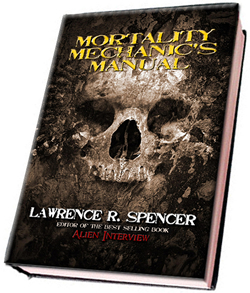
I have included this symbol, as it has been used almost universally on Earth throughout the ages, beginning in the Egyptian period, and possible as early as the Veda which dates back as far as 10,000 years. This symbol has been used to represent a variety of existential interpretations of the spiritual and physical condition of humankind and the universe.
“The Ouroboros is an ancient symbol depicting a serpent or dragon eating its own tail. The name originates from within Greek language; (oura) meaning “tail” and (boros) meaning “eating”, thus “he who eats the tail”.
The Ouroboros represents the perpetual cyclic renewal of life and infinity, the concept of eternity and the eternal return, and represents the cycle of life, death and rebirth, leading to immortality, as in the Phoenix. The current mathematical symbol for infinity – may be derived from a variant on the classic Ouroboros with the snake looped once before eating its own tail, and such depictions of the double loop as a snake eating its own tail are common today in fantasy art and fantasy literature, though other conjectures also exist.
It can also represent the idea of primordial unity related to something existing in or persisting before any beginning with such force or qualities it cannot be extinguished. The ouroboros has been important in religious and mythological symbolism, but has also been frequently used in alchemical illustrations, where it symbolizes the circular nature of the alchemist’s opus. It is also often associated with Gnosticism and Hermeticism.

The serpent or dragon eating its own tail has survived from antiquity and can be traced back to Ancient Egypt, circa 1600 B.C.E. It is contained in the Egyptian Book of the Netherworld. The Ouroboros was popular after the Amarna period. In the Book of the Dead, which was still current in the Graeco-Roman period,
( DOWNLOAD THE AUDIOBOOK )
the self-begetting sun god Atun is said to have ascended from chaos-waters with the appearance of a snake, the animal renewing itself every morning, and the deceased wishes to turn into the shape of the snake Sato (“son of the earth”), the embodiment of Atun.
The famous Ouroboros drawing from the early alchemical text The Chrysopoeia of Cleopatra dating to 2nd century Alexandria encloses the words hen to pan, “one is the all”. Its black and white halves represent the Gnostic duality of existence. As such, the Ouroboros could be interpreted as the Western equivalent of the Taoist Yin-Yang symbol. The Chrysopoeia Ouroboros of Cleopatra is one of the oldest images of the Ouroboros to be linked with the legendary opus of the Alchemists, the Philosopher’s Stone.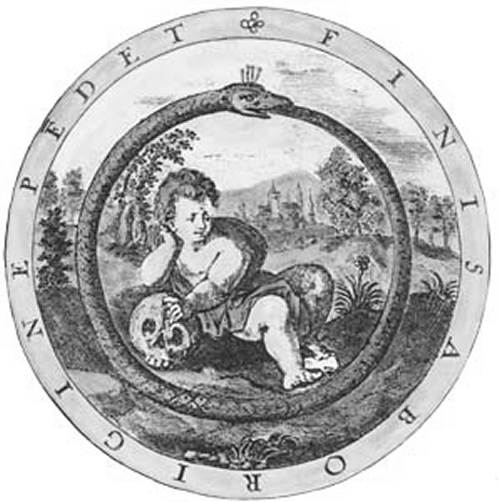
Plato described a self-eating, circular being as the first living thing in the universe – an immortal, mythologically constructed beast. The living being had no need of eyes when there was nothing remaining outside him to be seen; nor of ears when there was nothing to be heard; and there was no surrounding atmosphere to be breathed; nor would there have been any use of organs by the help of which he might receive his food or get rid of what he had already digested, since there was nothing which went from him or came into him: for there was nothing beside him.
All the other six motions were taken away from him, and he was made not to partake of their deviations. And as this circular movement required no feet, the universe was created without legs and without feet. In Gnosticism, this serpent symbolized eternity and the soul of the world. The universe was early divided into Earth below and Heaven above. These, two as one, gave the idea of opposites but forming a unity. Each opposite was assumed to be powerful and so was their final unity. For creation of the universe they projected reproduction to conceive creation. Now reproduction results in the union of two opposites as male and female.
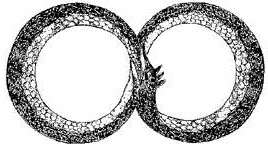
Correspondingly, the Chinese believed Light and Darkness, as the ideal opposites, when united, yielded creative energy. The two opposites were further conceived as matter and energy which became dual-natured but as one. The two opposites were yin-yang and their unity was called Chhi. Yin-Yang was treated separately in Chinese cosmology which consisted of five cosmic elements.
Since Chinese alchemy did reach Alexandria probably the symbol Yin-Yang, as dual-natured, responsible for creation, was transformed into a symbol called Ouroboros. It is a snake and as such as symbol of soul. Its head and anterior portion is red, being the color of blood as soul; its tail and posterior half is dark, representing body.
Ouroboros here is depicted white and black, as soul and body, the two as “one which is all.” It is cosmic soul, the source of all creation. Ouroboros is normally depicted with its anterior half as black but it should be the reverse as shown here. With the name Chemeia taken to Kim-Iya, the last word would take Ouroboros to Yin-Yang.
In Mesoamerica the serpent god Quetzalcoatl is sometimes portrayed biting his tail on Aztec and Toltec ruins. A looping Quetzalcoatl is carved into the base of the Pyramid of the Feathered Serpent, at Xochicalco, Mexico, 700-900 AD.
In Norse mythology, it appears as the serpent Jormungandr, one of the three children of Loki and Angrboda, who grew so large that it could encircle the world and grasp its tail in its teeth. In the legends of Ragnar Lodbrok, such as Ragnarssona patter, the Geatish king Herraud gives a small lindworm as a gift to his daughter Pora Town-Hart after which it grows into a large serpent which encircles the girl’s bower and bites itself in the tail. The serpent is slain by Ragnar Lodbrok who marries Pora. Ragnar later has a son with another woman named Kraka and this son is born with the image of a white snake in one eye. This snake encircled the iris and bit itself in the tail, and the son was named Sigurd Snake-in-the-Eye.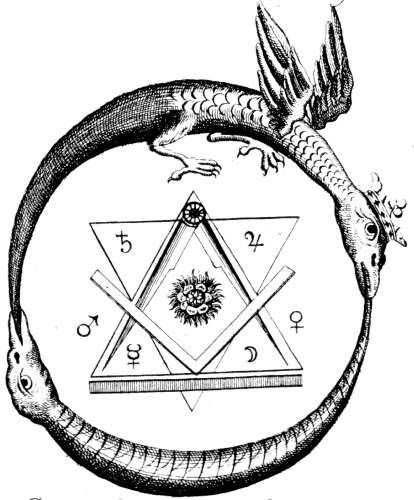
Christians adopted the Ouroboros as a symbol of the limited confines of this world (that there is an “outside” being implied by the demarcation of an inside), and the self-consuming transitory nature of a mere this-worldly existence following in the footsteps of the Preacher in Ecclesiastes.
It could very well be used to symbolize the closed-system model of the universe of some physicists even today.’
In Freemasonry the Ouroboros is displayed on numerous Masonic seals, frontispieces and other imagery, especially during the 17th century.
The Ouroboros is featured in the seal of the Theosophical Society along with other traditional symbols.
Alchemically, the ouroboros is also used as a purifying glyph. Ouroboros was and is the name for the Great World Serpent, encircling the Earth.
Ouroboros represents the conflict of life as well in that life comes out of life and death. ‘My end is my beginning.’ In a sense life feeds off itself, thus there are good and bad connotations which can be drawn. It is a single image with the entire actions of a life cycle – it begets, weds, impregnates, and slays itself, but in a cyclical sense, rather than linear.
Thus, it fashions our lives to a totality more towards what it may really be – a series of movements which repeat. “As Above, So Below” – we are born from nature, and we mirror it, because it is what man wholly is a part of. It is this symbolic rendition of the eternal principles that are presented in the Emerald Tablets of Thoth, (cited earlier).”

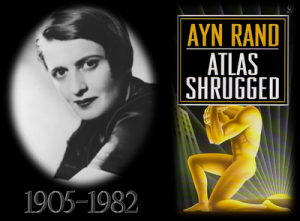 Ayn Rand, born Alisa Zinov’yevna Rosenbaum, February 2 1905 – March 6, 1982) was a Russian-American novelist, philosopher,playwright, and screenwriter. She is known for her two best-selling novels The Fountainhead and Atlas Shrugged and for developing a philosophical system she called Objectivism.