Republished by Blog Post Promoter
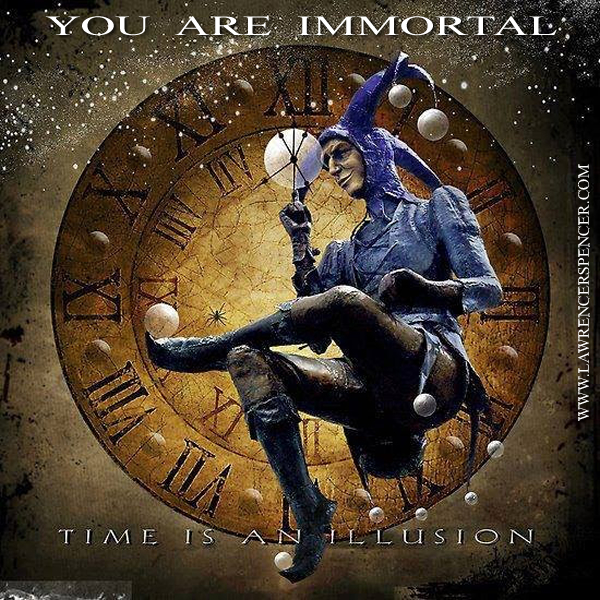
You are Immortal — Time is an Illusion

Free Advice about Life, Universe and Other Stuff from Lawrence R. Spencer
Republished by Blog Post Promoter

“(January 2, 1920 – April 6, 1992) Isaac Asimov was a Russian American author and professor of biochemistry at Boston University, best known for his works of science fiction and for his popular science books. Asimov was one of the most prolific writers of all time, having written or edited more than 500 books and an estimated 90,000 letters and postcards. His works have been published in all ten major categories of the Dewey Decimal System Asimov’s career can be divided into several time periods. His early career, dominated by science fiction, began with short stories in 1939 and novels in 1950. This lasted until about 1958, all but ending after publication of The Naked Sun. He began publishing nonfiction in 1952, co-authoring a college-level textbook called Biochemistry and Human Metabolism. Following the brief orbit of the first man-made satellite Sputnik I by the USSR in 1957, his production of nonfiction, particularly popular science books, greatly increased, with a consequent drop in his science fiction output. Over the next quarter century, he wrote only four science fiction novels. Starting in 1982, the second half of his science fiction career began with the publication of Foundation’s Edge. From then until his death, Asimov published several more sequels and prequels to his existing novels, tying them together in a way he had not originally anticipated, making a unified series. There are, however, many inconsistencies in this unification, especially in his earlier stories.
Asimov believed that his most enduring contributions would be his “Three Laws of Robotics” and the Foundation Series (see Yours, Isaac Asimov, p. 329). Furthermore, the Oxford English Dictionary credits his science fiction for introducing the words positronic (an entirely fictional technology), psychohistory (which is also used for a different study on historical motivations) and robotics into the English language. Asimov coined the term robotics without suspecting that it might be an original word; at the time, he believed it was simply the natural analogue of words such as mechanics and hydraulics, but for robots. Unlike his word psychohistory, the word robotics continues in mainstream technical use with Asimov’s original definition. Star Trek: The Next Generation featured androids with “positronic brains” giving Asimov full credit for “inventing” this fictional technology.” (Wikipedia.org)
Republished by Blog Post Promoter
Republished by Blog Post Promoter
 Mohandas Karamchand Gandhi (; 2 October 1869 – 30 January 1948) was the preeminent leader of Indian independence movement in British-ruled India. Employing nonviolent civil disobedience, Gandhi led India to independence and inspired movements for civil rights and freedom across the world. The term Indian Independence Movement encompasses activities and ideas aiming to end first the company rule (East India Company), and then the rule of the British.
Mohandas Gandhi’s storied history of resistance included many stints in jail, starting with a two-month imprisonment in 1907 in South Africa, where he was working to end discrimination against Indians living there. He was arrested for urging them to ignore a law requiring Indians to be registered and fingerprinted. While in jail, Gandhi read Henry David Thoreau’s “Civil Disobedience”, which would become a major part of his philosophy upon his return to India. Back in his home country, Gandhi was put behind bars several times for his movement to end British rule. In 1922 he was tried for the last time by the British government for “bringing or attempting to excite disaffection towards His Majesty’s Government established by law in British India.” He pleaded guilty to all charges and was sentenced to six years, of which he served two before being released for an emergency appendectomy. India achieved independence on Aug. 15, 1947, five months before Gandhi was assassinated.
Gandhi preached rebellion, launched mass civil disobedience and was repeatedly jailed. When arrested, he pleaded guilty and asked for the severest punishment. In South Africa, the charge against him and his co-workers was proved by witnesses furnished by him. The horror, shame and hardship of jail life, originally a punishment allotted to criminals, scared the Indians. Gandhi removed this fear from their hearts. He was jailed eleven times. Once he was arrested three times within four days. If he had to complete all his jail terms, he would have spent 11 years and 19 days in jail. Occasionally his punishment was reduced and and he altogether spent 6 years and 10 months in prison. At the age of 39, he first entered a jail. He came out of the prison gates for the last time when he was 75.
On 14 and 15 August 1947 the Indian Independence Act was invoked.