Category Archives: FREE ADVICE

Free Advice about Life, Universe and Other Stuff from Lawrence R. Spencer

GREATEST GEEK

Republished by Blog Post Promoter
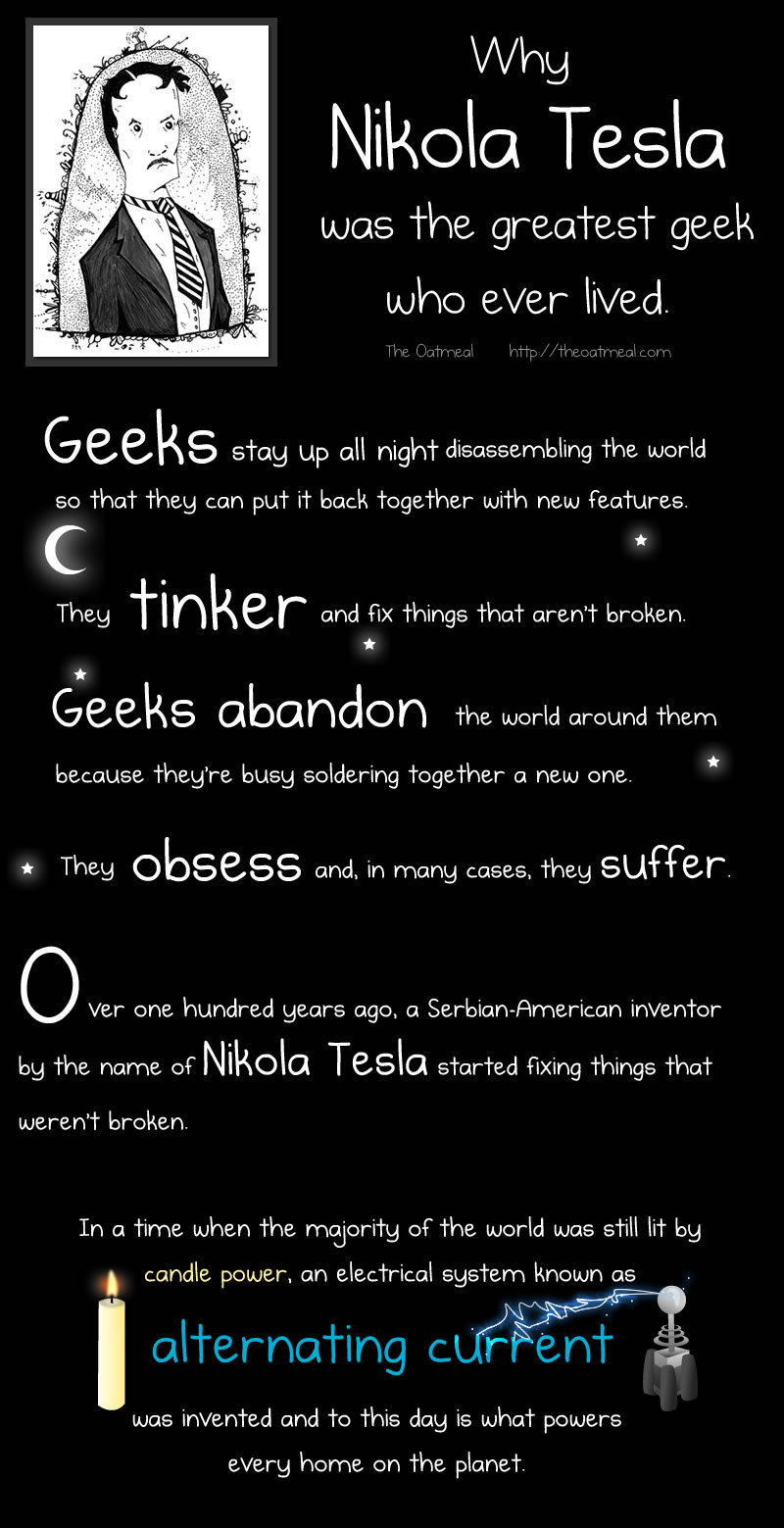
THIS IS THE FIRST PAGE OF A VERY EXCELLENT ON-LINE “COMIC BOOK”  ABOUT NIKOLA TESLA.  READ THE ENTIRE THING HERE:  Why Nikola Tesla was the greatest geek who ever lived – The Oatmeal

Additional notes from the author:

  • If you want to learn more about Tesla, I highly recommend reading Tesla: Man Out of Time
  • Also, this Badass of the week by Ben Thompson is what originally inspired me to write a comic about Tesla. Ben’s also got a book out which is packed full of awesome.
  • There’s an old movie from the 80s on Netflix Instant Queue right now about Tesla: The Secret of Nikola Tesla. It’s corny and full of bad acting, but it paints a fairly accurate depiction of his life.
  • The drunk history of Tesla is quite awesome, too.
  • X-rays: just to clarify, Tesla did not discover x-rays, but he was one of the early pioneers in its research.
  • Cryogenic engineering: I’m referring to the cryogenic engineering that has to do with using liquified air to cool a coil and reduce its electrical resistance (Patent No. 11,865), not freezing people and waking them up in the future so they can fight Wesley Snipes.
  • Transistor: Tesla’s influence on the modern transistor can be found in patents 723,188 and 725,605. (a better explanation here)
  • Radio: Tesla was the nicest geek ever until he decided to sue Marconi a few years later. 8 months after Tesla died, the U.S. Supreme Court overturned Marconi’s patents on the invention of radio. So Tesla eventually won that battle, although he was dead by then.
  • Tesla VS Edison: I could write a novel on the differences between Tesla and Edison, but seeing as how this comic is already huge I decided to leave many things out. For instance, Edison killed cats and dogs, but Tesla loved animals and had a cat as a child. Originally Tesla wanted to be a poet, but after getting zapped by static electricity from his kitty he was inspired to study the effects of electricity. One could vaguely construe that Tesla’s cat was responsible for the second industrial revolution, which arguably makes it the most awesome cat who ever lived.
    Edison believed that fossil fuels were the future and that there were enough resources in South America to provide for the next 50,000 years. Tesla believed that renewable energy sources like hydroelectric, solar, and wind power were the future. This is remarkable because in the 1890s there was no such thing as “going green,” so Tesla’s ideas on conservation were very forward-thinking at the time.  (From OATMEAL)

HOW DO YOU KNOW YOU’RE MAD?

Republished by Blog Post Promoter

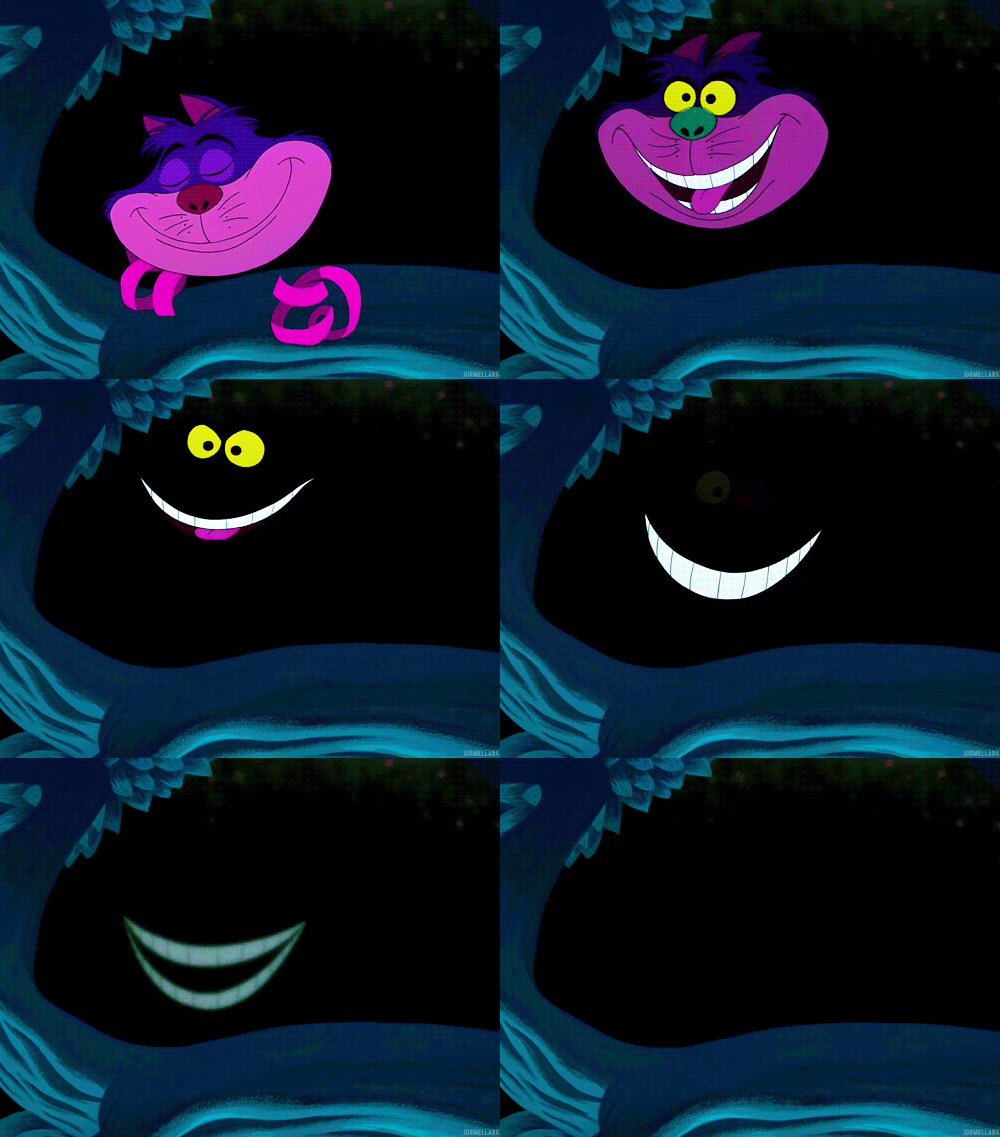
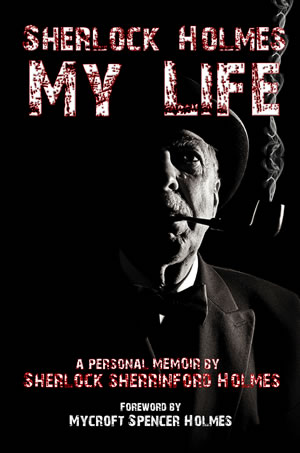
Cheshire CatExcerpt from the book SHERLOCK HOLMES: MY LIFE Support independent publishing: Buy this book on Lulu.

“”I do not ask you, or anyone, to believe anything whatsoever. Belief is a matter of personal opinion or conviction which cannot be shared by anyone else, accept to the degree that they share a similar opinion. Some men believe that the world was created by an omnipotent, invisible being in seven days. People in some aboriginal tribes believe that the world is supported on the back of an enormous elephant which stands upon the shell of a colossal tortoise”, I said, finally arriving at the pages I was looking for in the manuscript.

“As for myself, I believe that what is true for you is true for you, although no other person may agree upon your belief. Regardless, a truth for you, may not be true for others. Is that not a fundamentally sound assumption?”, I asked.

Sherlock-Holmes-My-Life_cover300“I suppose you are right Mr. Holmes. It is difficult, if not impossible, to stay apace of your ability to remain logical in the face of a situation which is so absurdly enigmatic. You are proposing that the philosophical paradigm of reality should be considered of equal importance with fiction. How can you ever solve a criminal case, your occupation, if every piece of hard evidence could be a contrivance of imagination on the part of the investigator or of the criminal?”, said Mr. Dodgson.

“Quite the contrary”, I said. “But rather than keeping to my methods alone, let me ask you what meaning you attribute to the following passage in your book”, I said, turning to the page which described in the encounter between Alice and the Cheshire Cat.

“Let me read your own words to you.”

“…she was a little startled by seeing the Cheshire Cat sitting on a bough of a tree a few yards off.

The Cat only grinned when it saw Alice. It looked good-natured, she

thought: still it had VERY long claws and a great many teeth, so she

felt that it ought to be treated with respect.

‘Cheshire Puss,’ she began, rather timidly, as she did not at all know

whether it would like the name: however, it only grinned a little wider.

‘Come, it’s pleased so far,’ thought Alice, and she went on. ‘Would you

tell me, please, which way I ought to go from here?’

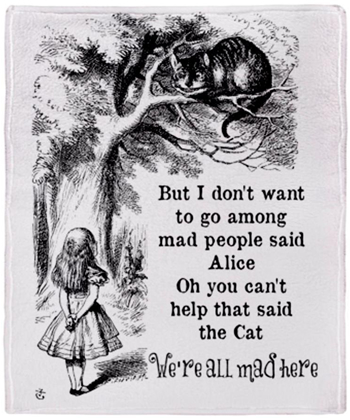
were all mad‘That depends a good deal on where you want to get to,’ said the Cat.

‘I don’t much care where–‘ said Alice.

‘Then it doesn’t matter which way you go,’ said the Cat.

‘–so long as I get SOMEWHERE,’ Alice added as an explanation.

‘Oh, you’re sure to do that,’ said the Cat, ‘if you only walk long

enough.’

Alice felt that this could not be denied, so she tried another question.

‘What sort of people live about here?’

‘In THAT direction,’ the Cat said, waving its right paw round, ‘lives

a Hatter: and in THAT direction,’ waving the other paw, ‘lives a March

Hare. Visit either you like: they’re both mad.’

‘But I don’t want to go among mad people,’ Alice remarked.

‘Oh, you can’t help that,’ said the Cat: ‘we’re all mad here. I’m mad.

You’re mad.’

‘How do you know I’m mad?’ said Alice.

‘You must be,’ said the Cat, ‘or you wouldn’t have come here.’

Alice didn’t think that proved it at all; however, she went on ‘And how

do you know that you’re mad?'”

“So, Mr. Dodgson, let me pose the same question to you that young Alice asked of the chimerical cat in your own story: how do you know whether you are mad or not mad? How would you satisfy yourself that I am not mad? How do we know that everyone is mad or not mad?”, I said, rising from my chair to place the manuscript upon the sideboard.

I refilled my pipe once again, in anticipation of the protracted debate that was sure to follow on the heels of these profoundly, absurd, yet existential queries and arguments.

lewis-carrollMr. Dodgson did not seem the least bit nonplused by my insinuation regarding his sanity, or the sanity of all. Rather, he thanked us very cordially for our hospitality, rose from his chair and reached the door to exit the apartment. As he reached the door he turned back to me.

“Mr. Holmes, I will leave the resolution of this mystery entirely in your very capable hands. If anyone were able to solve the questions you pose to me, I assure you that I am not that man. Neither are any of the mentors whom I have studied, including Sir Isaac himself. I trust that you will be kind enough to inform me of your eventual success, if such is possible. Good day to you, gentlemen”.

With that, he departed, clomped down the stairs. Through the window we saw him walk briskly away through a light drizzle of rain in the direction of the train station.”

THE CORE

Republished by Blog Post Promoter

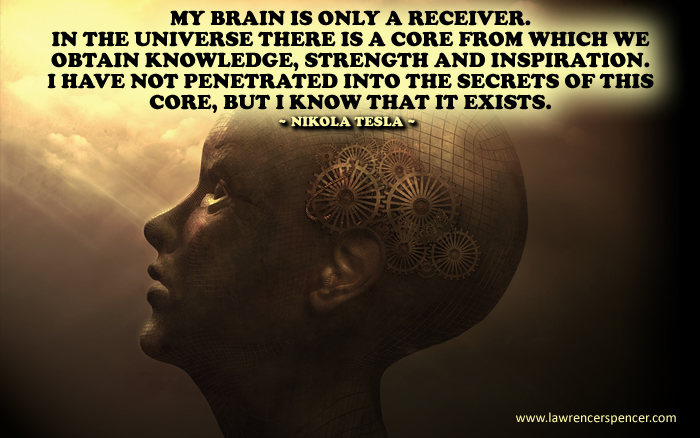
TESLA BRAIN

Nikola Tesla (July 10, 1856 – January 7, 1943) was a physicist, inventor, mechanical and electrical engineer of unusual intellectual brilliance and practical achievement. He was an important contributor to the birth of commercial electricity, and is best known for his many revolutionary developments in the field of electromagnetism in the late 19th and early 20th centuries. Tesla’s patents and theoretical work formed the basis of modern alternating current (AC) electric power systems, including the polyphase system of electrical distribution and the AC motor. This work helped usher in the Second Industrial Revolution.

Tesla is most famous for conceiving the rotating magnetic field principle (1882) and then using it to invent the induction motor together with the accompanying alternating current long-distance electrical transmission system (1888). His patents and theoretical work still form the basis for modern alternating current electric power systems. He also developed numerous other electrical and mechanical devices including the fundamental principles and machinery of wireless technology, including the high frequency alternator, the Tesla coil, the blameless turbine, the spark plug, and numerous other inventions.

In addition to his work on electromagnetism and electromechanical engineering, Tesla contributed in varying degrees to the establishment of robotics, remote control, radar, and computer science, and to the expansion of ballistics, nuclear physics, and theoretical physics.

He pioneered modern electrical engineering and many of his discoveries were of groundbreaking importance. In the United States during this time, Tesla’s fame rivaled that of any other inventor or scientist in history or popular culture. Tesla demonstrated wireless energy transfer to power electronic devices as early as 1893, and aspired to intercontinental wireless transmission of industrial power in his unfinished Wardenclyffe Tower project (1901-1917) also known as the Tesla Tower, located in Long Island, New York.

Tesla was fluent in eight languages – Serbian, Czech, English, French, German, Hungarian, Italian, and Latin.