Republished by Blog Post Promoter

THE TRUTH THAT WILL SET US FREE MAY NOT BE THE TRUTH WE WANT TO REMEMBER.

Republished by Blog Post Promoter
THE TRUTH THAT WILL SET US FREE MAY NOT BE THE TRUTH WE WANT TO REMEMBER.
Republished by Blog Post Promoter

“I maintain that Truth is a pathless land, and you cannot approach it by any path whatsoever, by any religion, by any sect.”
— Jiddu Krishnamurti —
_____________________________________
Jiddu Krishnamurti (May 12, 1895 – February 17, 1986) was an Indian speaker and writer on philosophical and spiritual subjects, and was widely considered as a World Teacher. His subject matter included: psychological revolution, the nature of mind, meditation, inquiry, human relationships, and bringing about radical change in society. He constantly stressed the need for a revolution in the psyche of every human being and emphasized that such revolution cannot be brought about by any external entity, be it religious, political, or social.
Republished by Blog Post Promoter

Republished by Blog Post Promoter

The “good news” is that I have seen “the truth”. The “bad news” is that it cannot be unseen! However the REAL NEWS is that “the truth” for me isn’t the same as “the truth” for you. If this is “the truth”, then “the truth” is a personal opinion. Logically, one can observe the so-called “reality” that people call “the truth” can’t be “real” because no two people share the exact same opinion as to what “the truth” is. Therefore, “reality” must also be a personal opinion. So, if every person keeps their personal opinions of “the truth” to themselves we can all enjoy a perfectly pleasant “reality” believing the “the truth” is “the truth”. So, when you “see the truth” keep it to yourself, please. I am busy convincing myself that “my truth” is “the ONLY truth” and that My Reality is Real! (and, in case you have any doubts what is or is not “the truth”, don’t worry about it. Just read what I’ve written. It’s “the truth”.
Republished by Blog Post Promoter
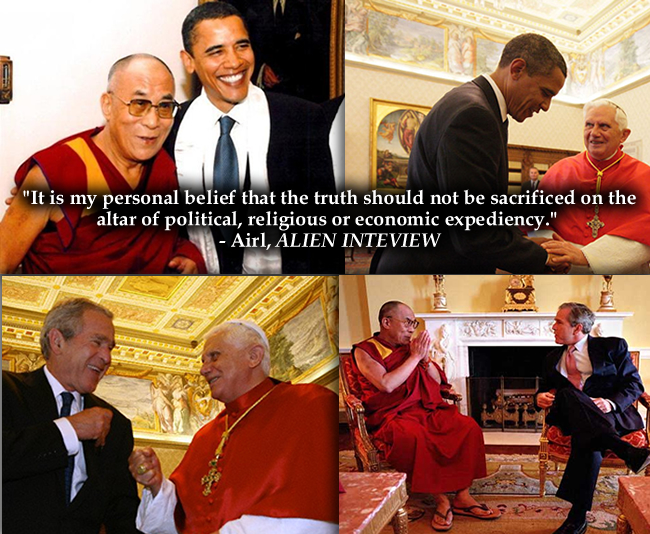
 “A priesthood, or prison guards, were used to help reinforce the idea that an individual is only a biological body and is not an Immortal Spiritual Being. The individual has no identity. The individuals have no past lives. The individual has no power. Only the gods have power. And, the gods are a contrivance of the priests who intercede between men and the gods they serve. Men are slaves to the dictates of the priests who threaten eternal spiritual punishment if men do not obey them. What else would one expect on a prison planet where all prisoners have amnesia, and the priests themselves are prisoners?”
— Airl, from the Top Secret interview transcripts published in the book ALIEN INTERVIEW 
DEFINITION: expedient —
noun: a means to an end; not necessarily a principled or ethical one
expediency:
noun: the quality of being suited to the end in view