Republished by Blog Post Promoter
Voices for Freedom from wearecaptive on Vimeo.

Republished by Blog Post Promoter
Voices for Freedom from wearecaptive on Vimeo.
Republished by Blog Post Promoter
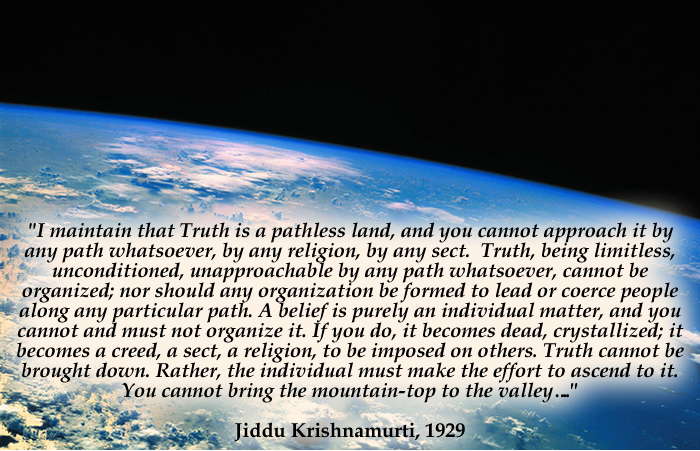
Jiddu Krishnamurti was born on 11 May 1895 in Madanapalle, a small town in south India. He and his brother were adopted in their youth by Dr Annie Besant, then president of the Theosophical Society. Dr Besant and others proclaimed that Krishnamurti was to be a world teacher whose coming the Theosophists had predicted. To prepare the world for this coming, a world-wide organization called the Order of the Star in the East was formed and the young Krishnamurti was made its head. In 1929, however, Krishnamurti renounced the role that he was expected to play, dissolved the Order with its huge following, and returned all the money and property that had been donated for this work. What follows is the speech made by Jiddu Krishnamurti in 1929 when he dissolved the Order of the Star.
“We are going to discuss this morning the dissolution of the Order of the Star. Many will be delighted, and others will be rather sad. It is a question neither for rejoicing nor for sadness, because it is inevitable, as I am going to explain….
I maintain that Truth is a pathless land, and you cannot approach it by any path whatsoever, by any religion, by any sect. That is my point of view, and I adhere to that absolutely and unconditionally. Truth, being limitless, unconditioned, unapproachable by any path whatsoever, cannot be organized; nor should any organization be formed to lead or coerce people along any particular path. If you first understand that, then you will see how impossible it is to organize a belief. A belief is purely an individual matter, and you cannot and must not organize it. If you do, it becomes dead, crystallized; it becomes a creed, a sect, a religion, to be imposed on others. This is what everyone throughout the world is attempting to do. Truth is narrowed down and made a plaything for those who are weak, for those who are only momentarily discontented. Truth cannot be brought down, rather the individual must make the effort to ascend to it. You cannot bring the mountain-top to the valley….
So that is the first reason, from my point of view, why the Order of the Star should be dissolved. In spite of this, you will probably form other Orders, you will continue to belong to other organizations searching for Truth. I do not want to belong to any organization of a spiritual kind; please understand this….
If an organization be created for this purpose, it becomes a crutch, a weakness, a bondage, and must cripple the individual, and prevent him from growing, from establishing his uniqueness, which lies in the discovery for himself of that absolute, unconditioned Truth. So that is another reason why I have decided, as I happen to be the Head of the Order, to dissolve it.
This is no magnificent deed, because I do not want followers, and I mean this. The moment you follow someone you cease to follow Truth. I am not concerned whether you pay attention to what I say or not. I want to do a certain thing in the world and I am going to do it with unwavering concentration. I am concerning myself with only one essential thing: to set man free. I desire to free him from all cages, from all fears, and not to found religions, new sects, nor to establish new theories and new philosophies. Then you will naturally ask me why I go the world over, continually speaking. I will tell you for what reason I do this; not because I desire a following, not because I desire a special group of special disciples. (How men love to be different from their fellow-men, however ridiculous, absurd and trivial their distinctions, may be! I do not want to encourage that absurdity.) I have no disciples, no apostles, either on earth or in the realm of spirituality.
Nor is it the lure of money, nor the desire to live a comfortable life, which attracts me. If I wanted to lead a comfortable life I would not come to a Camp or live in a damp country! I am speaking frankly because I want this settled once and for all. I do not want these childish discussions year after year.
A newspaper reporter, who interviewed me, considered it a magnificent act to dissolve an organization in which there were thousands and thousands of members. To him it was a great act because he said: “What will you do afterwards, how will you live? You will have no following, people will no longer listen to you.” If there are only five people who will listen, who will live, who have their faces turned towards eternity, it will be sufficient. Of what use is it to have thousands who do not understand, who are fully embalmed in prejudice, who do not want the new, but would rather translate the new to suit their own sterile, stagnant selves?….
Because I am free, unconditioned, whole, not the part, not the relative, but the whole Truth that is eternal, I desire those, who seek to understand me, to be free, not to follow me, not to make out of me a cage which will become a religion, a sect. Rather should they be free from all fears – from the fear of religion, from the fear of salvation, from the fear of spirituality, from the fear of love, from the fear of death, from the fear of life itself. As an artist paints a picture because he takes delight in that painting, because it is his self-expression, his glory, his well-being, so I do this and not because I want any thing from anyone. You are accustomed to authority, or to the atmosphere of authority which you think will lead you to spirituality. You think and hope that another can, by his extraordinary powers – a miracle – transport you to this realm of eternal freedom which is Happiness. Your whole outlook on life is based on that authority.
You have listened to me for three years now, without any change taking place except in the few. Now analyze what I am saying, be critical, so that you may understand thoroughly, fundamentally….
For eighteen years you have been preparing for this event, for the Coming of the World Teacher. For eighteen years you have organized, you have looked for someone who would give a new delight to your hearts and minds, who would transform your whole life, who would give you a new understanding; for someone who would raise you to a new plane of life, who would give you new encouragement, who would set you free – and now look what is happening! Consider, reason with yourselves, and discover in what way that belief has made you different – not with the superficial difference of the wearing of a badge, which is trivial, absurd. In what manner has such a belief swept away all unessential things of life? That is the only way to judge: in what way are you freer, greater, more dangerous to every society which is based on the false and the unessential? In what way have the members of this organization of the Star become different?….
You are all depending for your spirituality on someone else, for your happiness on someone else, for your enlightenment on someone else…. when I say look within yourselves for the enlightenment, for the glory, for the purification, and for the incorruptibility of the self, not one of you is willing to do it. There may be a few, but very, very few. So why have an organization?….
No man from outside can make you free; nor can organized worship, nor the immolation of yourselves for a cause, make you free; nor can forming yourselves into an organization, nor throwing yourselves into work, make you free. You use a typewriter to write letters, but you do not put it on an alter and worship it. But that is what you are doing when organizations become your chief concern. “How many members are there in it?” That is the first question I am asked by all newspaper reporters. “How many followers have you? By their number we shall judge whether what you say is true or false.” I do not know how many there are. I am not concerned with that. If there were even one man who had been set free, that were enough….
Again, you have the idea that only certain people hold the key to the Kingdom of Happiness. No one holds it. No one has the authority to hold that key. That key is your own self, and in the development and the purification and in the incorruptibility of that self alone is the Kingdom of Eternity….
You have been accustomed to being told how far you have advanced, what is your spiritual status. How childish! Who but yourself can tell you if you are incorruptible?….
But those who really desire to understand, who are looking to find that which is eternal, without a beginning and without an end, will walk together with greater intensity, will be a danger to everything that is unessential, to unrealities, to shadows. And they will concentrate, they will become the flame, because they understand. Such a body we must create, and that is my purpose. Because of that true friendship – which you do not seem to know – there will be real co-operation on the part of each one. And this not because of authority, not because of salvation, but because you really understand, and hence are capable of living in the eternal. This is a greater thing than all pleasure, than all sacrifice.
So those are some of the reasons why, after careful consideration for two years, I have made this decision. It is not from a momentary impulse. I have not been persuaded to it by anyone – I am not persuaded in such things. For two years I have been thinking about this, slowly, carefully, patiently, and I have now decided to disband the Order, as I happen to be its Head. You can form other organizations and expect someone else. With that I am not concerned, nor with creating new cages, new decorations for those cages. My only concern is to set men absolutely, unconditionally free.”
DISCOVER MORE ABOUT THE TEACHINGS OF KRISHNAMURTI ON THE OFFICIAL WEBSITE
Republished by Blog Post Promoter

Republished by Blog Post Promoter