Republished by Blog Post Promoter
 “The term “Oz Factor” was originally coined by the British UFO researcher Jenny Randles in reference to a peculiar, almost dreamlike state of silence that sometimes precedes UFO encounters. Jenny Randles supposed the Oz Factor to be an altered state of consciousness induced by the “persons” behind the UFO phenomenon. She conceived that this influence originated from beings of another planet, capable of reaching across space to influence human behavior. She postulated that these beings are physically present in the vicinity of the affected person. Jenny describes this experience as “not really happening, yet it is far more than a mere hallucination.”
Randles uses the term to describe a variety of phenomena:
“What I wanted to do was to anchor this state of mind very firmly in real experience. I have surveyed what witnesses say in this wide range of paranormal phenomena, both obviously time related (such as time-slips) and not so obviously related (such as near-death or UFO close-encounter visions). The pattern is the same and you can readily build up this portrait of the state of consciousness which seems to facilitate their occurrence.
“That is the first step. Giving it a neutral name to capture its essence of magical transportation was the next move forward, hence the Oz Factor.
“We must move on from here. It helps a little to say that the Oz factor is a set of symptoms denoting an altered state of consciousness in which the normal bonds of time are freed and the mind senses the universe as it really is and can wander through those corridors of forever.”
Illusion, hallucination, imagination and reality: universes can be created by each of us individually and/or collectively.
Our purpose here is not to speculate on the relative validity of universes. Like Jenny Randles, we are traveling on a “Yellow Brick Road” toward the resolution of primordial questions. The road may be a reality or it may be an hallucination. Our journey is to examine some of the factors that may adversely effect our ability to discover workable solutions–the differences between reality and hallucination–in any universe.
Unlike Dorothy in the Land of Oz, we do not have Ruby Slippers and a Good Witch to lead us or protect us. We are on our own in our travels through the Land of Oz, Kansas, planet Earth, the Physical Universe and Your Own Universe.
Like a scarecrow who can’t decide which way to go, the twists and turns of the road which have been charted by western science, have not resolved our primordial questions. Some people, who don’t have any more brains than a scarecrow, do an awful lot of talking but we still have no reliable road map–we have no proven sign posts. Therefore, we must draw our own map and post signs to guide ourselves and mark the way for others who may follow.
Our journey must define a new map through uncharted universes. Our map must not only help to choose the right road, but it must also protect us from the perils of lions and tigers and bears (oh, my!), witches, flying monkeys, great and powerful Ozes, and other distractions, along the way.
Every time we take a wrong turn, every time we encounter a perilous barrier to understanding, we must post a new sign. We call each one of these sign posts, an “Oz Factor”.
DEFINITION OF “OZ FACTOR”: A COMMON DENOMINATOR OF WESTERN LOGIC WHICH PREVENTS OBSERVATION, UNDERSTANDING, AND THE ATTAINMENT OF A WORKABLE SOLUTION.”

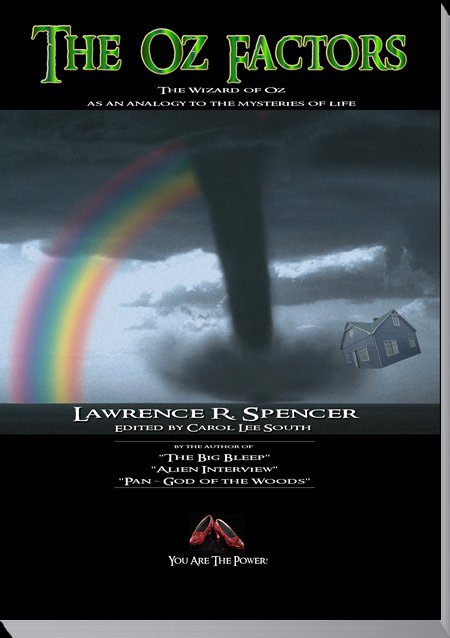
READ The Oz Factors to discover the 12 Common Denominators (Oz Factors) and how you can use them to improve your life.