Republished by Blog Post Promoter

They said I could be anything, so I decided to be a god.

Republished by Blog Post Promoter
 Diogenes of Sinope was a Greek philosopher and one of the founders of Cynic philosophy. The term “Cynic” itself derives from the Greek word κυνικός, “dog-like”. Later Cynics also sought to turn the word to their advantage, as a later commentator explained:
There are four reasons why the Cynics are so named. First because of the indifference of their way of life, for they make a cult of indifference and, like dogs, eat and make love in public, go barefoot, and sleep in tubs and at crossroads. The second reason is that the dog is a shameless animal, and they make a cult of shamelessness, not as being beneath modesty, but as superior to it. The third reason is that the dog is a good guard, and they guard the tenets of their philosophy. The fourth reason is that the dog is a discriminating animal which can distinguish between its friends and enemies. So do they recognize as friends those who are suited to philosophy, and receive them kindly, while those unfitted they drive away, like dogs, by barking at them.
Diogenes of Sinope he was born in Sinope (modern-day Sinop, Turkey), an Ionian colony on the Black Sea, in 412 or 404 BCE and died at Corinth in 323 BCE. He was a controversial figure. His father minted coins for a living, and when Diogenes took to debasement of currency, he was banished from Sinope.
After being exiled, he moved to Athens and criticized many cultural conventions of the city. He believed that virtue was better revealed in action than in theory. He used his simple lifestyle and behavior (which arguably resembled poverty) to criticize the social values and institutions of what he saw as a corrupt or at least confused society. In a highly non-traditional fashion, he had a reputation of sleeping and eating wherever he chose and took to toughening himself against nature.
He declared himself a cosmopolitan and a citizen of the world rather than claiming allegiance to just one place. Diogenes made a virtue of poverty. He begged for a living and often slept in a large ceramic jar in the marketplace. He became notorious for his philosophical stunts such as carrying a lamp in the daytime, claiming to be looking for an honest man. He criticized and embarrassed Plato, disputed his interpretation of Socrates and sabotaged his lectures, sometimes distracting attendees by bringing food and eating during the discussions.
Diogenes was also noted for having publicly mocked Alexander the Great:
“Alexander the Great found the philosopher looking attentively at a pile of human bones. Diogenes explained, “I am searching for the bones of your father but cannot distinguish them from those of a slave.”
Republished by Blog Post Promoter
This video solves the 20 year old mysteries:
WHO IS MAKING THE CHEMTRAIL SPRAY MIX?
WHERE DOES THE CHEMTRAIL SPRAY MIX COME FROM?
Republished by Blog Post Promoter
 As opposed to single combat challenges such as chivalric duels or later private duels of honor, in the Medieval Ages in some regions of Europe, mostly in German principalities disputing parties would be obliged by authority to enter into a judicial combat. Such occasions could be huge spectacles for the community. Participants might be typically given a month or two to prepare. Certain formalities and ritual – varying from place to place – dictated the setting and conditions. In fact, besides civic and felon cases, the judicial combat sometimes was used as a tool for solving domestic disputes between husband and wife. The marital combat rules required to wear special attire – different in different places. Usually, competing husband and wife were required to wear a tight-fitting body suit with a hood (perhaps a ritual or burial outfit), as it was depicted in the 15th century fighting manual written by Hans Talhoffer. Another form of attire for a female participant was a special long chemise with an extended sack-like closed sleeve (in which a stone was placed) was required as the only clothing for a wife fighting against her husband as it as it was depicted in the 14th century fighting manual written by Paulus Kal.
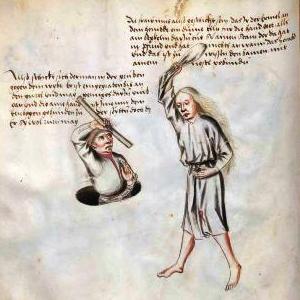 So, in some regions of medieval Europe (more truly in the Holy Roman Empire), a wife might be allowed to fight her husband, with rigorous conditions being imposed to make the duel a fair one. There are a few written testimonies about such combats. In the year 1200 a man and his wife fought under the sanction of the civic authorities at Bale, in Switzerland. In 1228, a woman fought her husband in Berne, Switzerland, and soundly defeated him. German law provided that in such a case the man should be armed with three wooden clubs. He was to put be up to his waist in a three-foot wide hole dug in the ground, with one hand tied behind his back. The woman was to be armed with three rocks, each weighing between one and five pounds, and each one wrapped in cloth in form of a small sack. The man could not leave his hole but the woman was free to run around the edge of the pit. If the man touched the edge of the pit with either his hand or his arm, he had to surrender one of his clubs to the judges. If the woman hit him with a rock while he was doing so, she forfeited one of her stones. Bizarre as it may seem to us today, this marital duel was very far from play-acting. In the early Medieval Era, for both parties, the penalty for defeat could be death. If the woman won, the man was executed; if the man won, the woman was buried alive. Later, the terms seemed to be softened.
Republished by Blog Post Promoter

The good news is that you get a new body. The bad news is that you get a new body.