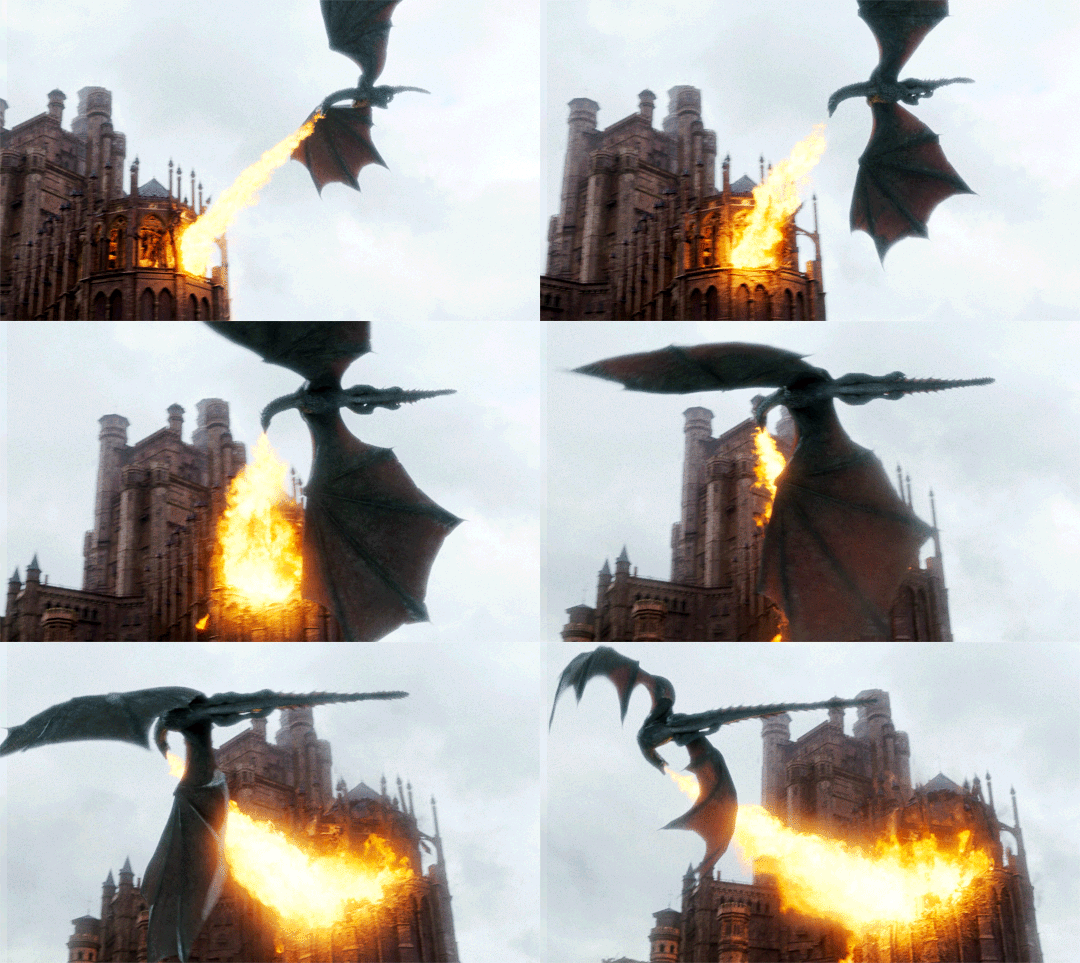
GAMES OF THRONES LESSON UNLEARNED

Republished by Blog Post Promoter

The Game of Thrones teaches a lesson observed repeatedly throughout the history of the physical universe, but is rarely learned — violence, motivated by psychotic lust for conquest and revenge, is the reason human civilizations do not endure. Psychopaths are not aware of immortal spiritual beings. They think everything, including themselves, is a physical object. They think power and possession are the path to personal immortality. There are many examples, such as the first emperor of China, Qin Shi Huang (259 BCE-210 BCE). Avoid those who desire to rule your possessions, including your body. Know who you really are. Be the indestructible, eternal spirit that is you.

THE TAO

Republished by Blog Post Promoter

THE TAO

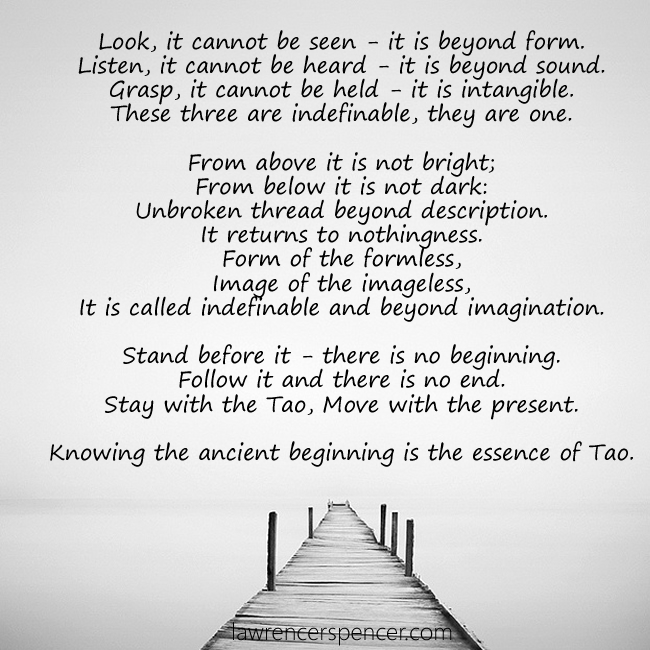
Tao or Dao is a concept signifying ‘way’, ‘path’, ‘route’, or sometimes more loosely, ‘doctrine’ or ‘principle’, or as a verb, speak.  Within these contexts Tao signifies the primordial essence or fundamental nature of existence. Tao is thus “eternally nameless”, or Immortal Spiritual Beings, and to be distinguished from the countless ‘named’ things which are considered to be its manifestations, as the space, energy and forms of, and within, the physical universe, and other universes.

The Tao Te Ching, Daodejing, or Dao De Jing (道德經: 道 dào “way”; 德 dé “virtue”; 經 jīng “classic” or “text”) is simply referred to as the Laozi. According to tradition, it was written around 6th century BC by the sage Laozi (or Lao Tzu, “Old Master”), a record-keeper at the Zhou Dynasty court, by whose name the text is known in China. The text’s true authorship and date of composition or compilation are still debated, although the oldest excavated text dates back to the late 4th century BC.

Many different translations, versions and interpretations of The Tao have been produced through the past 2,500 years, or so, since the original appearance.  Like any “religion”, the “opinions” and “interpretations” of “priests” MODIFY and INTRODUCE FASLE IDEAS into the original.  Therefore, I suggest that anyone who wished to sincerely study The Tao as a Body of Wisdom, study many difference translations in order to DECIDE FOR YOURSELF what is “true” or not.  

Here is a link to a website containing many different translations, and COMPARISONS between translations. 

BEETHOVEN 9th SYMPHONY

Republished by Blog Post Promoter

The Greatest Performance of The Greatest Musical Masterpiece written by Ludwig van Beethoven — 17 December 1770 – 26 March 1827) was a German composer and pianist.

392px-Beethoven_Signature.svg


Text of the fourth movement of Beethoven’s 9th Symphony is largely taken from Schiller’s “Ode to Joy“, with a few additional introductory words written specifically by Beethoven (shown in italics). The text without repeats is shown below, with a literal translation into English:

O Freunde, nicht diese Töne!
Sondern laßt uns angenehmere anstimmen,
und freudenvollere.
Freude!
Oh friends, not these sounds!
Let us instead strike up more pleasing
and more joyful ones!
Joy!
Freude, schöner Götterfunken
Tochter aus Elysium,
Wir betreten feuertrunken,
Himmlische, dein Heiligtum!
Deine Zauber binden wieder
Was die Mode streng geteilt;
Alle Menschen werden Brüder,
Wo dein sanfter Flügel weilt.
Joy, beautiful spark of the divinity,
Daughter from Elysium,
We enter your sanctuary, burning with fervour,
o heavenly being!
Your magic brings together
what custom has sternly divided.
All men shall become brothers,
wherever your gentle wings hover.
Wem der große Wurf gelungen,
Eines Freundes Freund zu sein;
Wer ein holdes Weib errungen,
Mische seinen Jubel ein!
Ja, wer auch nur eine Seele
Sein nennt auf dem Erdenrund!
Und wer’s nie gekonnt, der stehle
Weinend sich aus diesem Bund!
Whoever has been lucky enough
to become a friend to a friend,
Whoever has found a beloved wife,
let him join our songs of praise!
Yes, and anyone who can call one soul
his own on this earth!
Any who cannot, let them slink away
from this gathering in tears!
Freude trinken alle Wesen
An den Brüsten der Natur;
Alle Guten, alle Bösen
Folgen ihrer Rosenspur.
Küße gab sie uns und Reben,
Einen Freund, geprüft im Tod;
Wollust ward dem Wurm gegeben,
Und der Cherub steht vor Gott.
Every creature drinks in joy
at nature’s breast;
Good and Evil alike
follow her trail of roses.
She gives us kisses and wine,
a true friend, even in death;
Even the worm was given desire,
and the cherub stands before God.
Froh, wie seine Sonnen fliegen
Durch des Himmels prächt’gen Plan,
Laufet, Brüder, eure Bahn,
Freudig, wie ein Held zum Siegen.
Gladly, just as His suns hurtle
through the glorious universe,
So you, brothers, should run your course,
joyfully, like a conquering hero.
Seid umschlungen, Millionen!
Diesen Kuß der ganzen Welt!
Brüder, über’m Sternenzelt
Muss ein lieber Vater wohnen.
Ihr stürzt nieder, Millionen?
Ahnest du den Schöpfer, Welt?
Such’ ihn über’m Sternenzelt!
Über Sternen muss er wohnen.
Be embraced, you millions!
This kiss is for the whole world!
Brothers, above the canopy of stars
must dwell a loving father.
Do you bow down before Him, you millions?
Do you sense your Creator, o world?
Seek Him above the canopy of stars!
He must dwell beyond the stars.

MARK TWAIN: COMMENTS ON THE HUMAN RACE

Republished by Blog Post Promoter

Are the comments made about the human race more than 100 years ago by Mark Twain intended to be humorous, sarcastic or serious?

Mark Twain (1835 – 1910)  was an American writer, humorist, entrepreneur, publisher, and lecturer. Among his novels are The Adventures of Tom Sawyer (1876) and its sequel, Adventures of Huckleberry Finn (1885), the latter often called “The Great American Novel“.

“Why was the human race created? Or at least why wasn’t something creditable created in place of it? God had His opportunity; He could have made a reputation. But no, He must commit this grotesque folly–a lark which must have cost him a regret or two when He came to think it over & observe effects.” – Letter to William Dean Howells, 25 January 1900

“As to the human race. There are many pretty and winning things about the human race. It is perhaps the poorest of all the inventions of all the gods but it has never suspected it once. There is nothing prettier than its naive and complacent appreciation of itself. It comes out frankly and proclaims without bashfulness or any sign of a blush that it is the noblest work of God. It has had a billion opportunities to know better, but all signs fail with this ass. I could say harsh things about it but I cannot bring myself to do it–it is like hitting a child.” — Autobiographical dictation, 25 June 1906

“We all belong to the nasty stinking little human race, & of course it is not nice for God’s beloved vermin to scoff at each other… Oh, we are a nasty little lot–& to think there are people who would like to save us & continue us. It won’t happen if I have any influence.” — Letter to William Dean Howells, 2 April 1899

 “Can any plausible excuse be furnished for the crime of creating the human race?” — from The New York Times, “Hartford Museum Purchases Barrels Full of Twain’s Old Books,” July 31, 1997