MONGOLIAN IDOL

Republished by Blog Post Promoter

“Tuvan throat singing is one particular variant of overtone singing practiced by the Tuva people of southern Siberia.
“The art of Tuvan throat singing is a style in which one or more pitches sound simultaneously over a fundamental pitch, producing a unique sound. The history of Tuvan throat singing reaches very far back. Many of the male herders can throat sing, but women are beginning to practice the technique as well. The popularity of throat singing among Tuvans seems to have arisen as a result of geographic location and culture. The open landscape of Tuva allows for the sounds to carry a great distance. Ethnomusicologists studying throat singing in these areas mark khoomei as an integral part in the ancient pastoral animism that is still practiced today. Often, singers will travel far into the countryside looking for the right river, or will go up to the steppes of the mountainside to create the proper environment for throat-singing.[1]

The animistic world view of this region identifies the spirituality of objects in nature, not just in their shape or location, but in their sound as well.[2] Thus, human mimicry of nature’s sounds is seen as the root of throat singing. (An example is the Mongolian story of the waterfall above the Buyan Gol (Deer River), where mysterious harmonic sounds are said to have attracted deer to bask in the waters, and where it is said harmonic sounds were first revealed to people.)[citation needed] Indeed, the cultures in this part of Asia have developed many instruments and techniques to mimic the sounds of animals, wind, and water.[citation needed] While the cultures of this region share throat singing, their styles vary in breadth of development.

It is simply the harmonized sounds that they are able to produce from deep within their throats.[3] Ordinarily, melodies are created by isolating the 6th, 7th, 8th, 9th, 10th and 12th partial in accordance with the harmonic series (if fundamental frequency were C3, the overtones would be: G5, B♭5, C6, D6, E6, G6). The base pitch is typically around a G below Middle C.

The people of Tuva have a wide range of throat singing vocalizations, and were the pioneers of six pitch harmonics.[4] There are several different classification schemes for Tuvan throat singing. In one, the three basic styles are khoomei, kargyraa and sygyt, while the sub-styles include borbangnadyr, chylandyk, dumchuktaar, ezengileer and kanzyp. In another, there are five basic styles: khoomei, sygyt, kargyraa, borbangnadyr and ezengileer. The substyles include chylandyk, despeng borbang, opei khoomei, buga khoomei, kanzyp, khovu kargyraazy, kozhagar kargyraazy, dag kargyraazy, Oidupaa kargyraazy, uyangylaar, damyraktaar, kishteer, serlennedyr and byrlannadyr.[5] These schemes all use Tuvan terminology.”  — Wikipedia.org

WHORE MOANS

Republished by Blog Post Promoter

“it’s just sex”
she said
flouncing out of bed
through the shower
and out the door.

my heart broke
to see her go.
I was
left in the room
alone.

she called later:
“hi, honey bunny
there’s a bun
in my oven.
it’s yours.”

“it’s not just sex
anymore”, I said.
it’s a life.
growing…
hormones.

BATSHIT CRAZY

Republished by Blog Post Promoter

DEFINITION — “batshit crazy”
“A person who is batshit crazy is certifiably nuts. The phrase has origins in the old fashioned term “bats in the belfry.” Old churches had a structure at the top called a belfry, which housed the bells. Bats are extremely sensitive to sound and would never inhabit a belfry of an active church where the bell was rung frequently. Occasionally, when a church was abandoned and many years passed without the bell being rung, bats would eventually come and inhabit the belfry. So, when somebody said that an individual had “bats in the belfry” it meant that there was “nothing going on upstairs” (as in that person’s brain). To be BATSHIT CRAZY is to take this even a step further. A person who is batshit crazy is so nuts that not only is their belfry full of bats, but so many bats have been there for so long that the belfry is coated in bat shit.” — Urban Dictionary

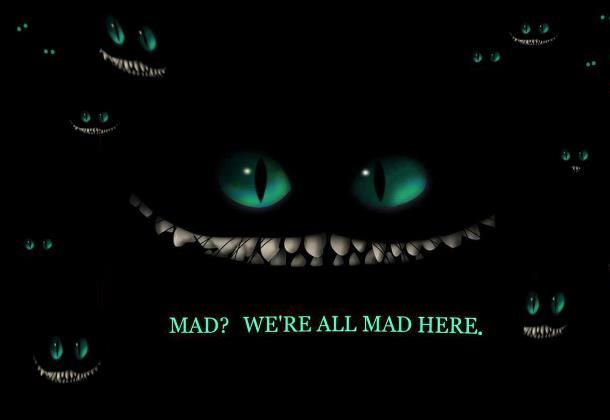
WE’RE ALL MAD HERE

Republished by Blog Post Promoter

“”‘What sort of people live about here?’

‘In THAT direction,’ the Cat said, waving its right paw round, ‘lives

a Hatter: and in THAT direction,’ waving the other paw, ‘lives a March

Hare. Visit either you like: they’re both mad.’

‘But I don’t want to go among mad people,’ Alice remarked.

‘Oh, you can’t help that,’ said the Cat: ‘we’re all mad here. I’m mad.

You’re mad.’

‘How do you know I’m mad?’ said Alice.

‘You must be,’ said the Cat, ‘or you wouldn’t have come here.’

Alice didn’t think that proved it at all; however, she went on ‘And how

do you know that you’re mad?'”

“So, Mr. Dodgson, let me pose the same question to you that young Alice asked of the chimerical cat in your own story: how do you know whether you are mad or not mad? How would you satisfy yourself that I am not mad? How do we know that everyone is mad or not mad?”, I said, rising from my chair to place the manuscript upon the sideboard. 

I refilled my pipe once again, in anticipation of the protracted debate that was sure to follow on the heels of these profoundly absurd, yet existential queries and arguments.

Mr. Dodgson did not seem the least bit nonplused by my insinuation  regarding his sanity, or the sanity of all. Rather, he thanked us very cordially for our hospitality, rose from his chair and reached the door to exit the apartment. As he reached the door he turned back to me. 

“Mr. Holmes, I will leave the resolution of this mystery entirely in your very capable hands. If anyone were able to solve the questions you pose to me, I assure you that I am not that man. Neither are any of the mentors whom I have studied, including Sir Isaac himself. I trust that you will be kind enough to inform me of your eventual success, if such is possible. Good day to you, gentlemen”.

With that, he departed, clomped down the stairs. Through the window we saw him walk briskly away through a light drizzle of rain in the direction of the train station.

“What do you make of it Holmes?”, asked Watson, who seemed to have been disquieted by our visitor. “I must admit that our meeting with this  gentleman is the most perplexing I have ever had,” he said, resuming his seat in front of the fire.

“Yes. Most perplexing, indeed”, I agreed, taking my own seat and refilling my pipe. “Most perplexing.””

— Excerpt from SHERLOCK HOLMES: MY LIFE, by Lawrence R. Spencer

Support independent publishing: Buy this book on Lulu.