Category Archives: UNIVERSES

Universes are comprised of thoughts, ideas, dreams, illusions, delusions, which may also include stars, space, time, energy and objects. Or not. These are the universes of the author Lawrence R. Spencer, and others for whom he has an affinity.

PARADIGM SHIFT

Republished by Blog Post Promoter

“Just because we cannot perceive something, does not mean that it cannot exist.

Science cannot evolve without change, and there is a dire need for change in its fundamental philosophy. The Oxford Dictionary defines Materialism as “the doctrine that nothing exists except matter and its movements and modifications”.

Materialism is the paradigm of scientific philosophy under which the vast majority of contemporary scientists operate. It is essentially the belief that everything can be explained in physical terms, and that there is no need to explore anything further.

Why are most scientists operating within this doctrine when science has already demonstrated many examples of non-physical phenomena? Well, our mainstream science culture certainly tends to reflect materialist values in media such as internet articles and websites, television shows and news, and especially the science curriculum in educational institutions. Since we are all, to a degree, products of our society, it stands to reason that many scientists would hold true to materialism. However, there are many examples of science going beyond the realm of physical reality.

Let’s start with the magnetic force. It cannot be denied that the magnetic force has physical applications and implications, but there is nothing physical about the actual force itself. You can see a magnet, or a magnetically charged metal, but you cannot see what charges it. We can see that a compass points in the north direction. But if the magnetic force itself appeared to us physically in its natural state, does it not stand to reason that the human race would never have had a use for a compass? It is an invisible and non-physical force which affects the physical world.

Light is another example. The light in which we are capable of seeing is just a very small portion of “the electromagnetic spectrum”, which is represented below. the electromagnetic spectrumThe area which is outlined in blue gives a representation of how small that portion is. Radio waves, microwaves, X-rays, UV rays, and gamma rays are all elements of this spectrum as well. Like light waves, we can only see their physical effects, not the radiation itself. For example, you cannot see the UV rays which give you a suntan, you can only see the tan itself. All that we can perceive from the visible light spectrum is the wavelength that it takes when it bounces off physical objects, and we experience this wavelength as a color. Therefore, there is nothing physical about light itself, it simply interacts with physical objects.

The force of gravity is another glaring example. We can see and feel how gravity affects us through its effect on physical objects, but we cannot actually see the force of gravity itself. If we could “see gravity”, then surely someone would have been credited with discovering gravity before Sir Isaac Newton in the 1600’s. Again, a force which in itself is not visible or physical, but has profound effects on the physical world surrounding us.

When you hear modern alternative philosophers use the term “energy” or assert that “everything is energy”, these are some of the types of energies that they are referring to. This theme of non-physical energy only being experienced through their ramifications on physical entities seems to be evident throughout science, yet the idea has little credibility in the scientific community.

The current paradigm of materialism tends to put the physical explanations first, while ignoring the super-physical. This is limiting our range of scientific inquiry. It limits us to only giving scientific due to physical effects, thereby potentially ignoring the cause or origin of a force or entity completely. For example, we do not know if the cause of magnetism, is physical or non-physical, but our current paradigm is only allowing us to explore one option with credibility. We need to open our minds and look at the potential of a non-materialist explanation of such forces.

One thing that bothers modern scientists, is that we have really vague explanations regarding the origins of gravity, magnetism, and light. The best explanation to date regarding the cause of the magnetic force and the photon is that these entities appeared shortly after the “Big Bang”, with all other matter. This is basically like saying, we know they exist, but we do not know why. And since gravity seems to be caused by a moving physical body, gravity would have had to appear when the first physical matter was set in motion in our universe, which is again close to the alleged “Big Bang”.

Materialist scientists, answer me this: How are we supposed to discover the cause or origin of a non-physical entity, like gravity and magnetism, when your fundamental philosophy does not permit you to believe that studying non-physical entities is worthwhile? How do we expect ourselves to advance science to the next paradigm without embracing the idea that more exists than our physical realm?

future scienceAs mentioned, we have not been able to fully explain the effects of gravity, magnetism, and the photon under our current paradigm of thought. It is most certainly time for a new generation of forward-thinking scientists to take a less materialistic approach to explaining these entities instead of taking pages from the old playbook, which has not gotten us far since the time of Einstein.

Could this rationale also be why we have been so unsuccessful at explaining the existence and implications of black holes, as well as the entity that is consciousness?

What amazes me even further, is that materialist scientists, like the rest of us, use technologies which are operational because of these non-physical entities. Basically every one of us have all listened to a radio, had an x-ray done, operated some form of remote control, and used a cell phone or wireless internet. We need such non-physical entities in order to function in today’s society. When is the philosophy upon which our science is based going to catch up to this reality?

So if we change our mindsets and start to take non-physical entities seriously, as a scientific community, this will certainly allow for further exploration of the cause and implications of thoughts, consciousness, and what happens to us after we die. We must shed this outdated notion of materialism in order to maximize our potential in studying these areas of interest.

If you wish to explore the idea of why it is necessary to move past the scientific paradigm of materialism, let Dr. Rupert Sheldrake enlighten you with some theories regarding materialist science in the video below. The fact that his TED talk was not deemed to be “scientific’ enough for the TED indicates that there is a bias towards this methodology of thinking in the scientific world.”

This article is a reprint (with gratitude) from the following link: http://fractalenlightenment.com/33059/issues/its-time-for-a-new-paradigm-of-scientific-thought
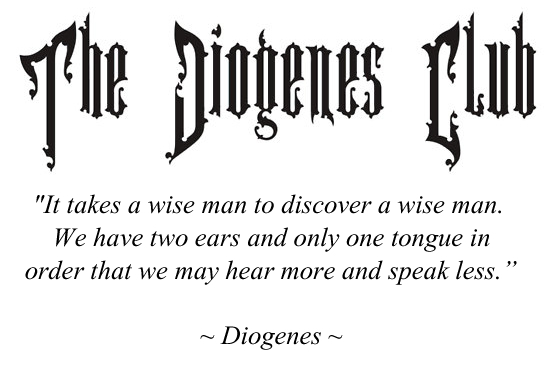

THE DIOGENES CLUB

Republished by Blog Post Promoter

Diogenes sign

“Watson and I gathered our things and a five p.m. set out in a hansom cab from Baker Street to arrive at the one place at which I was certain to locate my brother in the early evening each day: The Diogenes Club.

“There are many men in London, you know, who, some from shyness, some from misanthropy, have no wish for the company of their fellows. Yet they are not averse to comfortable chairs and the latest periodicals. It is for the convenience of these that the Diogenes Club was started, and it now contains the most unsociable and unclubable men in town.

Sherlock-Holmes-My-Life_cover300No member is permitted to take the least notice of any other one. Save in the Stranger’s Room, no talking is, under any circumstances, allowed, and three offenses, if brought to the notice of the committee, render the talker liable to expulsion. My brother was one of the founders, and I have myself found it a very soothing atmosphere.”, I informed Watson as we jostled our way through the streets of London in the cab.

Support independent publishing: Buy this book on Lulu.

This very exclusive men’s club was named after Diogenes, the Cynic. He made a virtue of extreme poverty, begging for a living and sleeping in a large tub in the marketplace. He was notorious for his provocative behavior and philosophical stunts. He carried a lamp in the daytime, claiming to be looking for an honest man. He regularly antagonized Plato, disputing his interpretation of Socrates and sabotaging his lectures. After being captured by pirates and sold into slavery, Diogenes eventually settled in Corinth, where he was befriended by Alexander The Great.

Fundamentally he was a Western contemporary of the ancient Indian ascetics who abstained from worldly possessions and comfort in favor of poverty as an aid toward spiritual purity. He believed that virtue was better revealed in action and not theory. His life was a relentless campaign to debunk the social values and institutions of what he saw as a corrupt society”, I explained to Watson, having read several treatises concerning the life of Diogenes written by modern day Cynics.

Alexander the Great went to meet Diogenes because he was impressed that the philosopher was so highly admired despite having neither money nor power. However, while Diogenes was relaxing in the sunlight one morning, Alexander, thrilled to meet the famous philosopher, asked if there was any favor he might do for him. Diogenes replied, “Yes. Stand out of my sunlight.”

Alexander declared, “If I were not Alexander, then I should wish to be Diogenes”, I said anecdotally, as Watson absorbed my diatribe, as well as the scenery passing by the window of our hansom.

The Diogenes Club was apparently founded, in part, as a front for the SIS, which, as you may know, is the supreme and indispensable brain-trust behind the British government. This organization secures government secrets and advises the best course of covert action to enable Britain to intervene in the affairs of other nations without detection.”

~ excerpt from the book SHERLOCK HOLMES: MY LIFE, by Lawrence R. Spencer

______________________________

Diogenes of Sinope was a Greek philosopher and one of the founders of Cynic philosophyhe was born in modern-day Sinop, Turkey, an Ionian colony on the Black Sea, in 412 or 404 BC and died at Corinth in 323 BC.

— https://en.wikipedia.org/wiki/Diogenes_of_Sinope

ART FOR ART’S SAKE

Republished by Blog Post Promoter

fiji

“Works of art, in my opinion, are the only objects in the material universe to possess internal order, and that is why, though I don’t believe that only art matters, I do believe in Art for Art’s sake.”

—  E. M. Forster,  British novelist (1879 – 1970)

English novelist, short story writer, essayist and librettist. He is known best for his ironic and well-plotted novels examining class difference and hypocrisy in early 20th-century British society. Forster’s humanistic impulse toward understanding and sympathy may be aptly summed up in the epigraph to his 1910 novel Howards End: “Only connect … “. His 1908 novel,  A Room with a View, is his most optimistic work, while A Passage to India (1924) brought him his greatest success.

WHY I LOVE SHERLOCK HOLMES

Republished by Blog Post Promoter

tumblr_mhfaalo5Bt1r1473do1_500If you speak the English language, (which very few American do), you will appreciate that the period during which Arthur Conan Doyle wrote the Sherlock Holmes detective stories was, without question, the most prolific era in English literature.  I have written a fictional “autobiography” which in intended to embody and resurrect the culture, literature and mystique of Great Britain at the pinnacle of it’s Imperialistic and Literary Majesty.  Although the British Empire has relinquished it’s global domination of subservient nations, since World War I, to the burgeoning New World Order the English language now dominates as the preferred language the “gods” of the current era, The International Cabal of Global Corporations.  Ironically, Sherlock Holmes elder brother, Mycroft, was arguably the most powerful man in England, serving the Queen as the unofficial director of the Secret Information Services in the Offices of the Chancellor of The Exchequer.

I love Sherlock Holmes because he is a man of preeminent Sherlock Holmes Audio on AUDIBLE.COM and iTUNESpersonal integrity and idiosyncrasy.  Above all things he loved music and smoking Latakia and Cavendish tobacco in pipes, which were universally smoked by men during the Victorian Age.   I managed a pipe and tobacco store for two years, early in my life, and very much enjoy the avocation of pipe smoking!  I the visual effect of observing smoke drifting in languid drafts toward the ceiling, combined with the elegant flavor of fine pipe tobacco evokes a sublime, meditative state of being.

Mr. Holmes also enjoyed solitude, alchemy, intellectual stimulation, cocaine, mystery, action and adventure!   He disdained personal notoriety, wealth and sex.  Sherlock was an intensely private person, preferring the disheveled, masculine clutter of his rooms at Baker Street, rather than submit himself to the domesticated order of matrimony.  Sherlock was a living demonstration of the adage, “If you want to move quickly, move alone”.

This book incorporates and amalgamates the authors, as characters, and their classic works of fiction of the 19th century, into the professional and private life of Sherlock Holmes — as a living, rather than fictional, person —  including:  Peter Pan, Dr. Jekyll and Mr. Hyde, Frankenstein, Dracula, Alice in Wonderland, as well as all of the Adventures of Sherlock Holmes, and the infamous life of Sir Arthur Conan Doyle himself!

During my many years invested in the creation of the Sherlock Holmes “autobiography” I read everything written by Arthur Conan Doyle and about him as an individual.  I read all of the literature of the age.  Moreover, I applied the principles of investigatory observation for which Sherlock Holmes is universally famous to discover that, in fact, Sherlock Holmes was a real person!  The details of an extensive and elaborately convoluted conspiracy to dehumanize the greatest detective in history are revealed herein….

Click here to listen to the first 15 minutes of the Audio Book version of my book, Sherlock Holmes – My Life. 

Content of this 15 minute audio presentation:

1) FORWARD: by Mycroft Holmes, and  2) AN OPEN LETTER FROM SHERLOCK HOLMES