Republished by Blog Post Promoter

Universes are comprised of thoughts, ideas, dreams, illusions, delusions, which may also include stars, space, time, energy and objects. Or not. These are the universes of the author Lawrence R. Spencer, and others for whom he has an affinity.
Republished by Blog Post Promoter
Republished by Blog Post Promoter

At the center of the Norse spiritual cosmos is an ash tree, Yggdrasil (pronounced “IG-druh-sill”; Old Norse Askr Yggdrasils), which grows out of the Well of Urd (Old Norse Urðarbrunnr). The Nine Worlds are held in the branches and roots of the tree. The name Askr Yggdrasils probably strikes most modern people as being awkwardly complex. It means “the ash tree of the horse of Yggr.”[1] Yggr means “The Terrible One,” and is a byname of Odin. The horse of Odin is Sleipnir. This may seem like a puzzling name for a tree, but it makes sense when one considers that the tree as a means of transportation between worlds is a common theme in Eurasian shamanism.[2] Odin rides Sleipnir up and down Yggdrasil’s trunk and through its branches on his frequent journeys throughout the Nine Worlds. “Urd” (pronounced “URD”; Old Norse Urðr, Old English Wyrd) means “destiny.” The Well of Urd could therefore just as aptly be called the Well of Destiny.
One of the poems in the Poetic Edda, Völuspá or “The Insight of the Seeress,” describes the scene thus:
There stands an ash called Yggdrasil,
A mighty tree showered in white hail.
From there come the dews that fall in the valleys.
It stands evergreen above Urd’s Well.From there come maidens, very wise,
Three from the lake that stands beneath the pole.
One is called Urd, another Verdandi,
Skuld the third; they carve into the tree
The lives and destinies of children.[3]
These three maidens are the Norns, and their carvings consist of runes, the magical alphabet of the ancient Germanic peoples.
In addition to the inhabitants of the Nine Worlds, several beings live in, on, or under the tree itself. The Eddic poem Grímnismál, “The Song of the Hooded One,” mentions many of them – but, unfortunately, only in passing. An anonymous eagle perches in the upper branches of the tree. A number of dragons or snakes, most notably Nidhogg, gnaw at the roots from below. A squirrel, Ratatosk, carries messages (presumably malicious ones) between Nidhogg and the eagle. Four deer, Dain, Dvalin, Duneyr, and Dyrathror, nibble the highest shoots.[4]
A Model of Time and Destiny
It’s important to keep in mind that the image of Yggdrasil and the Well of Urd is a myth, and therefore portrays the perceived meaning or essence of something rather than merely describing the thing’s physical characteristics. Yggdrasil and the Well of Urd weren’t thought of as existing in a single physical location, but rather dwell within the invisible heart of anything and everything.
Fundamentally, this image expresses the indigenous Germanic perspective on the concepts of time and destiny.
As Paul Bauschatz points out in his landmark study The Well and the Tree: World and Time in Early Germanic Culture, Yggdrasil and the Well of Urd correspond to the two tenses of Germanic languages. Even modern English, a Germanic language, still has only two tenses: 1) the past tense, which includes events that are now over (“It rained”) as well as those that began in the past and are still happening (“It has been raining”), and 2) the present tense, which describes events that are currently happening (“It is raining”). Unlike Romance languages such as Spanish or French, for example, Germanic languages have no true future tense. Instead, they use certain verbs in the present tense to express something similar to futurity, such as “will” or “shall” (“I will go to the party” or “It shall rain”). Rather than “futurity,” however, what these verbs express could more accurately be called “intention” or “necessity.”
The Well of Urd corresponds to the past tense. It is the reservoir of completed or ongoing actions that nourish the tree and influence its growth. Yggdrasil, in turn, corresponds to the present tense, that which is being actualized here and now.
What of intention and necessity, then? This is the water that permeates the image, flowing up from the well into the tree, dripping from the leaves of the tree as dew, and returning to the well, where it then seeps back up into the tree.[5]
Here, time is cyclical rather than linear. The present returns to the past, where it retroactively changes the past. The new past, in turn, is reabsorbed into a new present, whose originality is an outgrowth of the give-and-take between the waters of the well and the the waters of the tree.
This provides a framework within which we can understand the Germanic view of destiny. The residents of the Well of Urd, the Norns, design the earliest form of the destinies of all of the beings who live in the Nine Worlds of Yggdrasil, from humans to slugs to gods to giants. In contrast to the Greek concept of fate, however, all beings who are subject to destiny have some degree of agency in shaping their own destiny and the destinies of others – this is the dew that falls back into the well from the branches of the tree, accordingly reshaping the past and its influence upon the present. All beings do this passively; those who practice magic do it actively. (In fact, one could accurately say that, in the surviving accounts of the practice of magic in ancient Germanic societies, magic is viewed as being precisely the process of gaining a greater degree of control over destiny.) There is no absolutely free will, just as there is no absolutely unalterable fate; instead, life is lived somewhere between these two extremes. A fuller discussion of the ancient Germanic view of destiny can be found here.
Creation as an Ongoing Process
When we consider the elements of time and destiny together, we arrive at a fascinating and compelling model of the process of creation itself. While Norse mythology does contain a tale that can be considered a creation narrative, that tale only tells of the initial shaping of the cosmos. In the image of Yggdrasil and the Well of Urd, we find a continuation of this tale. Creation is an ongoing process in which everything, from a goddess to a speck of dirt, participates. In the well-known Christian model of creation, one being (God) made the world all by himself in a single act that occurred at some specific point in the past. As a result, all beings are nothing more than his “Creation,” defined and determined by his omnipotent will. By contrast, the Germanic model implicitly claims that we are all created creators, carrying forward the world’s ceaseless reinvention of itself. As the famous naturalist and conservationist John Muir wrote, “I used to envy the father of our race, dwelling as he did in contact with the new-made fields and plants of Eden; but I do so no more, because I have discovered that I also live in creation’s dawn.”[6]
Looking for more great information on Norse mythology and religion? While this site provides the ultimate online introduction to the topic, my book The Viking Spirit provides the ultimate introduction to Norse mythology and religion period. I’ve also written a popular list of The 10 Best Norse Mythology Books, which you’ll probably find helpful in your pursuit.
 References:
[1] Simek, Rudolf. 1993. Dictionary of Northern Mythology. Translated by Angela Hall. p. 375.
[2] Eliade, Mircea. 1964. Shamanism: Archaic Techniques of Ecstasy. Translated by Willard Trask. p. 37.
[3] My own translation. The original Old Norse verses are:
19.
Ask veit ek standa,
heitir Yggdrasils,
hár baðmr, ausinn
hvíta auri;
þaðan koma döggvar,
þærs í dala falla,
stendr æ yfir grænn
Urðarbrunni.20.
Þaðan koma meyjar
margs vitandi
þrjár ór þeim sæ,
er und þolli stendr;
Urð hétu eina,
aðra Verðandi,
– skáru á skíði, –
Skuld ina þriðju;
þær lög lögðu,
þær líf kuru
alda börnum,
örlög seggja.
[4] The Poetic Edda. Grímnismál, stanzas 32-34.
[5] Bauschatz, Paul C. 1982. The Well and the Tree: World and Time in Early Germanic Culture.
[6] Muir, John. 1938. John of the Mountains: The Unpublished Journals of John Muir. p. 72.the
Visit the website of the author at: http://norse-mythology.org/cosmology/yggdrasil-and-the-well-of-urd/
Republished by Blog Post Promoter
Nikola Tesla: Inventions In Three-Dimensions from The Tesla Science Foundation on Vimeo.
Republished by Blog Post Promoter
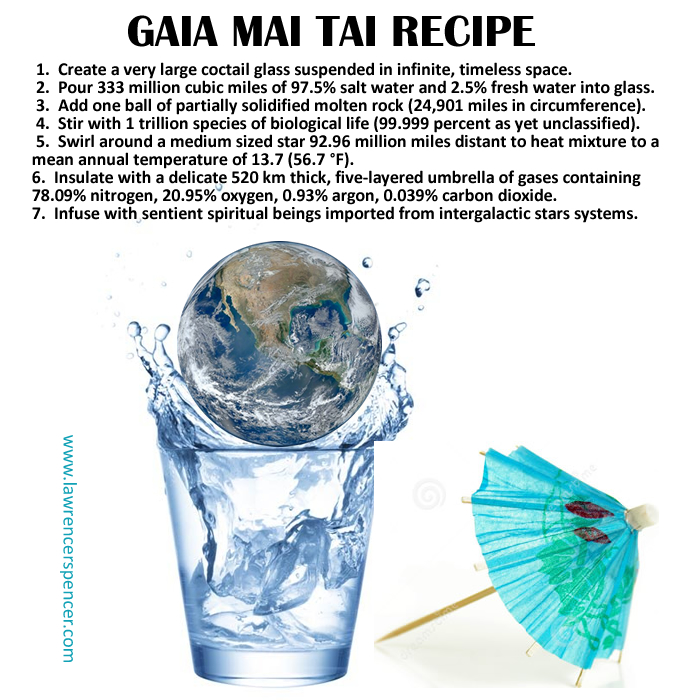
* GAIA, meaning Earth, elated to the Avestan word gaiia ‘life;’ cf. Av. gaēθā ‘(material) world, totality of creatures’ and gaēθiia ‘belonging to/residing in the worldly/material sphere, material’; or perhaps Av, gairi ‘mountain’. Gaia is the ancestral mother of all life: the primal Mother Earth goddess. She is the immediate parent of Uranus (the sky), from whose sexual union she bore the Titans (themselves parents of many of the Olympian gods) and the Giants, and of Pontus (the sea), from whose union she bore the primordial sea gods.
Mai Tai is an alcoholic cocktail based on rum, Curaçao liqueur and lime juice, associated with Polynesian-style settings. “Maita’i” is the Tahitian word for “good”.
Republished by Blog Post Promoter
Here are photographs of each man which have recently been “colorized” from the black and white original pictures, by the photographer Dana Keller. Her colorization brings these men “to life”, and reminds me that they are still alive through the poetic wisdom of Whitman, the world changing inventions of Tesla, and a wealth of words in the books of Twain.
These are three of the GREATEST men on modern civilization. Each of them were”sages”. (Definition: “SAGE” = The sage does not love or seek wisdom, because he already has wisdom. According to Plato, there are two categories of beings who do not do philosophy: 1) Gods and sages, because they are wise 2) senseless people, because they think they are wise.
These men lived, as we continue to do, in a Savage Society. We are “savage” in the sense that we worship or condone murder (war), greed, and violence toward each other and every life form on Earth. Warfare is nearly continuous during the entire history of humanity. Within 50 years, ONE HALF OF ALL SPECIES OF LIFE on Earth will have come extinct. In western society the wealthy, the monarchs, the corrupt politicians, the military, the criminal bankers, the strong athlete, the Super Hero, etc., are revered as though they were “gods”. They are conceived by the majority to be “the good guys” in our “civilized” society.
In contrast, the following three men (Walt Whitman, Nikola Tesla and Mark Twain) possessed the wisdom of a sage, the revolutionary genius of inventive imagination and ability, and gentle courage and personal integrity that are nearly beyond comprehension in the Age of Twitter and Monday Night Football.
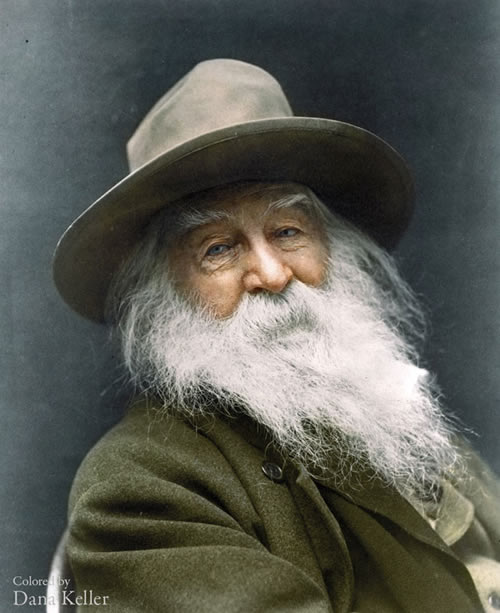
THE GREATEST AMERICAN POET
Walter “Walt” Whitman (May 31, 1819 – March 26, 1892)
“This is what you shall do: Love the earth and sun and the animals, despise riches, give alms to every one that asks, stand up for the stupid and crazy, devote your income and labor to others, hate tyrants, argue not concerning God, have patience and indulgence toward the people, take off your hat to nothing known or unknown or to any man or number of men, go freely with powerful uneducated persons and with the young and with the mothers of families, read these leaves in the open air every season of every year of your life, re examine all you have been told at school or church or in any book, dismiss whatever insults your own soul, and your very flesh shall be a great poem and have the richest fluency not only in its words but in the silent lines of its lips and face and between the lashes of your eyes and in every motion and joint of your body. . . . The poet shall not spend his time in unneeded work. He shall know that the ground is always ready ploughed and manured . . . . others may not know it but he shall. He shall go directly to the creation. His trust shall master the trust of everything he touches . . . . and shall master all attachment.”
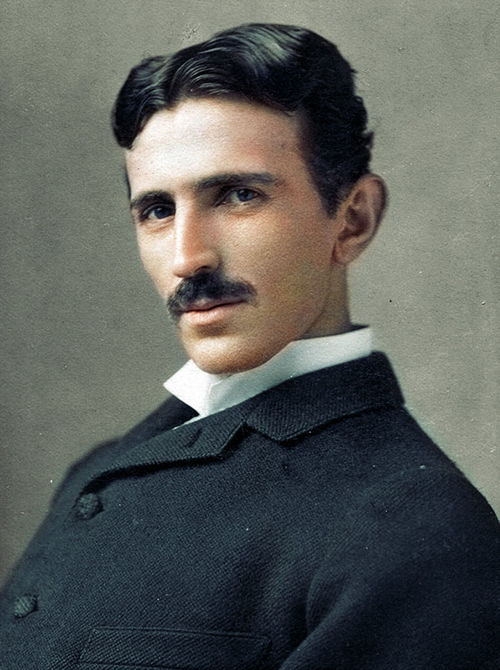
THE GREATEST INVENTOR IN THE HISTORY OF EARTH
Nikola Tesla (10 July 1856 – 7 January 1943)
“Like a wave in the physical world, in the infinite ocean of the medium which pervades all, so in the world of organisms, in life, an impulse started proceeds onward, at times, may be, with the speed of light, at times, again, so slowly that for ages and ages it seems to stay, passing through processes of a complexity inconceivable to men, but in all its forms, in all its stages, its energy ever and ever integrally present. A single ray of light from a distant star falling upon the eye of a tyrant in bygone times may have altered the course of his life, may have changed the destiny of nations, may have transformed the surface of the globe, so intricate, so inconceivably complex are the processes in Nature.”
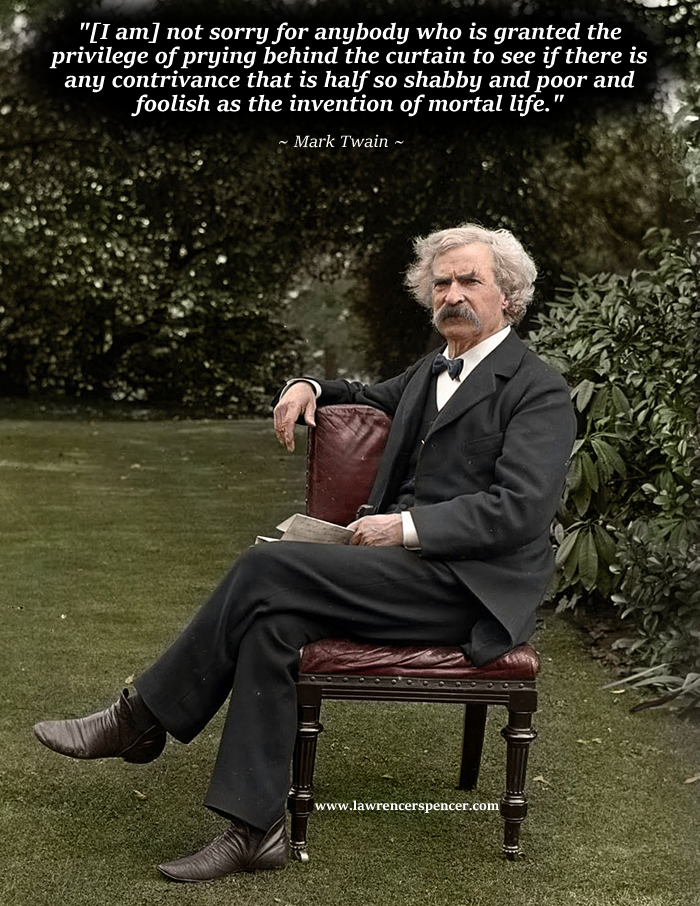
THE GREATEST AMERICAN WRITER
Samuel Langhorne Clemens (November 30, 1835 – April 21, 1910), who was a personal friend of Nikola Tesla.
“We are strangely made. We think we are wonderful creatures. Part of the time we think that, at any rate. And during that interval we consider with pride our mental equipment, with its penetration, its power of analysis, its ability to reason out clear conclusions from confused facts, and all the lordly rest of it; and then comes a rational interval and disenchants us. Disenchants us and lays us bare to ourselves, and we see that intellectually we are no great things; that we seldom really know the things we think we know; that our best-built certainties are but sand-houses and subject to damage from any wind of doubt that blows.”
“Man seems to be a rickety poor sort of a thing, any way you take him; a kind of British Museum of infirmities and inferiorities. He is always undergoing repairs. A machine that was as unreliable as he is would have no market.”
“Man is the only animal that deals in that atrocity of atrocities, War. He is the only one that gathers his brethren about him and goes forth in cold blood and calm pulse to exterminate his kind. He is the only animal that for sordid wages will march out, as the Hessians did in our Revolution, and as the boyish Prince Napoleon did in the Zulu war, and help to slaughter strangers of his own species who have done him no harm and with whom he has no quarrel.”
“The Damned Human Race,” v: The Lowest Animal, by Mark Twain