Republished by Blog Post Promoter
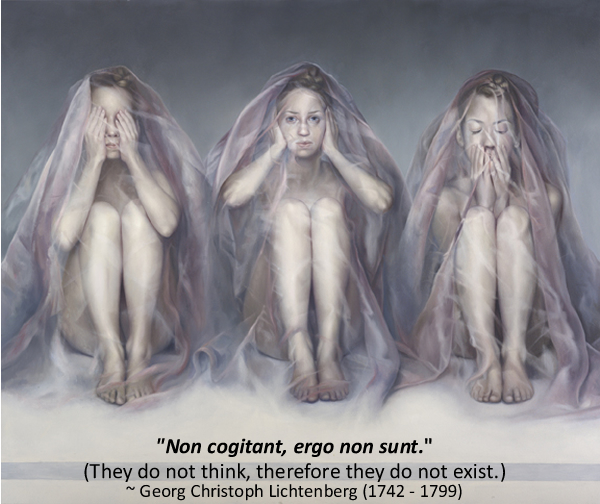 (image: Shizaru by Ewelina Koszykowska)
COGITANT ~ from Latin, Present participle of cogitare. “to think”

Books I read & recommend
Republished by Blog Post Promoter
(image: Shizaru by Ewelina Koszykowska)
COGITANT ~ from Latin, Present participle of cogitare. “to think”
Republished by Blog Post Promoter
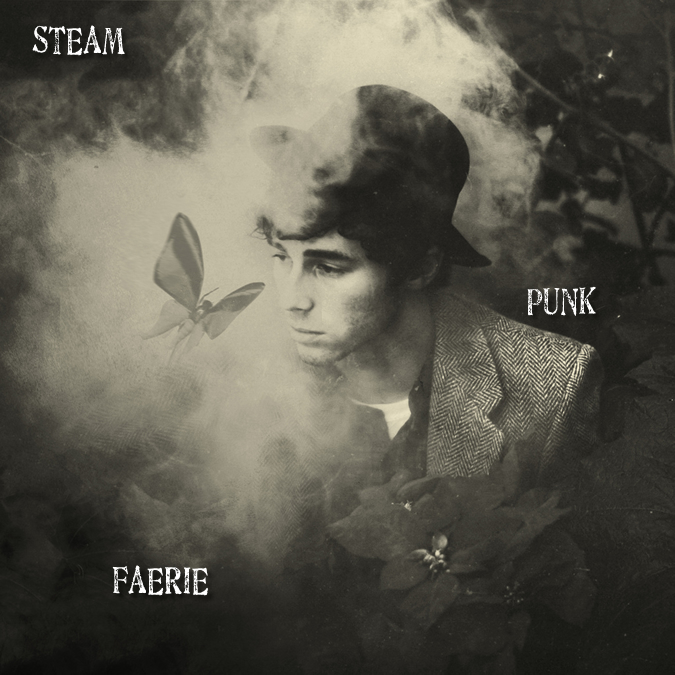
STEAMPUNK
Steampunk is a genre which came into prominence during the 1980s and early 1990s and incorporates elements of science fiction, fantasy, alternate history, horror, and speculative fiction. It involves a setting where steam power is widely used—whether in an alternate history such as Victorian era Britain or “Wild West”-era United States, or in a post-apocalyptic time —that incorporates elements of either science fiction or fantasy. Works of steampunk often feature anachronistic technology, or futuristic innovations as Victorians might have envisioned them, based on a Victorian perspective on fashion, culture, architectural style, and art. This technology includes such fictional machines as those found in the works of H. G. Wells and Jules Verne, or the contemporary authors Philip Pullman, Scott Westerfeld and China Mieville.
Other examples of steampunk contain alternative history-style presentations of such technology as lighter-than-air airships, analog computers, or such digital mechanical computers as Charles Babbage and Ada Lovelace’sAnalytical Engine.
Steampunk also refers to art, fashion, and design that are informed by the aesthetics of Steampunk literature. Various modern utilitarian objects have been modded by individual artisans into a pseudo-Victorian mechanical “steampunk” style, and a number of visual and musical artists have been described as steampunk. Steampunk is most directly influenced by, and often adopts the style of, the 19th century scientific romances of Jules Verne, H.G. Wells, and Mary Shelley.
FAERIE
The word fairy derives from Middle English faierie (also fayerye, feirie, fairie), a direct borrowing from Old French faerie (Modern French féerie) meaning the land, realm, or characteristic activity (i.e. enchantment) of the legendary people of folklore and romance called (in Old French) faie or fee (Modern French fée). This derived ultimately from Late Latin fata (one of the personified Fates, hence a guardian or tutelary spirit, hence a spirit in general); cf. Italian fata, Portuguese fada, Spanish hada of the same origin.
Fata, although it became a feminine noun in the Romance languages, was originally the neuter plural (“the Fates”) of fatum, past participle of the verb fari to speak, hence “thing spoken, decision, decree” or “prophetic declaration, prediction”, hence “destiny, fate”. It was used as the equivalent of the Greek Μοῖραι Moirai, the personified Fates who determined the course and ending of human life.
To the word faie was added the suffix -erie (Modern English -(e)ry), used to express either a place where something is found (fishery, heronry, nunnery) or a trade or typical activity engaged in by a person (cookery, midwifery, thievery). In later usage it generally applied to any kind of quality or activity associated with a particular sort of person, as in English knavery, roguery, witchery, wizardry.
Faie became Modern English fay “a fairy”; the word is, however, rarely used, although it is well known as part of the name of the legendary sorceress Morgan le Fay of Arthurian legend. Faierie became fairy, but with that spelling now almost exclusively referring to one of the legendary people, with the same meaning as fay. In the sense “land where fairies dwell”, the distinctive and archaic spellings Faery and Faerie are often used. Faery is also used in the sense of “a fairy”, and the back-formation fae, as an equivalent or substitute for fay is now sometimes seen.
The word fey, originally meaning “fated to die” or “having forebodings of death” (hence “visionary”, “mad”, and various other derived meanings) is completely unrelated, being from Old English fæge, Proto-Germanic *faigja- and Proto-Indo-European *poikyo-, whereas Latin fata comes from the Indo-European root *bhã- “speak”. Due to the identical pronunciation of the two words, “fay” is sometimes misspelled “fey”.
Fairies are generally described as human in appearance and having magical powers. Their origins are less clear in the folklore, being variously dead, or some form of demon, or a species completely independent of humans or angels.[3] Folklorists have suggested that their actual origin lies in a conquered race living in hiding,[4] or in religious beliefs that lost currency with the advent of Christianity. These explanations are not necessarily incompatible, and they may be traceable to multiple sources.
Much of the folklore about fairies revolves around protection from their malice, by such means as cold iron (iron is like poison to fairies, and they will not go near it) or charms of rowan and herbs, or avoiding offense by shunning locations known to be theirs.[6] In particular, folklore describes how to prevent the fairies from stealing babies and substituting changelings, and abducting older people as well. Many folktales are told of fairies, and they appear as characters in stories from medieval tales of chivalry, to Victorian fairy tales, and up to the present day in modern literature. ( Reference: Wikipedia.org)
Republished by Blog Post Promoter
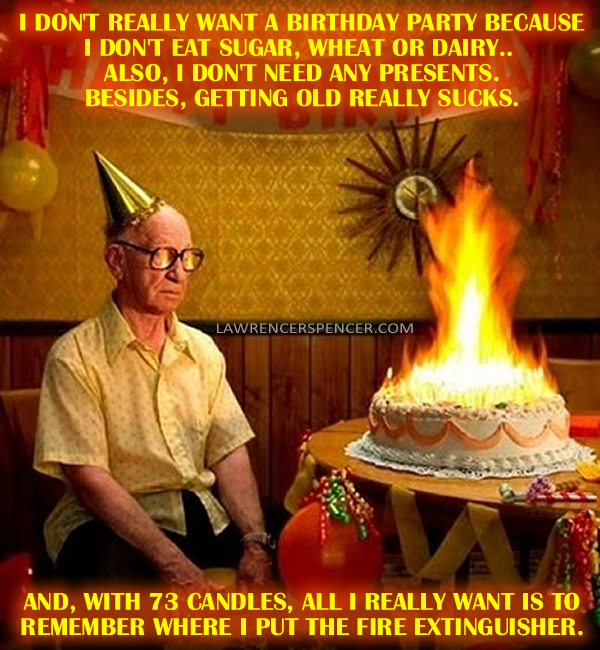
My birthday countdown to the “BIG 73” starts today…. actually it’s taken almost 73 years for my body to get here…. I’ve been ignoring the signs and symptoms, but, Alas, for biological bodies, reality is real…. of all the lifetimes I’ve lived on Earth, I don’t remember having a body that lived this long…. it’s weird….
Republished by Blog Post Promoter