Category Archives: READING MATTER

Books I read & recommend

THE DIOGENES CLUB

Republished by Blog Post Promoter
Diogenes sign

“Watson and I gathered our things and a five p.m. set out in a hansom cab from Baker Street to arrive at the one place at which I was certain to locate my brother in the early evening each day: The Diogenes Club.

“There are many men in London, you know, who, some from shyness, some from misanthropy, have no wish for the company of their fellows. Yet they are not averse to comfortable chairs and the latest periodicals. It is for the convenience of these that the Diogenes Club was started, and it now contains the most unsociable and unclubable men in town.

Sherlock-Holmes-My-Life_cover300No member is permitted to take the least notice of any other one. Save in the Stranger’s Room, no talking is, under any circumstances, allowed, and three offenses, if brought to the notice of the committee, render the talker liable to expulsion. My brother was one of the founders, and I have myself found it a very soothing atmosphere.”, I informed Watson as we jostled our way through the streets of London in the cab.

Support independent publishing: Buy this book on Lulu.

This very exclusive men’s club was named after Diogenes, the Cynic. He made a virtue of extreme poverty, begging for a living and sleeping in a large tub in the marketplace. He was notorious for his provocative behavior and philosophical stunts. He carried a lamp in the daytime, claiming to be looking for an honest man. He regularly antagonized Plato, disputing his interpretation of Socrates and sabotaging his lectures. After being captured by pirates and sold into slavery, Diogenes eventually settled in Corinth, where he was befriended by Alexander The Great.

Fundamentally he was a Western contemporary of the ancient Indian ascetics who abstained from worldly possessions and comfort in favor of poverty as an aid toward spiritual purity. He believed that virtue was better revealed in action and not theory. His life was a relentless campaign to debunk the social values and institutions of what he saw as a corrupt society”, I explained to Watson, having read several treatises concerning the life of Diogenes written by modern day Cynics.

Alexander the Great went to meet Diogenes because he was impressed that the philosopher was so highly admired despite having neither money nor power. However, while Diogenes was relaxing in the sunlight one morning, Alexander, thrilled to meet the famous philosopher, asked if there was any favor he might do for him. Diogenes replied, “Yes. Stand out of my sunlight.”

Alexander declared, “If I were not Alexander, then I should wish to be Diogenes”, I said anecdotally, as Watson absorbed my diatribe, as well as the scenery passing by the window of our hansom.

The Diogenes Club was apparently founded, in part, as a front for the SIS, which, as you may know, is the supreme and indispensable brain-trust behind the British government. This organization secures government secrets and advises the best course of covert action to enable Britain to intervene in the affairs of other nations without detection.”

~ excerpt from the book SHERLOCK HOLMES: MY LIFE, by Lawrence R. Spencer

______________________________

Diogenes of Sinope was a Greek philosopher and one of the founders of Cynic philosophyhe was born in modern-day Sinop, Turkey, an Ionian colony on the Black Sea, in 412 or 404 BC and died at Corinth in 323 BC.

— https://en.wikipedia.org/wiki/Diogenes_of_Sinope

CREATURES OF NATURE

Republished by Blog Post Promoter

CREATURES OF NATURE3Equality is an idea that individual members of a mass of beings have equal rights to action, self-possession and thought.
Aristocracy is the unchallengable right of power, control and possession of an entitled few over subservient individuals.
In nature these ideas are pre-programmed into the essence and behavior of every living creature, according to their nature.
Humans beings are creatures of nature.

~ lawrence r. spencer ~

ILLUSIONS OF SENTIENCE

Republished by Blog Post Promoter

In the philosophy of consciousness, “sentience” can refer to the ability of any entity to have subjective perceptual experiences.  This is distinct from other aspects of the mind and consciousness, such as creativity, intelligence, sapience, self-awareness, and intentionality (the ability to have thoughts that mean something or are “about” something). Sentience is a minimalistic way of defining “consciousness“, which is otherwise commonly used to collectively describe sentience plus other characteristics of the mind.

Eastern religions including Hinduism, Buddhism, Sikhism, and Jainism recognize non-humans as sentient beings.According to Buddhism, sentient beings made of pure consciousness are possible. In Buddhism, the concept is related to the Bodhisattva, an enlightened being devoted to the liberation of others. The first vow of a Bodhisattva states: “Sentient beings are numberless; I vow to free them.”  Sentience in Buddhism is the state of having senses (sat + ta in Pali, or sat + tva in Sanskrit). In Buddhism, the senses are six in number, the sixth being the subjective experience of the mind. Thus, an animal qualifies as a sentient being.

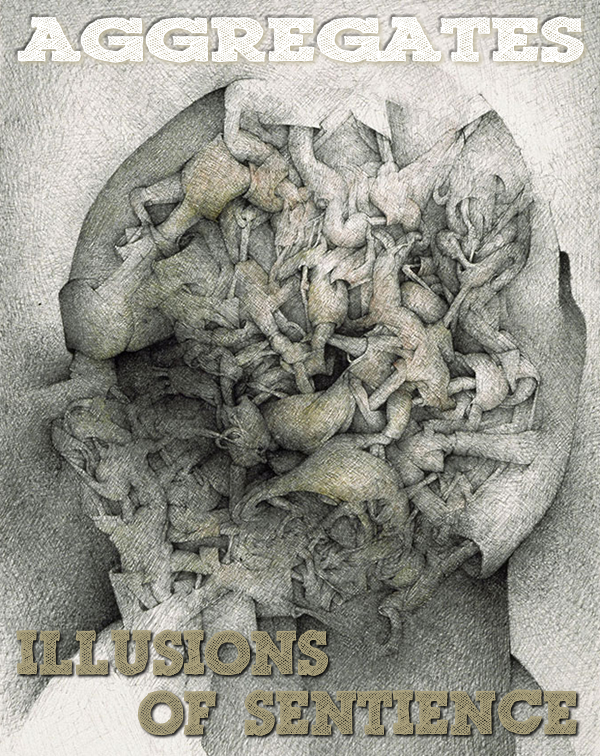
In Buddhism the skandhas (or aggregates in English) are the five functions or aspects that constitute the human being.  The Buddha teaches that nothing among them is really “I” or “mine”.  Suffering arises when one identifies with or clings to an aggregate. Suffering is extinguished by relinquishing attachments to aggregates.

The five skandhas:

  1. “form” or “matter”  external and internal matter. Externally, is the physical world. Internally, this  includes the material body and the physical sense organs.
  2. “sensation” or “feeling”, sensing an objectas either pleasant or unpleasant or neutral.
  3. “perception”, “conception”, “apperception”, “cognition”, or “discrimination”, registers whether an object is recognized or not (for instance, the sound of a bell or the shape of a tree).
  4. “mental formations”, “impulses”, “volition”, or “compositional factors”, all types of mental habits, thoughts, ideas, opinions, prejudices, compulsions, and decisions triggered by an object.
  5. “consciousness” or “discernment”

The Buddhist literature describes the aggregates as arising in a linear or progressive fashion, from form to feeling, to perception, to mental formations to consciousness.  In the early texts, the scheme of the five aggregates is not meant to be an exhaustive classification of the human being. Rather it describes various aspects of the way an individual manifests.

  1. Understanding suffering: the five aggregates are the “ultimate referent” in the Buddha’s elaboration on suffering in his First Noble Truth: “Since all four truths revolve around suffering, understanding the aggregates is essential for understanding the Four Noble Truths as a whole.”
  2. Clinging causes future suffering: the five aggregates are the substrata for clinging and thus “contribute to the causal origination of future suffering”.
  3. Release from samsara: clinging to the five aggregates must be removed in order to achieve release from samsara, literally meaning “continuous flow”, is the repeating cycle of birth, life, death and rebirth (reincarnation)

— I HAVE EXCERPTED THE TEXT ABOVE FROM VARIOUS ARTICLES AND LINKS FOUND IN WIKIPEDIA.ORG  (LRS)