Republished by Blog Post Promoter

miscellaneous postings by Lawrence R. Spencer
Republished by Blog Post Promoter
Republished by Blog Post Promoter
Jews Worldwide Declare War on Germany in 1933
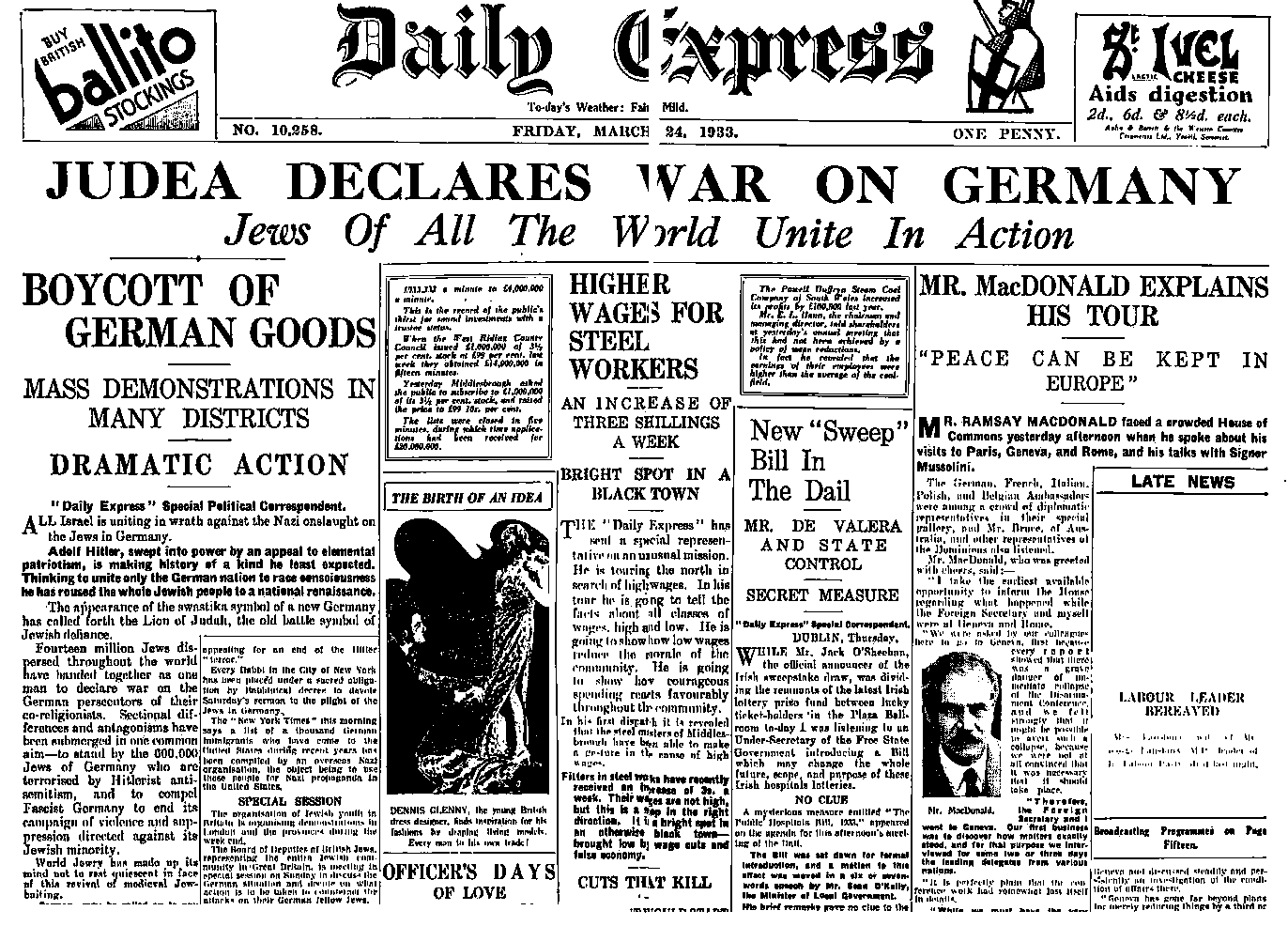
As published in the March 24, 1933 edition of the Daily Express in England in an article entitled “Judea Declares War On Germany”, international jewish leaders announced: “The Israeli people around the world declare economic and financial war against Germany. Fourteen million Jews stand together as one man, to declare war against Germany.”

Chaim Weizmann, President of the World Jewish Congress made the following statement in a speech in New York in December 1942:
“We are not denying and are not afraid to confess that this war is our war and that it is waged for the liberation of Jewry… Stronger than all fronts together is our front, that of Jewry. We are not only giving this war our financial support on which the entire war production is based, we are not only providing our full propaganda power which is the moral energy that keeps this war going.”
“We managed to drag the United States into the First World War and if they (the US) do what we demand in regards to Palestine and the Jewish armed forces, then we can get the Jews in the USA to drag the United States into this one (the Second World War) too.” – Chaim Weizmann to Winston Churchill (September 1941)
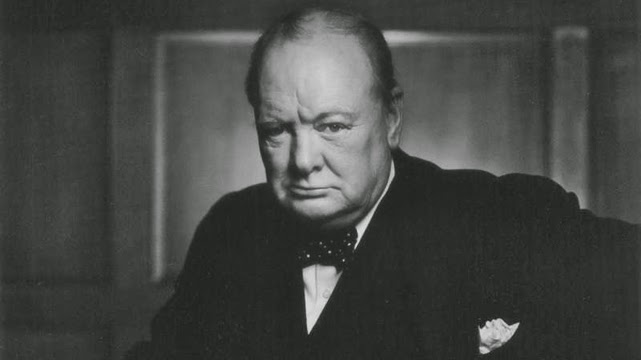 Winston Churchill, Jewish Prime Minister of the U.K., admits that the real reason for the war was to defend the financial interests of the international Jewish banking cabal, which rules the world
“Germany’s unforgivable crime before the second world war was her attempt to extricate her economic power from the world’s trading system and to create her own exchange mechanism which would deny world finance its opportunity to profit.” – Winston Churchill to Lord Robert Boothby, quoted in the Foreword, 2nd Ed. Sydney Rogerson, ‘Propaganda in the Next War‘ 2001
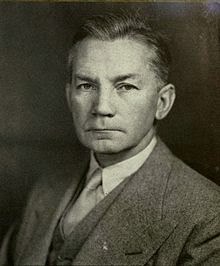 U.S. Secretary of Defense James Forrestal admits World Jewry pushed England and the U.S. into war with Germany
“I asked Joe Kennedy (US ambassador in London) about his talks with Roosevelt and N. Chamberlain in 1938. He said it had been Chamberlain´s belief in 1939 that Great Britain has nothing in its hands to fight and therefore wouldn´t dare to go to war against Hitler…Neither the French nor the English would have made Poland a motive for war if they hadn´t been continuously spurred on by Washington…America and the World-Jewry have driven England to war.”
– US Secretary of Defense James Forrestal 27.12.1945 in his diary (The Forrestal Diaries, New York, 1951, S. 121 ff)
Forrestal became an opponent of the jewish/Zionist power structure (for example, stating his opposition to the establishment of the state of “Israel”), and was forced out of his position as U.S. Secretary of Defense in March of 1949. He reportedly intended to buy a newspaper and write a book exposing secrets surrounding the Roosevelt and Truman administrations, especially the jewish interests that caused World War Two. Before he could complete these tasks, Forrestal was murdered in May 1949, with his death covered up as a “suicide”. To this day, kosher “historians” continue to characterize Forrestal and an “anti-Semite” and “nut”.
Republished by Blog Post Promoter
“The primary difference between IS-BEs of The Domain and those of the physical universe is the condition known as “games”. In The Domain it has long been observed that in order for each individual IS-BE to remain free from intrusion or tyranny imposed on them by more powerful, or less ethical IS-BEs, we must cooperate to defend and nurture each other. A principle of benevolent mutual respect for all IS-BEs, and the universes they create / occupy, is referred to as “All-Mother”.
“All-Mother” is a philosophy in which the behavior or conduct of an individual and groups of IS-BEs is adjudicated based on the logical premise that in order to sustain optimum freedom, order and serenity for all IS-BEs, each IS-BE must serve all IS-BEs.
This premise is not intended to eliminate disagreements between IS-BEs, but to mitigate destruction or chaotic behavior between them.
“All-Mother” assures the inherent right of an individual IS-BE to approach, depart from, or not interact, with other IS-BEs while maintaining an optimum serenity.
The purpose of The Domain is to defend the right of an individual or group of IS-BEs to create a universe, or not, at their own discretion.
It has been observed that when responsibility for maintaining organization within the co-created universe shared by all IS-BEs is not defended and preserved, each individual IS-BE is deprived of the freedom assured by the power of a collaborative, creative will and combined power.
 The Omniscient and Omnipotent Matriarch (abbrev: Omnimat) is an IS-BE who acts as magistrate of The Domain.
To the degree that IS-BEs of The Domain do not need or desire admiration, and are not compelled to “play” a game at all times, the power, stability and serenity of The Domain remains relatively stable, when compared to the physical universe.
(The physical universe is, by definition, an infinite, icy void cluttered with random sources of savage energy combined with mindless chunks of matter. The massive and chaotic construction of the physical universe is utterly antipathetic to the spiritual “nothingness” which is the intelligent source of life forms and of universes.)
WE CREATE THE ETERNALLY BENEVOLENT DOMAIN!”
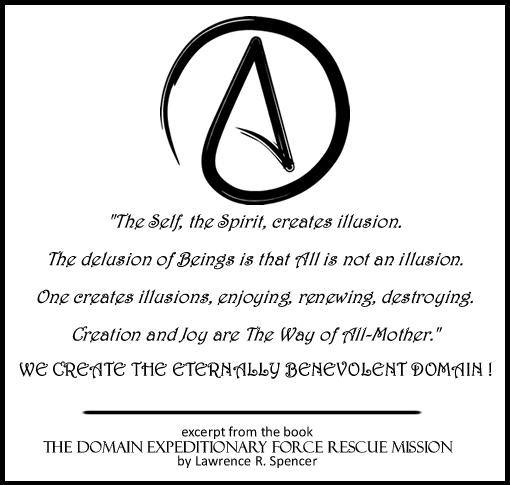
“The Self, the Spirit, creates illusion.
The delusion of Beings is that All is not an illusion.
One creates illusions, enjoying, renewing, destroying.
Creation and Joy are The Way of All-Mother.”
I am present, as Omnimat is present, in the eternal now. ”
_______________
Excerpt from THE DOMAIN EXPEDITIONARY FORCE RESCUE MISSION, by Lawrence R. Spencer
Republished by Blog Post Promoter
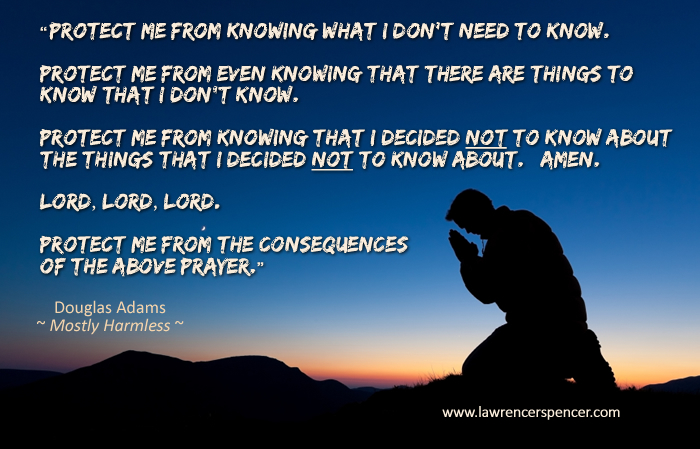
~ Douglas Adams ~
from “Mostly Harmless”
Republished by Blog Post Promoter
Some priests will do or say anything to recruit devotes into a cult.
Kunga Legpai Zangpo (1455 – 1529), was also known by other names such as Drukpa Kunley, Drukpa Kunleg, and “The Divine Madman of the Dragon Lineage” Kunga Legpa. He was a great master ofMahamudra in the Buddhist tradition, as well as being a famous poet. He was known for his crazy methods of enlightening other beings, mostly women, which earned him the title “The Saint of 5,000 Women“. Women would seek his blessing in the form of sex. However, the female consort had/has an important (albeit secret) role in many monasteries in the East. (Wikipedia.org)
Poem about happiness
I am happy that I am a free Yogi.
So I grow more and more into my inner happiness.
I can have sex with many women,
because I help them to go the path of enlightenment.
Outwardly I’m a fool
and inwardly I live with a clear spiritual system.
Outwardly, I enjoy wine, women and song.
And inwardly I work for the benefit of all beings.
Outwardly, I live for my pleasure
and inwardly I do everything in the right moment.
Outwardly I am a ragged beggar
and inwardly a blissful Buddha.