Republished by Blog Post Promoter
 “As the Christian Church became more organized and regimented, it progressively absorbed the populations of the ancient Western world like A Great Sponge. It soaked up the common denominator of the local Pagan superstitions, rituals and practices in order to gain strength of membership, power and money.
 Within several hundred years after the death of Jesus of Mary, the organizations of Christianity, founded by Paul and others, were no longer the persecuted disciples who endured prosecution, murder and martyrdom for the sake of their convictions. The Church controlled the political power that had once been the Roman State.
The Pontifex Maximus of the Temple of Jupiter was the highest office of the Roman State Religion. This office, which was bought and paid for in cash money by the first Roman Emperor, Julius Caesar, was thereafter held by the Emperor of Rome. The original Roman state religion, though hundreds of years old, was based on the ancient pantheon of gods borrowed from their remote origins in the Veda and transmitted through Babylonian, Egyptian and Greek personifications.
By the time of the Emperor Aurelias in the third century, the state religion of the Roman Empire and the predominant god of the Roman Army was Mithra, who was considered to be the God of Battles, among other attributes. The origin of this religion is the Rig-Veda’s god Mithra, later called by a very Japanese sounding name, Ahura-Mazda.
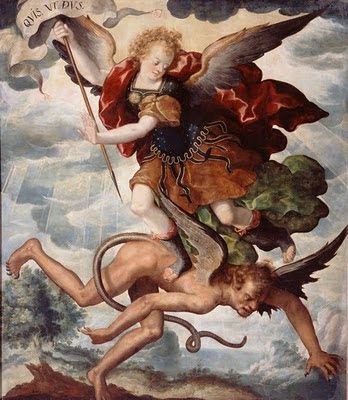
 Mithraism* spread from India in various forms throughout the ancient world, including Iran, all of Persia, Asia Minor, Greece and throughout the Roman World. It was, itself, later merged with the Roman pantheon to become the official state religion of Rome and was spread around the known world by the travels of soldiers and along trade routes.
Many of the rites and beliefs of Mithraism, though not the deity itself, were absorbed into the practices of the Christian Church. These include the rite of baptism, the communion ritual using bread and water, robed priests and the symbol of the cross. The Pontifical hierarchy and the organization of the Temple of Jupiter, epiphany, the immaculate conception and virgin mother, the concepts of heaven and hell, priests called “fathers”, angels and Easter, to name a few, were also ideas borrowed from Mithraism.
The celebration of Christmas, held during the Winter Solstice to commemorate the birthday of Jesus was adapted from a variety of pagan cults. The celebration of the Roman holiday season of “Saturnalia”, for the god Saturn, was adapted to become Christmas in 336 AD. Saturnalia was a festival during which Roman slaves were given control of the household for one day each year. The festival was held between December 17th and 23rd during which families feasted together, slaves were given time off and presents were exchanged.
The evolution of the Christian Church is explored in many very interesting books. One of the most thoroughly documented histories of Western religions was written by the Oxford historian, Robin Lane Fox, ‘Pagans and Christians’, published by Knopf in 1986. Mr. Fox is marvelous in his ability to resurrect the souls of the pagan gods, obscured these thousands of years beneath tumbled down temples desecrated by jealous religious zealots. One can only speculate on the revenge those noble gods may have wrought on succeeding generations of those who have trampled the Spirit of gods and Man alike in the wake of soulless religious rhetoric.
EMPEROR JUSTINIAN
Over time, the practices and, to a large degree, the philosophy of the Christian Church were irrevocably altered by too close an alliance with the materialistic business of power politics.
The consolidation of the Church under the control of a totalitarian Roman State became state law. By the end of the fourth century, Pagan worship, both public and private, was prohibited with severe penalties. All Pagan temples were closed or destroyed. The institution of Christianity became the very same political entity which had persecuted it in its infancy.
In the fifth century, Pagans were barred from any community service. In 529 AD, Roman Emperor Justinian closed the thousand year old Platonic Academy in Athens and ordered all Pagans to become Christians. Any who refused were exiled and their property confiscated. Competitive religions such as Judaism, Samaritanism, Zoroastrianism and Manicheism were violently persecuted.
 By Justinian’s time, the enormous growth of Church property and personnel caused a corresponding growth in the power and wealth of the Church hierarchy of bishops. They came to be part of the same class as the highest government officials, including senators.
A good-sized cathedral would employ 50 to 100 clergy. The election of Church officials was violently contested; one election in Rome left 137 dead in one day’s fighting. We are fortunate that modern day churches no longer employ so many priests with such covetous zeal!
By the year 543 AD, the writings of Origen, in keeping with the spiritual concepts of Christ and of the Greek philosophers that included the concept of past lives, had become politically “inconvenient”. In 553 AD at the Fifth Ecumenical Council at Constantinople, the Byzantine Emperor Justinian decided to OUTLAW THE IDEA OF THE PRE-EXISTENCE OF SOULS! He officially cursed the doctrine and vowed to excommunicate anyone who believed in Origin’s teachings. In addition, these ideas were banned from all subsequent publications of the Bible.
Thereafter, the increase in poverty, caused by religious suppression and government taxation, led to a decline throughout the Roman Empire.
The era became characterized by a sort of mass paranoia of superstition, fanaticism and violence regarding incomprehensible religious formulas. “Demonic possession” grew to epidemic proportions; every church employed large staffs of exorcists. Magic became the most important branch of philosophy. Medicine was overrun with recipes for amulets which were later replaced by the relics of holy men, especially martyrs. Saints of the Church assumed the functions once filled by the Pagan gods to send rain, avert storms, drive away pestilence, and so forth. The most important cult became that of Mary, the all-holy Mother of God.
The Dark Ages had begun.
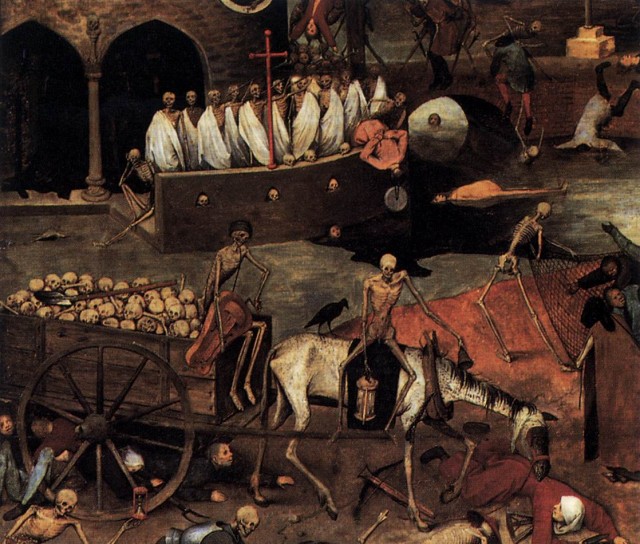
 Was it a coincidence that the worst outbreak of plague in history occurred during Justinian’s rule? The plague spread from Palestine, the very home of the Christ, and struck the Roman capital of Byzantium in the spring of 542 AD. The mortality rate in the city rapidly rose to 10,000 deaths a day. So many were the deaths that graves could not be dug fast enough to dispose of the rotting bodies. Roofs were taken off the towers of forts, the towers filled with corpses and the roof replaced. Ships were loaded with the dead, rowed out to sea and abandoned! And, if the plague weren’t enough, the entire world experienced disastrous earthquakes during that time.
Such a series of events might persuade one to consider the possibility that there might be such a thing as the wrath of God!”
* NOTE: The religion of Mithraism, with its central theme of a dualistic battle between good and evil, was popular in the Roman Empire. It was especially favored by the military. Michael, like Mithras, is also connected to those in uniform, being considered the patron of police officers and soldiers.
~ excerpt from THE OZ FACTORS
by Lawrence R. Spencer

 On planet Earth, it’s really not a good idea to “believe” or to accept ANYTHING on the surface. As safe bet is to DOUBT EVERYTHING.