Republished by Blog Post Promoter


Republished by Blog Post Promoter
Republished by Blog Post Promoter

Crucifixion was often performed to terrorize and dissuade its witnesses from perpetrating particularly heinous crimes. Victims were left on display after death as warnings to others who might attempt dissent. Crucifixion was usually intended to provide a death that was particularly slow, painful (hence the term excruciating, literally “out of crucifying”), gruesome, humiliating, and public, using whatever means were most expedient for that goal. Crucifixion methods varied considerably with location and time period.
The Greek and Latin words corresponding to “crucifixion” applied to many different forms of painful execution, from impaling on a stake to affixing to a tree, to an upright pole (a crux simplex) or to a combination of an upright (in Latin, stipes) and a crossbeam (in Latin,patibulum).
In some cases, the condemned was forced to carry the crossbeam on his shoulders to the place of execution. A whole cross would weigh well over 300 pounds (135 kg), but the crossbeam would not be quite as burdensome, weighing around 100 pounds. The Roman historian Tacitus records that the city of Rome had a specific place for carrying out executions, situated outside the Esquiline Gate, and had a specific area reserved for the execution of slaves by crucifixion. Upright posts would presumably be fixed permanently in that place, and the crossbeam, with the condemned person perhaps already nailed to it, would then be attached to the post.
While a crucifixion was an execution, it was also a humiliation, by making the condemned as vulnerable as possible. Although artists have depicted the figure on a cross with a loin cloth or a covering of the genitals, writings by Seneca the Younger suggest that victims were crucified completely naked. When the victim had to urinate or defecate, they had to do so in the open, in view of passers-by, resulting in discomfort and the attraction of insects. Despite its frequent use by the Romans, the horrors of crucifixion did not escape mention by some of their eminent orators. Cicero for example, described crucifixion as “a most cruel and disgusting punishment”, and suggested that “the very mention of the cross should be far removed not only from a Roman citizen’s body, but from his mind, his eyes, his ears.”
Frequently, the legs of the person executed were broken or shattered with an iron club, an act called crurifragium, which was also frequently applied without crucifixion to slaves. This act hastened the death of the person but was also meant to deter those who observed the crucifixion from committing offenses. — REFERENCE SOURCE: Wikipedia.org
Republished by Blog Post Promoter

“Material technology, without spiritual knowledge, is leading us to a global catastrophe on Earth. Technology should ASSIST in the spiritual development and not be used (as it is used now) to confine and enslave people within a monetary system and materialistic world, which are both temporary anyway.
The danger does NOT lie in the death of the physical body, as millions believe: the danger exists in the WAY in which one LIVES. There is nothing in the Universe to be afraid of, except our own ignorance and its consequences. We live on Earth to develop our consciousness, awareness and understanding of the specific aspects of laws of Nature and the Universe. What we think we “know” on Earth is just a tiny drop in the Ocean of Knowledge.” — © Dr Tom J. Chalko 1997
_________________
Dr. Tom Chalko holds Masters degree in engineering and a Ph.D. in physics (laser holography). His professional interests span from lasers and vibration engineering to physics of consciousness and meditation.
Republished by Blog Post Promoter

Republished by Blog Post Promoter
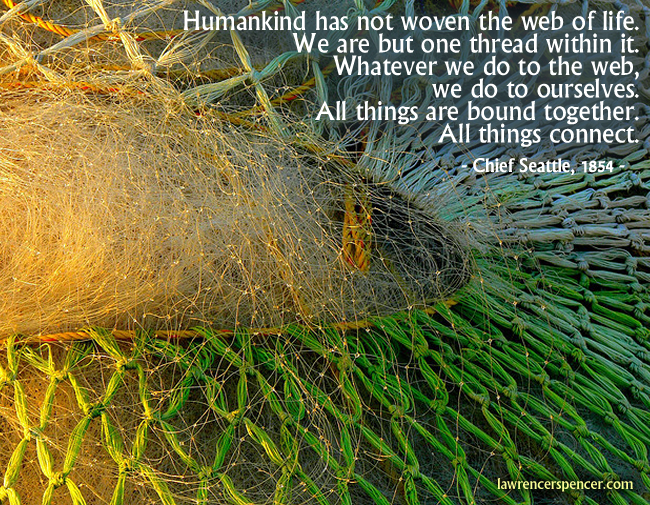
Chief Seattle (an Anglicization of Si’ahl) c. 1780 – June 7, 1866) was a Dkhw’Duw’Absh (Duwamish) chief,also known as Sealth, Seathle, Seathl, or See-ahth. A prominent figure among his people, he pursued a path of accommodation to white settlers, forming a personal relationship with David Swinson “Doc” Maynard. The city of Seattle, in the U.S. state of Washington, was named after him. A widely publicized speech arguing in favor of ecological responsibility and respect of native Americans’ land rights has been attributed to him.
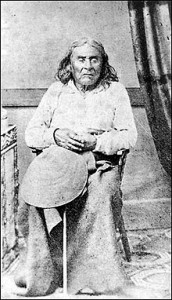 Si’ahl earned his reputation at a young age as a leader and a warrior, ambushing and defeating groups of enemy raiders coming up the Green River from the Cascade foothills, and attacking the Chimakum and the S’Klallam, tribes living on the Olympic Peninsula. Like many of his contemporaries, he owned slaves captured during his raids. He was tall and broad for a Puget Sound native at nearly six feet; Hudson’s Bay Company traders gave him the nickname Le Gros (The Big One). He was also known as an orator; and when he addressed an audience, his voice is said to have carried from his camp to the Stevens Hotel at First and Marion, a distance of 3⁄4 miles (1.2 km).
He took wives from the village of Tola’ltu just southeast of Duwamish Head on Elliott Bay (now part of West Seattle). His first wife La-Dalia died after bearing a daughter. He had three sons and four daughters with his second wife, Olahl.[3] The most famous of his children was his first, Kikisoblu or Princess Angeline. For all his skill, Si’ahl was gradually losing ground to the more powerful Patkanim of the Snohomish when white settlers started showing up in force. When his people were driven from their traditional clamming grounds, Si’ahl met Maynard in Olympia; they formed a friendly relationship useful to both. Persuading the settlers at Duwamps to rename the town Seattle, Maynard established their support for Si’ahl’s people and negotiated relatively peaceful relations among the tribes. (Wikipedia.org)