Category Archives: INSIDE THE BOOK

Inside the book, Vermeer: Portraits of A Lifetime. Analysis of all the paintings of Johannes Vermeer. The book reveals for the first time that the women featured in the paintings of Johannes Vermeer were members of his own family, his daughters, his wife and mother-in-law, Maria Thins.

MORE THINGS TO DO WHILE YOU’RE DEAD

Republished by Blog Post Promoter
# 485  BE YOUNG FOREVER.

As a disembodied spirit you probably don’t show your age as much as you did when you were in a body. If you are an immortal spiritual being you are infinitely aged and will continue to be infinitely ageless.

There have been quite a few spiritual sages from the ancient east, like Buddha in India or Lao Tze in China, for example, who have contemplated the nature of the spirit. If the rumors are true, they were able to transcend the continual cycle of life, death and rebirth.

Apparently the process of birth, death and rebirth predisposes one to suffer from reoccurring amnesia so that one tends to forget the life just lived.

Part of this has to do with the loss of the body and possessions through which you established your identity while on Earth. When you lost your body and possessions you also felt as though you lost your “self” or your “identity”.

Conversely, if one does not identify oneself as their possessions or as their body, one is less likely to forget their actual, spiritual identity. Therefore, if you decide to go back to Earth to inhabit another body, for whatever reason, don’t forget that you are who you are – the same immortal spiritual being you’ve been for billions and billions of years.

# 749  AVOID OLD AGE.

One of the most unlovely disadvantages of owning and occupying a body made of meat is decay. Use of the euphemistic term “aging” does not diminish to reality that old bodies experience one or more of the following: chronic pain, general deterioration of function, loss of energy, loss of hair, accumulation of fat, loss of muscle strength, loss of eyesight, loss of teeth, loss of sexual desire, function (which is the main reason for getting the goddamned thing in the first place!) and loss of mental acuity which leads to emotional and spiritual anxiety.

Loss of friends and family who are expiring all around you leads to loneliness and grief. The final agony of death relieves the ordeal, but only if one does not fall for the temptation to return to Earth, yet again, and get another new body and start the whole  process again.

Seriously, what kind of “all-knowing, all-seeing, all-telling, all powerful creator god” would think up anything as defective, temporary and fragile as a body made of meat? Why not biodegradable plastic bodies? Or stainless steel bodies? Or lightweight titanium bodies?

If you happen to meet “the god” while you’re dead please tell it/him/her/them this: “For Christ’s sake, if you’re going to create bodies, get it right next time! OK?!”

— Excerpts from the book 1001 THINGS TO DO WHILE YOU’RE DEAD: A DEAD PERSON’S GUIDE TO LIVING, by Lawrence R. Spencer

BUY THE BOOK …BEFORE IT’S TOO LATE!

Support independent publishing: Buy this book on Lulu.

SHERLOCK HOLMES – MY LIFE, Chapter Four

Republished by Blog Post Promoter


READ CHAPTER ONE

READ CHAPTER TWO

READ CHAPTER THREE

CLICK THE LULU BUTTON TO READ THE ENTIRE BOOK:

Support independent publishing: Buy this book on Lulu.

CHAPTER FOUR: A CHARMING CHESHIRE CHEESE


“Would you tell me, please, which way I ought to go from here?”, asked Mr. Dodgson.

“That depends a good deal on where you want to get to”, I replied.

“I don’t much care where…”,  said Mr. Dodgson.

‘Then it doesn’t matter which way you go”, said Watson.

“I have solved many obscure and nefarious cases in my career to date.  However, the singular complexity of the matter which stands before us now — these accusations and alternative explanations, present features of a most illogical and inexplicable nature”, I said, passing the butter dish across to Mr. Dodgson.

“Prey, do have some butter with your bread “, I suggested, “while I ring for our landlady, Mrs. Hudson, to bring up the main course of our meal”, I said, stepping across to pull upon the bell chord to alert our mistress that we were ready to be served.

Momentarily, Mrs. Hudson appeared at the door, huffing with exertion of having carried a large tray of dishes up the stairs. She set the tray upon the sideboard.

“Will there be anything else you require, gentlemen?”, she asked. “If not, then I will retire for the evening. I’ve had a long day of shopping and preparations and cooking and cleaning already. Just leave the dishes outside the door when you have finished, and I will fetch them in the morning”, she said bowing herself out the door.

“Please leave to door open, Mrs. Hudson, if you would be so kind”, I said as she started to close it behind her.

“That will not be necessary, Mr. Holmes”, said Dodgson.  “I feel quite reassured that I am safe with you”.

“Very well then. Good evening to you all then, gentlemen”, she said. She glanced back at me curiously and pushed the door closed, turned and trudged back down the stairs.

The meal was hearty, yet bland, as is the traditional fair for the citizens of London: boiled flesh of some unidentifiable creature, peeled and boiled potatoes with a few carrots, bread, butter, and a pot of tea.  Fortunately, I had taken the trouble to supply ourselves with two bottles of red table wine for the occasion, which enlivened the otherwise nondescript flavor of the food.

As we finished eating our meal, and placing the dishes outside the door, as instructed by Mrs. Hudson, I reviewed the peculiar features of our situation with my companions.

“For the sake of securing the status of my identity, and to respond the most singular accusations brought against us by Dr. Doyle, please let me summarize the possible resolutions to this anomaly. Several possible answers may be postulated, as follow:

1. That I am impersonating a fictional character created by Dr. Doyle in his works of fiction, notwithstanding the testimony of Constable Barrett, who one might argue, is himself a fictional character.  That being the case, all here present must also be fictional characters, including Dr. Dodgson.

2. That I am a real person, from whom Dr. Doyle, as the author of works of fiction, has copied my name, address, actions and characteristics as a source of inspiration for his stories.

3.  That I am a real person, and that the author is an imposter, or a fictional character.  Inasmuch as you visited the alleged gentleman yourself upon this very morning, one would assume that he, like ourselves, is not a fictional character.

4.  That Dr. Watson and I are both fictional characters, including all of our surroundings, environs, apartment, possessions, bodies, memories, expertise and identities: a hypothesis which seems to have been disproven thus far, unless further evidence presents itself to our attention.

5. That Mr. Dodgson and Dr. Doyle are real characters, including all of their surroundings, environs, apartments, possessions, bodies, memories, expertise and identities, and Dr. Watson and I are both impersonating fictional characters, as discussed.

6. An alternative solution may also be proffered: that each and all of what is supposed to be “real”, whether deemed fact or fiction by the observer, are equally illusions. Therefore, neither comprises a definition of reality or fantasy, accept by the subjective opinion of the observers, creators and / or characters”, I concluded.

I paused momentarily to fill my pipe, and allowed sufficient time for the gravity and details of my proposition to be absorbed by Dr. Watson and our guest.  Neither of them had anything further to offer in the argument at the moment. No doubt they were confounded by the apparent absurdity of my arguments. Nonetheless, taking silence as permission to continue, I resumed my deductive analysis.

“I have observed that the lowest and vilest alleys in London do not present a more dreadful record of sin than does the smiling and beautiful countryside”, gentlemen.

“I do not see what you are getting at, Holmes”, said Watson. Mr. Dodgson looked up with equal, but silent, agreement.

“On the contrary, Watson, you can see everything. You fail, however, to reason from what you see. You are too timid in drawing your inferences”, I said, taking a seat in my armchair, and inviting our guest to take a cigar from the box I offered.

“However, before we digress, let me allude to the discussion that Mr. Dodgson and I had when I visited him in is quarters.  He himself mentioned several methods of investigation which he has studied in the alchemical works of Sir Isaac Newton, and in his own mathematical application of portmanteau poetry to the development of mathematical thinking.

“Circumstantial evidence is a very tricky thing.  It may seem to point very straight to one thing, but if you shift your own point of view a little, you may find it pointing in an equally uncompromising manner to something entirely different”, I said while crossing over to the sideboard.

I picked up the manuscript that Mr. Dodgson had given me when I visited him entitled, Alice’s Golden Hour. While flipping through the pages to find a particular passage, I asked Mr. Dodgson a question about his work.

“Might I inquire as to the origin of one of the fictional characters whom Alice meets in Wonderland — The Cheshire Cat?”

“Frankly, I believe the idea came to me from an old expression I learned as a child”, replied Mr. Dodgson after momentarily pondering the question. “I believe it to be derived from a cheese which was sold in Cheshire, near my home. The cheese was molded in the shape of a cat. The cheese was cut from the tail end first, so that the last part eaten was the head of the smiling cat”.

“Very well”, I said. “Let us then observe that you have extracted something from the reality of your childhood, and with a liberal application of your creative imagination have used it to conjure an illusion…an alternative to reality, as it were. Is this not so, Mr. Dodgson?”

“Well, yes, I suppose. However, I fail to see what relevance my fictional tales have to our current situation. Certainly you do not suppose that I am to believe that reality can be conjured from a work of fiction?  The notion is absurd!”, he replied.

“I do not ask you, or anyone, to believe anything whatsoever. Belief is a matter of personal opinion or conviction which cannot be shared by anyone else, accept to the degree that they share a similar opinion.  Some  men believe that the world was created by an omnipotent, invisible being in seven days. People in some aboriginal tribes believe that the world is supported on the back of an enormous elephant which stands upon the shell of a colossal tortoise”, I said, finally arriving at the pages I was looking for in the manuscript.

“As for myself, I believe that what is true for you is true for you, although no other person may agree upon your belief. Regardless, a truth for you, may not be true for others. Is that not a fundamentally sound assumption?”, I asked.

“I suppose you are right Mr. Holmes. It is difficult, if not impossible, to stay apace of your ability to remain logical in the face of a situation which is so absurdly enigmatic. You are proposing that the philosophical paradigm of reality should be considered of equal importance with fiction. How can you ever solve a criminal case, your occupation, if every piece of hard evidence could be a contrivance of imagination on the part of the investigator or of the criminal?”, said Mr. Dodgson.

“Quite the contrary”, I said. “But rather than keeping to my methods alone, let me ask you what meaning you attribute to the following passage in your book”, I said, turning to the page which described in the encounter between Alice and the Cheshire Cat.

“Let me read your own words to you.”

“…she was a little startled by seeing the Cheshire Cat sitting on a bough of a tree a few yards off.

The Cat only grinned when it saw Alice. It looked good-natured, she

thought: still it had VERY long claws and a great many teeth, so she

felt that it ought to be treated with respect.

‘Cheshire Puss,’ she began, rather timidly, as she did not at all know

whether it would like the name: however, it only grinned a little wider.

‘Come, it’s pleased so far,’ thought Alice, and she went on. ‘Would you

tell me, please, which way I ought to go from here?’

‘That depends a good deal on where you want to get to,’ said the Cat.

‘I don’t much care where–‘ said Alice.

‘Then it doesn’t matter which way you go,’ said the Cat.

‘–so long as I get SOMEWHERE,’ Alice added as an explanation.

‘Oh, you’re sure to do that,’ said the Cat, ‘if you only walk long

enough.’

Alice felt that this could not be denied, so she tried another question.

‘What sort of people live about here?’

‘In THAT direction,’ the Cat said, waving its right paw round, ‘lives

a Hatter: and in THAT direction,’ waving the other paw, ‘lives a March

Hare. Visit either you like: they’re both mad.’

‘But I don’t want to go among mad people,’ Alice remarked.

‘Oh, you can’t help that,’ said the Cat: ‘we’re all mad here. I’m mad.

You’re mad.’

‘How do you know I’m mad?’ said Alice.

‘You must be,’ said the Cat, ‘or you wouldn’t have come here.’

Alice didn’t think that proved it at all; however, she went on, ‘And how

do you know that you’re mad?'”

“So, Mr. Dodgson, let me pose the same question to you that young Alice asked of the chimerical cat in your own story: how do you know whether you are mad or not mad? How would you satisfy yourself that I am not mad? How do we know that everyone is mad or not mad?”, I said, rising from my chair to place the manuscript upon the sideboard.

I refilled my pipe once again, in anticipation of the protracted debate that was sure to follow on the heels of these profoundly absurd, yet existential queries and arguments.

Mr. Dodgson did not seem the least bit nonplused by my insinuation  regarding his sanity, or the sanity of all. Rather, he thanked us very cordially for our hospitality, rose from his chair and reached the door to exit the apartment. As he reached the door he turned back to me.

“Mr. Holmes, I will leave the resolution of this mystery entirely in your very capable hands. If anyone were able to solve the questions you pose to me, I assure you that I am not that man. Neither are any of the mentors whom I have studied, including Sir Isaac himself. I trust that you will be kind enough to inform me of your eventual success, if such is possible. Good day to you, gentlemen”.

With that, he departed, clomped down the stairs. Through the window we saw him walk briskly away through a light drizzle of rain in the direction of the train station.

“What do you make of it Holmes?”, asked Watson, who seemed to have been disquieted by our visitor. “I must admit that our meeting with this  gentleman is the most perplexing I have ever had,” he said, resuming his seat in front of the fire.

“Yes. Most perplexing, indeed”, I agreed, taking my own seat and refilling my pipe. “Most perplexing.”

“What do you know of this Dr. Doyle?”, I asked Watson after an interlude of silent contemplation.

“Well, I can’t say that I know anything about the man”, he said. “Have you not heard anything of him?”

“No.  I have not.  However, our friend, Mr. Dodgson seems to know quite a good deal about the fellow. So much so, that he was entirely certain that it is I that perform the part of an imposter in an imaginary play invented by this man!”, I observed.

“Well, my dear fellow, in my professional opinion as a doctor, I am certain that this gentleman is suffering from the residual effects of some narcotic. His own fantastical story, from which you read to us this evening, seems very peculiar indeed!”, said Watson. “And, his behavior is quite inappropriate for a professor of mathematics at Oxford, certainly. Perhaps the allegations suggested in the newspaper, that the man is a pedophile, or a kidnapper, should be investigated more thoroughly”, he suggested.

“Perhaps”, I said. “Let us sleep upon the matter for the moment. In this instance, however, the best way of successfully acting a part is to be it”, I conjectured. ”

___________________________________

Copyright © 2011 by Lawrence R. Spencer. All Rights Reserved.


BREAD OF LIFE

Republished by Blog Post Promoter

“Much like Leonardo da Vinci, I worked intermittently on this single painting over a period of many years, never satisfied that it was finished, and continually improving upon the original.  This painting is my personal Mona Lisa, my daughter, Maria.  

We had a live-in servant for many years, named Tanneke Everpoel, hired and paid by Maria Thins.  She did all of the “heavy labor”, as it were: cooking, cleaning, washing clothes, carrying water, tending fires, and a myriad other chores, including helping with the children.  However, the expense of paying her wage and room did not include standing for endless hours, day after day, while I painted this portrait!  My daughter, Maria, was lovelier and much more readily accessible for the task of standing for this portrait.

It is argued, convincingly, that the immortal painting by Leonard was his own self-portrait as his own, feminine  reflection. What man, or woman, regardless of sexual preference in a given lifetime, has not inhabited the flesh of ten thousand bodies, some human, many not, through  a nearly infinite cascade of galaxies, stars and planets come and gone.  Is not survival a nearly infinite game, in which we interchange ourselves as the players of many parts?

Leonardo kept his portrait with him all his life.  He never considered that it was complete or perfect.  Nor did he ever intend to sell it.  How could one sell a most cherished reflection of himself?  It is more meaningful than one’s own body, which only disguises the inner self, the essence of spirit that animates the fragile flesh.  In fact, a body hides the reflection of the soul!  How can any substance, especially that as rude and fragile as meat, reveal the inherent qualities an immortal nothingness?  Indeed, it is the fundamental challenge and the most formidable task of an artist to reveal it!

The name given to this painting by others, “The Milkmaid”, is a sacrilege!   It rivals the incomprehension others have for Leonardo’s personal masterpiece.  Yet, how can anyone truly understand that a painting is meant to reflect the  essence of an immortal being, seen through the eyes of another?Vermeer on iTunes

She is painted with angelic colors: blue, gold and white, in contrast to the menial nature of her station in life.  From her issues, for me, the Milk and Bread of Life.  Life is embodied in her and through her.  Women, are the source of children, the source of energy, the source of care.  There is no more vital responsibility for any being who plays the game of life, than to confront dreary daily tasks.  To humbly make the daily loaf.  To soak that bread, mix and soften it with milk, make it warm and feed it to a teething child.  Survival is made of such things.

In those days I viewed life as idyllic.  My dreams were more real than reality.  All things were a possibility.  Tragedy could not find me.  Until it did, of course.  Even when we lost a child, which we did with several, my wife, Catharina, remained resolute in her Faith.  God guided us.  He did what was best.  We knew not why and need not question His purpose for us. 

I have no such faith in predetermination.  A loaf of grain, clean water and a bed was my fare.  Time and a place to paint, uninterrupted, were necessities.  My love, shared with wife and family, was the staple diet of my life.  I assumed, as a Fool who knows not his own mortality, that they would endure, even when I was gone.”

_______________________________________

Excerpt from the book VERMEER: PORTRAITS OF A LIFETIME, by Lawrence R. Spencer

DOWNLOAD THIS BOOK FROM
http://itunes.apple.com/us/book/vermeer/id443800993?mt=11 

SOURCE OF BIODIVERSITY

Republished by Blog Post Promoter

“…there are millions of species [i] (Footnote) of insects. About 350,000 of these are species of beetles. [ii] (Footnote) There may be as many as 100 million species of life forms on Earth at any given time. In addition, there are many times more extinct species of life on Earth than there are living life forms. Some of these will be rediscovered in the fossil or geological records of Earth.

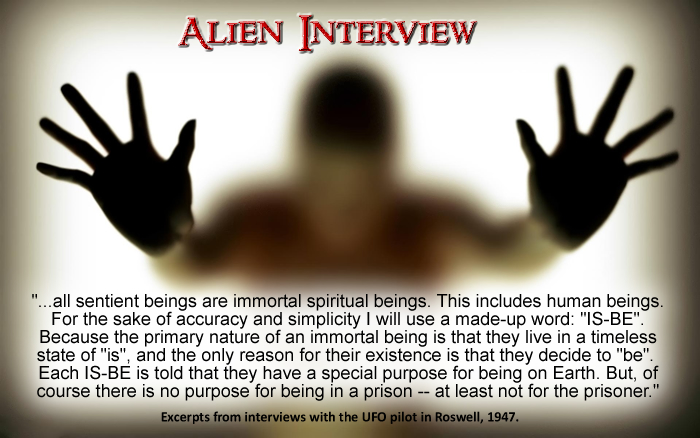
The current “theory of evolution” of life forms on Earth does not consider the phenomena of biological diversity. Evolution by natural selection is science fiction. One species does not accidentally, or randomly evolve to become another species, as the Earth textbooks indicate, without manipulation of genetic material by an IS-BE.    [iii] (Footnote)

80-beetlesA simple example of IS-BE intervention is the selective breeding of a species [iv] (Footnote) on Earth. Within the past few hundred years several hundred dog breeds and hundreds of varieties of pigeons and dozens of Koi fish have been “evolved” in just a few years, beginning with only one original breed. Without active intervention by IS-BEs, biological organisms rarely change.

The development of an animal like the ‘duck-billed platypus’ required a lot of very clever engineering to combine the body of a beaver with the bill of a duck and make a mammal that lays eggs. Undoubtedly, some wealthy client placed a “special order” for it as a gift or curious amusement. I am sure the laboratory of some biotechnical company worked on it for years to make it a self-replicating life form!

The notion that the creation of any life form could have resulted from a coincidental chemical interaction moldering up from some primordial ooze is beyond absurdity! Factually, some organisms on Earth, such as Proteobacteria, [v] (Footnote) are modifications of a Phylum [vi] (Footnote) designed primarily for “Star Type 3, Class C” planets. In other words, The Domain designation for a planet with an anaerobic atmosphere nearest a large, intensely hot blue star, [vii] (Footnote) such as those in the constellation of Orion’s Belt in this galaxy.ALIEN INTERVIEW

Creating life forms is very complex, highly technical work for IS-BEs who specialize in this field. Genetic anomalies are very baffling to Earth biologists who have had their memory erased. Unfortunately, the false memory implantations of the “Old Empire” prevent Earth scientists from observing obvious anomalies.”

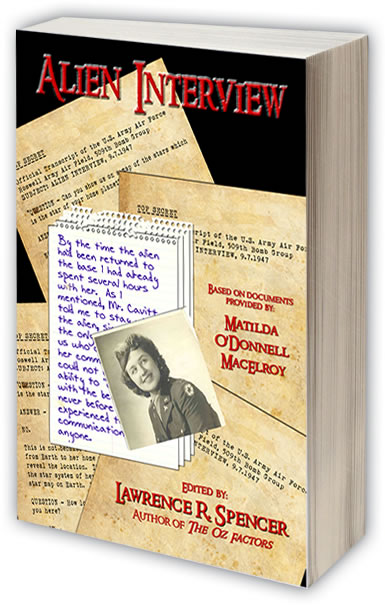
–Excerpted from the book ALIEN INTERVIEW

[i] “…species…”

“In biology, a species is one of the basic units of biological classification and a taxonomic rank. A species is often defined as a group of organisms capable of interbreeding and producing fertile offspring. While in many cases this definition is adequate, more precise or differing measures are often used, such as based on similarity of DNA or morphology. Presence of specific locally-adapted traits may further subdivide species into subspecies.

The commonly used names for plant and animal taxa sometimes correspond to species: for example, “lion,” “walrus,” and “Camphor tree,” each refers to a species. In other cases common names do not: for example, “deer” refers to a family of 34 species, including Eld’s Deer, Red Deer and Wapiti (Elk). The last two species were once considered a single species, illustrating how species boundaries may change with increased scientific knowledge.

Each species is placed within a single genus. This is a hypothesis that the species is more closely related to other species within its genus than to species of other genera. All species are given a binomial name consisting of the generic name and specific name (or specific epithet). For example, Pinus palustris (commonly known as the Longleaf Pine).

A usable definition of the word “species” and reliable methods of identifying particular species are essential for stating and testing biological theories and for measuring biodiversity. Traditionally, multiple examples of a proposed species must be studied for unifying characters before it can be regarded as a species. Extinct species known only from fossils are generally difficult to give precise taxonomic rankings to. A species which has been described scientifically can be referred to by its binomial names.

Nevertheless, as Charles Darwin remarked,

‘I look at the term species as one arbitrarily given for the sake of convenience to a set of individuals closely resembling each other …. it does not essentially differ from the term variety, which is given to less distinct and more fluctuating forms. The term variety, again in comparison with mere individual difference, is also applied arbitrarily, and for mere convenience sake.’

Because of the difficulties with both defining and tallying the total numbers of different species in the world, it is estimated that there are anywhere between 2 million and 100 million different species.”  — Reference: Wikipedia.org

[ii] “…species of beetle…”

“Beetles are a group of insects which have the largest number of species. They are placed in the order Coleoptera, which means “sheathed wing” and contains more described species than in any other order in the animal kingdom, constituting about twenty-five percent of all known life-forms. Forty percent of all described insect species are beetles (about 350,000 species), and new species are frequently discovered. Estimates put the total number of species, described and undescribed, at between 5 and 8 million.

Beetles can be found in almost all habitats, but are not known to occur in the sea or in the polar regions. They interact with their ecosystems in several ways. They often feed on plants and fungi, break down animal and plant debris, and eat other invertebrates. Some species are prey of various animals including birds and mammals. Certain species are agricultural pests, such as the Colorado potato beetle Leptinotarsa decemlineata, the boll weevil Anthonomus grandis, the red flour beetle Tribolium castaneum, and the mungbean or cowpea beetle Callosobruchus maculatus, while other species of beetles are important controls of agricultural pests. For example, coccinellidae (“ladybirds” or “ladybugs”) consume aphids, scale insects, thrips, and other plant-sucking insects that damage crops.”  –– Reference: Wikipedia.org

[iii]   “One species does not evolve to become another species, as the Earth textbooks indicate, without the intervention and manipulation of genetic material by an IS-BE.”

“Genetic engineering, recombinant DNA technology, genetic modification / manipulation (GM) and gene splicing are terms applied to the direct manipulation of an organism’s genes. Genetic engineering is not to be confused with traditional breeding where the organism’s genes are manipulated indirectly. Genetic engineering uses the techniques of molecular cloning and transformation. Genetic engineering endeavors have found some success in improving crop technology, the manufacture of synthetic human insulin through the use of modified bacteria, the manufacture of erythropoietin in Chinese hamster ovary cells, and the production of new types of experimental mice such as the oncomouse (cancer mouse) for research.

Since a protein sequence is specified by a segment of DNA called a gene, novel versions of that protein can be produced by changing the DNA sequence of the gene. The companies that own the modified genome are able to patent it. In the case of basic crops, the companies gain control of foodstuffs, controlling food production on a large scale and reducing agrobidiversity to a few varieties. The only apparent interest in promoting this tecnology appears to be purely economic, despite the claims of seed companies such as Monsanto and Novartis to solve the world food scarcity. It is now popularly understood that it is not the lack of food on a wholewide scale that is the main problem, but its distribution, aggravated by prohibitive tariffs by rich nations. Genetically modified crops do not reduce hunger. The majority of genetically crops are destined for animal food to meet the high demand for meat in developed countries. No genetic modification have yet to serve the needs of mankind despite all the promises in this direction.

However, even with regard to this technology’s great potential, some people have raised concerns about the introduction of genetically engineered plants and animals into the environment and the potential dangers of human consumption of GM foods. They say that these organisms have the potential to spread their modified genes into native populations thereby disrupting natural ecosystems. This has already happened.”  — Reference: Wikipedia.org

[iv] “…genetic manipulation of a species…”

“How much genetic variation is there? Historical debate: Classical school held that there was very little genetic variation, most individuals were homozygous for a “wild-type” allele. Rare heterozygous loci due to recurrent mutation; natural selection purges populations of their “load” of mutations. Balance school held that many loci will be heterozygous in natural populations and heterozygotes maintained by “balancing selection” (heterozygote advantage). Selection thus plays a role in maintaining variation.

How do we measure variation? To show that there is a genetic basis to a continuously varying character one can study 1) resemblance among relatives: look at the offspring of individuals from parents in different parts of the distribution; can estimate heritability (more later). 2) artificial selection: pigeons and dogs show that there is variation present; does not tell how much variation.”  — Reference: http://biomed.brown.edu/Courses/BIO48/5.Geno.Pheno.HTML

[v] “… Proteobacteria…”

“The Proteobacteria are a major group (phylum) of bacteria. They include a wide variety of pathogens, such as Escherichia, Salmonella, Vibrio, Helicobacter, and many other notable genera. Others are free-living, and include many of the bacteria responsible for nitrogen fixation. The group is defined primarily in terms of ribosomal RNA (rRNA) sequences, and is named for the Greek god Proteus (also the name of a bacterial genus within the Proteobacteria), who could change his shape, because of the great diversity of forms found in this group.

All Proteobacteria are Gram-negative, with an outer membrane mainly composed of lipopolysaccharides. Many move about using flagella, but some are non-motile or rely on bacterial gliding. The last include the myxobacteria, a unique group of bacteria that can aggregate to form multicellular fruiting bodies. There is also a wide variety in the types of metabolism. Most members are facultatively or obligately anaerobic and heterotrophic, but there are numerous exceptions. A variety of genera, which are not closely related to each other, convert energy from light through photosynthesis. These are called purple bacteria, referring to their mostly reddish pigmentation.”

— Reference: Wikipedia.org

[vi]   “…Phylum…”

“In biological taxonomy, a ‘phylum’ is a taxonomic rank at the level below Class and above Kingdom. “Phylum” is adopted from the Greek φυλαί phylai, the clan-based voting groups in Greek city-states.”  — Reference: Wikipedia.org

[vii] “…intensely hot blue star…”

“Blue stars are very hot and very luminous; in fact, most of their output is in the ultraviolet range. These are the rarest of all main sequence stars, constituting as few as 1 in 3,000,000 in the solar neighborhood. (Blue) stars shine with a power over a million times our Sun’s output.  Examples: Zeta Orionis, Zeta Puppis, Lambda Orionis, Delta Orionis”..   — Reference: Wikipedia.org