Republished by Blog Post Promoter


Inside the book, Vermeer: Portraits of A Lifetime. Analysis of all the paintings of Johannes Vermeer. The book reveals for the first time that the women featured in the paintings of Johannes Vermeer were members of his own family, his daughters, his wife and mother-in-law, Maria Thins.
Republished by Blog Post Promoter
 ASTRONOMY IS “SIRIUS” BUSINESS
“… meet the young lady who fell from a star. She fell from the sky, she fell very far and Kansas, she says, is the name of the star …” – Glinda in ‘The Wizard of Oz’
“As an Egyptian child 3,000 years ago, you might have asked your mother, “Mommy, where did I come from?” She may have replied, “Well, dear, I think it was from Orion’s Belt.
According to hieroglyphic records, the stars of Orion’s Belt were the symbolic analogy to the “phallus” of the constellation of Orion upon which his sister/wife Isis (the star Sirius) would “rise above Orion” in the sky and “impregnate” herself. The union of these two constellations, gave birth to their “son”, the Egyptian god Horus, the seventh “Divine Ruler” of Egypt.
Celestial orientation was the Egyptian common denominator to an understanding of the Egyptian viewpoint of life on Earth, and life after death. The Egyptian priesthood worshiped the stars. The comings and goings of the gods were monitored by the stars. The calendar of days, holidays, festivals and harvests were determined by the stars. The rising of the star Sirius, also called the “Dog Star” because of its prominent position in the constellation of Canis Major, marked the beginning of the new year and is the entire basis for the Easter celebration as adopted by the Christians centuries after the fall of Egypt. The movements of the star Sirius monitored the entire Egyptian calendar.
MYSTERIOUS SIRIUS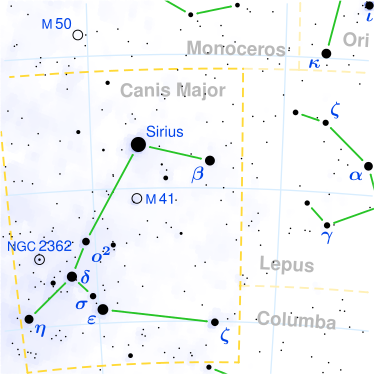
Sirius is actually a double star system. One of the stars is the brightest star in the sky visible from Earth. The other is a dark star, an extremely dense and heavy star, which is entirely invisible to the naked eye. (One teaspoon of matter from this star might weigh thousands of pounds on Earth). The dark star was not detected for the first time until 1970.
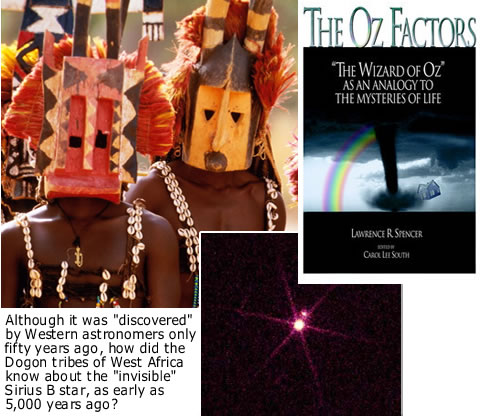
The triple star system of Sirius gained international notoriety during the late 1960s. Though never photographed until 1970, the dark star of Sirius was made known to a team of French anthropologists by a remote tribe living near Timbuktu in Northern Africa called the Dogon. The religious leaders of the Dogon knew all about these stars, including, mysteriously:
1/ The exact 50 year repeating pattern of the elliptical orbit of Sirius “B” around Sirius “A”.
2/ Patterns of orbital motion relative to each other (one star periodically blocks the view of the other as they revolve).
3/ The extremely small size, the tremendously dense and heavy mass and invisibility of Sirius “B”.
4/ The existence of the red dwarf star, Sirius “C”, which was not observed for the first time by modern astronomers until 1995.
5/ For more than a thousand years, the Dogon also knew about four other “invisible” bodies in our own solar system; namely, the four major moons of Jupiter which were not acknowledged in Western civilization until Galileo discovered them with his version of the telescope which had been invented the previous year, in 1608, by Hans Lippershey.
A DOGON SIRIUS MYSTERY
How could an obscure tribe of technically backward, uneducated people know so many factual details about a star system of which Western astronomers knew almost nothing?
This relatively primitive tribe of black Africans claimed that their ancestors were priests who had been driven out of Egypt in the very distant past. The secrets of these priests were closely held among the elders of their tribe. They claim that a race of beings with aquatic characteristics descended from a planet in the star system of Sirius. These being were called the “Nomos”. These beings are reported to have brought civilization to Earth about 5,000 years ago and then returned to the Sirius system. The Dogon say that the Nomos will return to Earth. The Dogon say that the detailed information they possess about the Sirius star system was given to them about 5,000 years ago by the beings who came to Earth from Sirius.
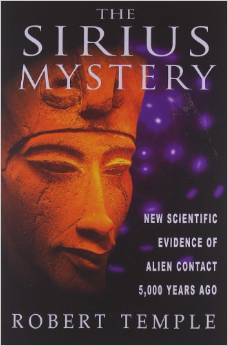 The scientific, cultural, religious, mythological, astronomical and anthropological implications of the knowledge of the Dogon, and of the tremendous significance placed on Sirius by the Egyptian priests, is marvelously documented in the fascinating book by Robert K G Temple entitled, ‘The Sirius Mystery’. This book has inspired other innovative investigators to pick up the trail of the investigation into what was REALLY going on in ancient Egypt.
Egyptology has fascinated scholars and captured popular imagination for thousands of years. Why? Simply because it has been so mysterious! Subjects that are easily investigated and understood rarely command much attention. And, there are few subjects as full of hidden meanings, esoteric innuendo and misleading anomalies as the hieroglyphic texts and architectural monuments of Egypt.
Despite decades of investigation, the theoretical posturing of Egyptologists have left many of the very basic elements of its mysteries unanswered. For example:
1/ What secret information did the priests of Isis and Osiris NOT share with the uninitiated layman?
2/ What knowledge did the priests and pharaohs possess, which empowered them with control over not only the affairs of state, but the wealth of the richest treasury in the world?
3/ Were the priests hiding something from the rest of the world?
Just as modern Western intelligence agencies have controlled knowledge to protect their special vested interests over the last thousand years, so did the priests of ancient Egypt.
The secret order of priests in Egypt possessed a very, very sophisticated knowledge of mathematics, architecture and astronomy, among other esoteric studies. In fact, most of the rest of the world learned almost everything they knew from Egypt, with the possible exception of the Sumerians, who had already built their own pyramid civilization before the Egyptians ever got started.”
_________________________
Excerpt from THE OZ FACTORS, by Lawrence R. Spencer
Republished by Blog Post Promoter
“Toto, I’ve a feeling we’re not in Kansas any more. We must be over the rainbow!” — Dorothy from ‘The Wizard of Oz’
What if you were in Dorothy’s shoes? First, you run away from home to save your dog from being destroyed by the sheriff. Then, you get amnesia from being knocked on the head by a window frame. Next, you’re swept up by a storm and carried far away from home. Finally, you crash-land in an alien world.
How would you feel?
Many of us, like Dorothy in ‘The Wizard of Oz’, feel as though we have crash-landed far, far from our own, personal home; far away from the place in our hearts or in our dreams where everything is just exactly the way we want it to be; a place where there is no trouble. We don’t quite know what happened to our home or how we ended up where we are now, but we have a vague, fleeting feeling, that our home is still there, waiting for us to come back.
Is there really such a place?
Is it just a dream?
If such a place exists, how do we get there from here?
Who are we?
How did we get here?
Where is here?
These are primordial questions–the original, fundamental questions about the mysteries of life and universes which have existed since the beginning of time.
One method of figuring out the answers to questions is to compare an unknown subject to one that is similar, but already known. The comparison of two similar things is called an analogy. Storytelling, teaching, explaining things to young children, and scientific research all use analogies as a tool for better understanding.
Thus we begin our journey into “The Wizard of Oz” as an Analogy to the Mysteries of Life.
***********************************************
‘The Wizard of Oz’, the MGM motion picture based on the popular children’s book of 1896, written by L Frank Baum, entitled ‘The Wonderful Wizard of Oz’, is familiar to nearly everyone in Western society and is possibly the most widely seen and loved motion picture ever made.
During the filming of the motion picture in 1932, years after the author’s death, a “psychic connection” between the book and the movie occurred. Frank Morgan, the actor who played the parts of Professor Marvel and the Wizard in the movie, wore a coat for the part which had been purchased at a second-hand clothing store in Chicago by the studio wardrobe department. Quite by accident, the actor turned out one of the pockets and to his astonishment, found the name, “L Frank Baum”, sewn on the tailor’s label in the lining. It was soon verified by the author’s widow, and by the tailor who made the coat, that it had indeed belonged to the “Royal Historian of Oz” himself.
The allegorical story of ‘The Wizard of Oz’ and its timeless characters are an appropriate vehicle through which to learn more about the mysteries of life.
Humanity is a lot like Dorothy. We are searching to find “the way back to Kansas”. There are questions many of us would like answered. But, since we have no Munchkins, beautiful witches or wizards to show us the way, we will have to rely on logic–that is, our own ability to reason–to find our own Yellow Brick Road that leads to solving these mysteries.
Earthly wizards, or scientists, have been unable to discover a contiguous record of man’s history on Earth. The pieces of evidence, which present themselves as clues to the enigma of the origin of man, are broken, scattered and missing. The origin and motive force life remain largely unexplained by the various scientific disciplines. Too many questions remain unsolved or ignored to provide us with conclusive answers to the apparent mysteries of our past, present and future existence.
By their own admission, Earth scientists are still unable to answer, among others, the following basic questions:
How were the first living cells formed?
What animates life organisms?
Where did Man come from?
How did the dinosaurs suddenly become extinct?
Who are we?
How did the universe begin and how will it end?
How did particles of matter and energy form?
Why are there galaxies, and why do they have spiral arms?
In a universe, which end is up?
Why have these questions never been answered?
A–“WHICH IS THE WAY BACK TO KANSAS?”
“I’d give anything to get out of Oz altogether, but which is the way back to Kansas? I can’t go the way I came.”–Dorothy
“The only person who might know would be the great and wonderful Wizard of Oz himself. He lives in the Emerald City and that’s a long journey from here. Did you bring your broomstick with you?”–Glinda, the Good Witch of the North
“No, I’m afraid I didn’t.”–Dorothy
“Well then, you’ll have to walk. It’s always best to start at the beginning and all you do is follow the Yellow Brick Road.”–Glinda in ‘The Wizard of Oz’
One of the primordial questions Dorothy was trying to answer in ‘The Wizard of Oz’ was, “which is the way back to Kansas?”
Trying to figure out the answers to the mysteries of life here on planet Earth is even harder than Dorothy trying to get back to Kansas–none of us have a broomstick to ride, we don’t have a good witch to ask for directions and there is no Yellow Brick Road to follow. So, we’re stuck here having to figure it out for ourselves, logically, using the information we have in our environment.
To begin at the beginning, the Land of Oz is a type of Universe. According to Webster’s Dictionary, a universe is defined as: “an area, province or sphere, as of thought or activity, regarded as a distinct, comprehensive system or world.”
The physical reality we all share on Earth and everything throughout the surrounding space is called the Physical Universe (PU).
On the other side of reality is your own imagination, your personal perceptions, viewpoints, dreams, hopes, desires, and creations, which comprise Your Own Universe (YOU).
The Land of Oz can be considered to be a Universe dreamed up by Dorothy, as conceived in the mind of L Frank Baum, the author of the book. (It has been speculated that the author created the “Land of Oz” after glancing at his file cabinet. The two file drawers were labeled “A-N” and “O-Z”. Dorothy could just as easily have been transported by the author’s pen into the imaginary “Land of AN”.)
In the movie version of the story, Dorothy creates the Land of Oz in a dream, induced by a knock on the head, using remnants of Kansas in the physical universe mixed together with creations from her own universe–which, for Dorothy, existed over the rainbow in the Land of Oz.
Every Universe seems to be made up of its own, peculiar set of Laws. The PHYSICAL UNIVERSE, for example, is built on a set of agreed upon Laws. A few examples of these Laws are:
The Law of Motion: “For every action, there is an equal and opposite reaction.”
The Food Chain Law: “In order for one life organism to live, another life organism must die.”
The Law of Gravity: “Whatever goes up, must come down.”
The Law of Time: “Time marches on.”
Most of us take the Laws of the Physical Universe for granted because everyone seems to agree with them. However, such laws leave a lot to be desired when compared to the Laws of a Universe we might create for ourselves!
In YOUR OWN UNIVERSE you can create any set of Laws, or have no Laws at all. You can make them, change them or break them. The Laws of YOUR OWN UNIVERSE can be anything or nothing, limited only by your imagination.
In YOUR OWN UNIVERSE, everything you wish comes true, because you are the “wizard” of YOUR OWN UNIVERSE!
In Dorothy’s universe, Scarecrows and trees can talk; witches can be beautiful and fly in magic bubbles; Munchkin girls join the “Lullaby League” and Munchkin boys have a “Lollipop Guild”; horses can change their color; and, Dorothy can dye her eyes to match her gown.
Dorothy’s first awareness of the particular universe she calls the Land of Oz is the realization that she is definitely NOT in Kansas. When she opens the door to her farmhouse, which has just crash-landed in Oz, Dorothy compares her past experience in Kansas with her present experience in Munchkinland. The Technicolor flowers, a good witch in a flying bubble, all the little brightly dressed people, a yellow brick road, etc, are definitely NOT similar to anything she has ever seen in Kansas.
The Land of Oz is an example of what Earth scientists would call an anomaly. For Dorothy, the anomaly is a departure from the usual arrangement of things as compared to her past experiences. In the universe of Oz, everything is so completely different from the universe Dorothy is familiar with in Kansas that she thinks she is lost.
How do you find the way back home when you are lost?
One way is to ask someone for directions. Of course, if you’ve ever been sent on a wild goose chase by a stranger, the experience taught you that it is a good idea to be somewhat selective as to whom you ask for directions. So, how do you know who is a reliable source of directions or information?
Perhaps it would be a good idea to find out something about the person from whom you are asking directions before you act upon what they tell you. Right? (Or, is it left?)
In our example, should Dorothy be asking for directions back to Kansas from the local natives, the Munchkins?
The main reason one would ask a local resident for directions is that one makes the assumption, otherwise known as an hypothesis (which is the first step in creating any scientific theory), that someone who lives in the area will be a reliable source of information and will give correct directions.
Well, in Dorothy’s case, the Munchkins have lots of familiarity with the Land of Oz, but they have no familiarity with Kansas. Fortunately for Dorothy, they are honest enough to tell her that they don’t have a clue where Kansas is, and they pass the buck to the Wizard of Oz, who they believe knows everything. And, based on their familiarity with the Yellow Brick Road and Munchkinland, they are certain that it leads to where the Great Oz lives.
Most would agree that a certainty is better than an assumption. When one has no familiarity based on personal experience or observation, it is best not to assume that one knows the correct directions. So, one asks for information from someone one believe knows–like a scientist, for example–who is supposed to be familiar with the area or subject in question.
Do the local Munchkins or local scientists of Oz give Dorothy the correct directions to help her get back to Kansas?
When Dorothy crash-landed her house in Munchkin City, the Munchkins cowered under the bushes and flowers in terror of retribution for the death of the Wicked Witch of the East from her mean, nasty, ugly sister, the Wicked Witch of the West.
Their benevolent, all-powerful protector, Glinda, the Good Witch of the North, who the Munchkins trust implicitly, is not much help in solving Dorothy’s problem, either. To begin with, Glinda does not have all the information regarding the situation, because she was not even there when Dorothy crashed her house into Munchkin City and inadvertently killed a wicked witch.
Undaunted by her lack of factual information, the first thing Glinda does after coaxing the Munchkins out from their hiding places, is to sing them a song about her assumption, or hypothesis, regarding Dorothy’s crash-landing. She sings: “Come out, come out, wherever you are, and meet the young lady who fell from a star. She fell from the sky, she fell very far, and ‘Kansas’ she says, is the name of the star.”
So, where did Glinda get the idea that Dorothy came from a star? Dorothy never said that she came from a star! But, somehow this all seems very logical to the Munchkins. Even Dorothy doesn’t object to Glinda’s false statement!
In our analogy, Glinda’s assumption that Dorothy fell from a star could be called a scientific theory. The theory proposed by the Good Witch of the North is that Kansas is a star! This theory is based on an assumption derived from an apparent anomaly as measured against her own personal experience and by information received from the Munchkins who are supposed to be a reliable source, but, who did not actually see the house crash because they were all in hiding. In truth, none of them have any familiarity with Kansas or cyclones or farm houses or dogs or little girls, either!
To complicate matters further, Glinda has to put on the appearance that she knows what she’s talking about in front of all her Munchkins followers, even though she is really just making a wild guess. After all, she has a very good job being the protector of the Munchkins, who appear to be utterly defenseless against their enemies, the Wicked Witch sisters. Anyway, Glinda is a good witch, which means she is probably really trying to help, so, they all believe her scientific theory that Dorothy has fallen from a star.
In their cute little minds, the Munchkins have accepted, without question, the logic, which underlies the assumption that is the basis of Glinda’s scientific theory:
SKY equals VERY FAR equals STAR equals KANSAS.
This kind of reasoning process could be called “Everything Logic”; i.e., Everything Equals Everything. This sort of logic might also be the definition of stupidity.
Example: If KANSAS equaled SKY equaled STAR, one could theoretically gaze up into the heavenly firmament to watch Kansas cattle grazing on the twinkling prairies in the stars above.
Unfortunately, much of what we call “science” on planet Earth is based on “Everything Logic”.
B–SCIENTIFIC THEORY: “ONLY BAD WITCHES ARE UGLY”
“I’m a little muddled. The Munchkins called me because a new witch has just dropped a house on the Wicked Witch of the East. And there’s the house, and here you are and that’s all that’s left of the Wicked Witch of the East. And so, what the Munchkins want to know is, are you a good witch or a bad witch?”–Glinda
“I’m not a witch at all! Witches are old and ugly.”–Dorothy
“Only bad witches are ugly.”–Glinda in ‘The Wizard of Oz’
In the dialogue from the movie, Glinda, the Good Witch of the North, and Dorothy begin a “scientific” investigation into Dorothy’s mysterious arrival in the Land of Oz. They start by making some assumptions based on what they have observed, or failed to observe, about what has happened.
To the misfortune of us “Munchkins” here on planet Earth, assumptions are all too often the basis for a scientific theory. In truth, many “scientific theories” are based on assumptions which could also be called “personal viewpoints”.
What is the difference between “personal viewpoint” and “scientific theory”?
1/ Personal Viewpoint–If you don’t know what is happening, you take in whatever information you can get from the immediate environment and make an assumption based upon that information which seems to explain the situation. This is your personal viewpoint.
Example: Dorothy assumes that all witches are ugly. Therefore, her personal viewpoint is that neither Glinda, nor she herself, is a witch.
2/ Scientific Theory–If you are a “scientist” and you don’t know what is really happening, you can make an assumption and call it a scientific theory.
Example: If witches are ugly (according to Dorothy) and Dorothy is a witch (according to Glinda) then Dorothy (and Glinda) should be UGLY.
There seems to be NO difference between personal viewpoint and scientific theory!
So, let’s examine the scientific theories and personal viewpoints found in the story of ‘The Wizard of Oz’ as an analogy to our own efforts to resolve the primordial mysteries of life and universes.
C–“IT REALLY WAS NO MIRACLE”
“She brings you good news. Or haven’t you heard? When she fell out of Kansas, a miracle occurred.”–Glinda
“It really was no miracle. What happened was just this …”–Dorothy in ‘The Wizard of Oz’
Whether an event is a miracle or not is relative–it depends on the person you talk to. What is their understanding of the events or evidence presented to them? What is their level of technology? How diverse and sophisticated is their own experience?
The Munchkins seem to agree with Glinda, that compared to their own experience, a house falling from the sky, which happens to kill a wicked witch, is a miracle. They know that the Wicked Witch of the East is dead and Dorothy was in the house that killed her. So, to them, Dorothy is a heroine. She is given a heroine’s welcome parade, a bouquet of flowers, a huge lollipop, and she inherits the Ruby Slippers. It’s not exactly a road map back to Kansas, but at least the natives of Munchkinland are appreciative of her inadvertent help.
As outside observers, our point of view on this rather pathetically illogical misinterpretation and misrepresentation of events is quite different. We have seen the beginning of the movie. We’re not afraid of witches because we don’t live in Munchkinland. We also know it’s just a movie, and that we can get up and go home after the show.
As a result, we are more reliable sources of information than the Munchkins, or the Good Witch of the North, for the following reasons:
1/ We have an external viewpoint to the Oz Universe.
2/ We have no vested interest in the Land of Oz.
3/ We are familiar with both Kansas and Munchkinland.
4/ As the audience, we also have the experience of viewing the black and white beginning of the film, so we know that Dorothy is using real-life characters to play fictional parts in the creation of her own Technicolor universe.
Yet, without an external observer to step into the movie to give her advice, Dorothy is still stuck in the Land of Oz.
So, the inexperienced Munchkins and their guardian witch in a flying bubble, tell Dorothy that she has to take a hike on the Yellow Brick Road to look for some wizard who they all seem certain will know how to get back to Kansas.
On Earth, the average scientist, who is trying to figure out the answers to the primordial questions of life, the history of planet Earth, the origins of life forms, global ecological and environmental problems, etc, has even more disadvantages than Dorothy:
1/ An Earth scientist hasn’t been on Earth since the beginning of “the movie”.
2/ An Earth scientist is one of the “Munchkins” himself. This means that he or she is subject to the fears, superstitions, economic pressures, personal viewpoints and lies told by the wicked witches of Earth.
3/ An Earth scientist doesn’t have a Yellow Brick Road to follow or Ruby Slippers to protect him from wicked witches who care only about their own vested interests (such as big corporations and governments with lots of money to spend on advertising and flying legal monkeys).
4/ There is no Wizard in the Emerald City of Earth to solve problems for them.
A logical method of evaluating whether or not we are on the right road to finding our way back home, or to answering the primordial questions of life, could be summed up as follows: A SCIENTIFIC THEORY OR A PERSONAL VIEWPOINT IS ONLY AS USEFUL AS IT CAN BE DEMONSTRATED TO SOLVE THE MYSTERY OR THE PROBLEMS IT ADDRESSES. WHEN THE THEORY OR VIEWPOINT CAN BE DEMONSTRATED TO SOLVE THE PROBLEMS OF THE SUBJECT IT ADDRESSES, IT IS NO LONGER A THEORY OR VIEWPOINT. IT IS A “WORKABLE SOLUTION”.
Let’s apply this to our search for a workable solution to finding our way “back to Kansas” and to solving the primordial questions of life.
D–IS PROFESSOR MARVEL A SCIENTIST, OR WHAT?
“Now, why are you running away? No, don’t tell me, they don’t understand you at home, they don’t appreciate you. You want to see other lands, big cities, big mountains, big oceans.”–Professor Marvel
“Why, it’s like you could read what’s inside of me!”–Dorothy in ‘The Wizard of Oz’
The sign on the side of Professor Marvel’s gypsy wagon says that he is “Acclaimed by the Crowned Heads of Europe” as a “Fortune Teller, Juggler and Slight of Hand Artist, and Balloon Exhibitionist”. Most interestingly, the sign says that he can read your “Past, Present and Future” in his crystal ball!
These credentials give Professor Marvel the three prerequisites that would qualify him as a modern-day scientist on planet Earth:
1/ An Academic Title
2/ Government Endorsements
3/ An Air of Mystery; i.e., we’re not sure what he really does for a living, but, since we don’t understand it, we assume that he must be doing something important.
Mystery is very much like Mythology. The word “mystery” comes from the Greek word “mysterion” which means the secret worship of a deity or a secret thing, something unknown or kept secret. The word “myth” is also from a Greek concept which means “a traditional story of unknown authorship, ostensibly with a historical basis, but serving usually to explain some phenomenon of nature, the origin of man”.
As we shall see, much of what we call science is merely an attempt to solve a mystery by creating a new mythology.
The dictionary defines “science” as: (from the Latin word scientia); to know, which originally meant the state or fact of knowing, systematized knowledge derived from observation, study and experimentation carried on in order to determine the nature or principles of what is being studied.
Okay, so a science is a body of knowledge about a subject. Then, what is “knowledge”? The dictionary says it is: familiarity, awareness, understanding of all that has been perceived.
The dictionary says that the word “perceive” comes from the Latin word “precipere” (to take hold of, to feel, to comprehend).
By definition then, anything that calls itself a science should be able to determine the principles of and comprehend a subject through observation.
We can extend our definition of science to include the following:
Observation and knowledge for its own sake would be a waste of time unless the knowledge were applied to find a workable solution–in this case, a workable solution to primordial questions.
Science obviously does not always find workable solutions, and very often fails to accurately and systematically observe, perceive and understand a subject. Witness the fact that the same problems with which humanity has been confronted since the beginning of time continue to exist today: war, insanity, violence, drugs and criminality.
Apparently, there are certain unknown factors that stand in the way of the ability of science to truly comprehend the nature and principles of life on Earth.
Since we’re using the study of the Land of Oz as an analogy through which to find workable solutions, we will call these barriers to observation and understanding the OZ FACTORS.
SCIENTIFIC THEORIES FROM CHAPTER ONE:
THEORY: Beings, individually and collectively, create Universes.
THEORY: What is true in Your Own Universe is true for you.
THEORY: Laws that apply to the Physical Universe do not necessarily apply to Your Own Universe.
THEORY: You create, alter and destroy the Laws of Your Own Universe.
THEORY: A miracle is proportionate to the ability of the observer to understand and/or cause the miracle.
—- END OF CHAPTER ONE —
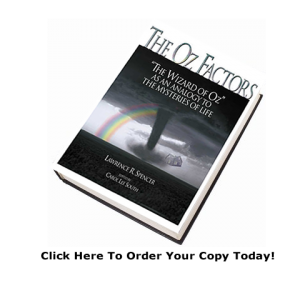
To preview or purchase of copy of THE OZ FACTORS book, click on on image below:

Republished by Blog Post Promoter
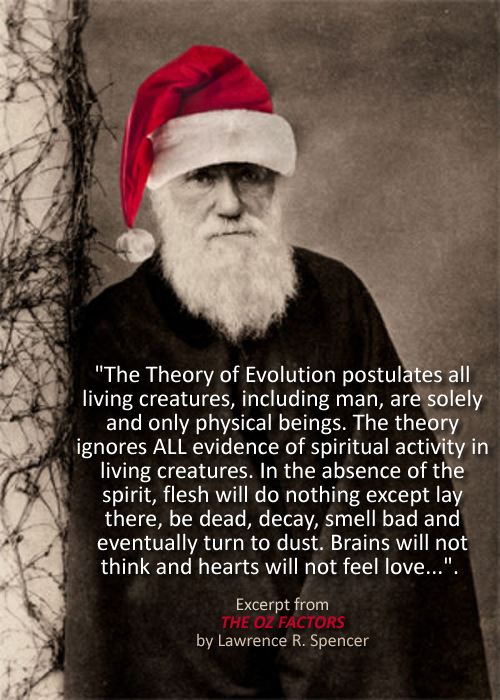
“The Theory of Evolution postulates all living creatures, including man, are solely and only physical beings. The theory ignores ALL evidence of spiritual activity in living creatures. In the absence of the spirit, flesh will do nothing except lay there, be dead, decay, smell bad and eventually turn to dust. Brains will not think and hearts will not feel love…”.
_____________________________________
“The celebration of Christmas, held during the Winter Solstice to commemorate the birthday of Jesus was adapted from a variety of pagan cults. The celebration of the Roman holiday season of “Saturnalia”, for the god Saturn, was adapted to become Christmas in 336 AD. Saturnalia was a festival during which Roman slaves were given control of the household for one day each year. The festival was held between December 17th and 23rd during which families feasted together, slaves were given time off and presents were exchanged.”
Excerpts from THE OZ FACTORS by Lawrence R. Spencer