Tag Archives: soul

THE LONELY GHOST COULD BE YOU

Republished by Blog Post Promoter
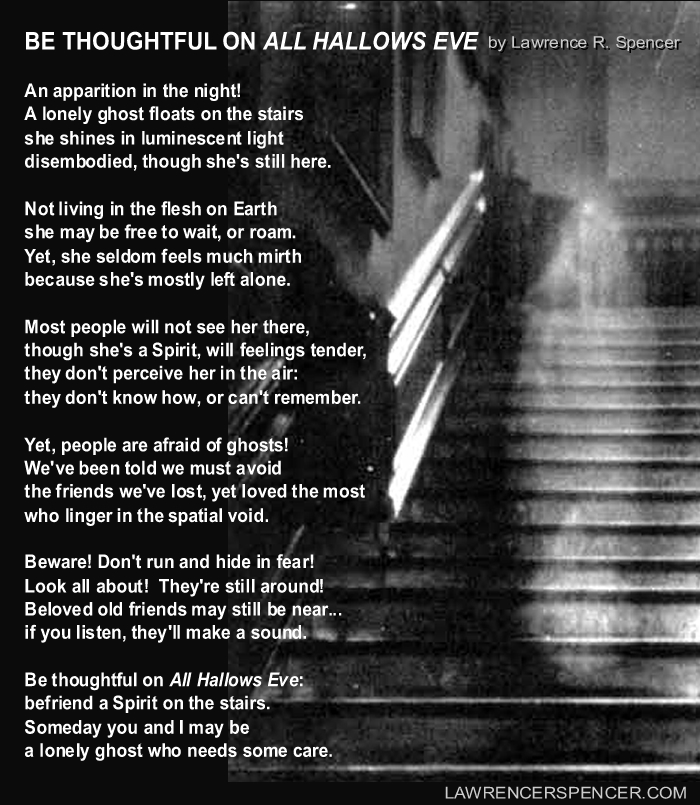
BE THOUGHTFUL ON ALL HALLOWS EVE
by Lawrence R. Spencer 
An apparition in the night!
A lonely ghost floats on the stairs
she shines in luminescent light
disembodied, though she's still here.

Not living in the flesh on Earth
she may be free to wait, or roam.
Yet, she seldom feels much mirth
because she's mostly left alone.

Most people will not see her there,
though she's a Spirit, will feelings tender,
they don't perceive her in the air:
they don't know how, or can't remember.

Yet, people are afraid of ghosts!
We've been told we must avoid
the friends we've lost, yet loved the most
who linger in the spatial void.

Beware! Don't run and hide in fear!
Look all about!  They're still around!
Beloved old friends may still be near...
if you listen, they'll make a sound.

Be thoughtful on All Hallows Eve:
befriend a Spirit on the stairs.
Someday you and I may be
a lonely ghost who needs some care.

SHADOW HAIKU

Republished by Blog Post Promoter

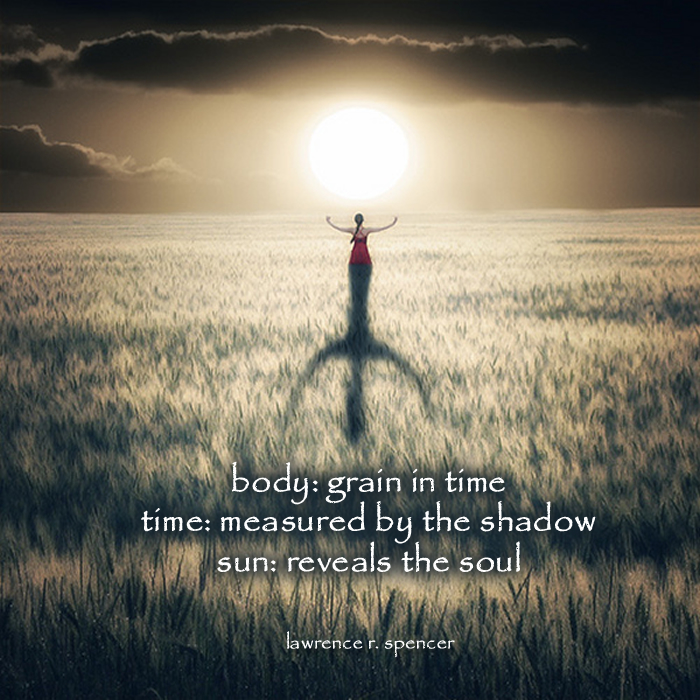
SHADOW HAIKU

A traditional Japanese haiku is a three-line poem with seventeen syllables, written in a 5/7/5 syllable count. Often focusing on images from nature, haiku emphasizes simplicity, intensity, and directness of expression.  Haiku began in thirteenth-century Japan.  In contrast to English verse typically characterized by meter, Japanese verse counts sound units known as “on” or morae. Traditional haiku consist of 17 on, in three phrases of five, seven and five on respectively.  Among contemporary poems teikei (定型 fixed form) haiku continue to use the 5-7-5 pattern while jiyuritsu (自由律 free form) haiku do not.

A Classic EXAMPLE:

An old pond!

A frog jumps in–

the sound of water.

 For more detailed information about Haiku, visit the website, 

HOW TO WRITE A HAIKU POEM:  http://www.wikihow.com/Write-a-Haiku-Poem

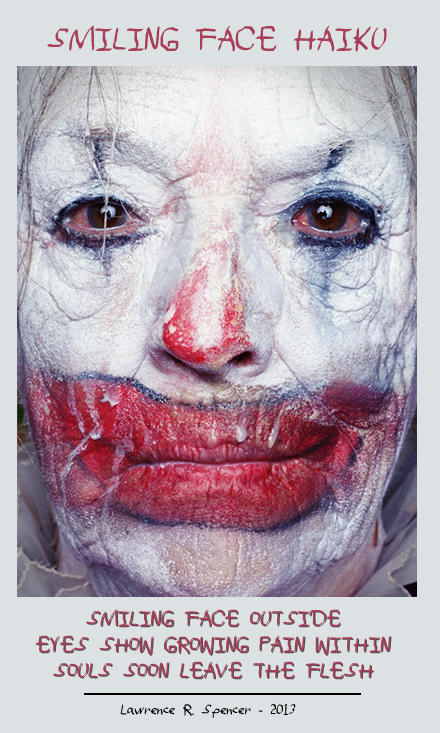
SMILING FACE HAIKU

Republished by Blog Post Promoter

smiling face haiku

A Haiku (in the English language) is a short poem which uses imagistic language to convey the essence of an experience of nature or the season intuitively linked to the human condition. It is a development of the Japanese haiku poetic form in the English language.  Some of the more common practices in English include:  use of three lines of up to 17 syllables;  most commonly, 5, 7, 5.  Haiku uses an economy of words to paint a multi-tiered painting, without “telling all”.

YOU WILL BE FREE?

Republished by Blog Post Promoter

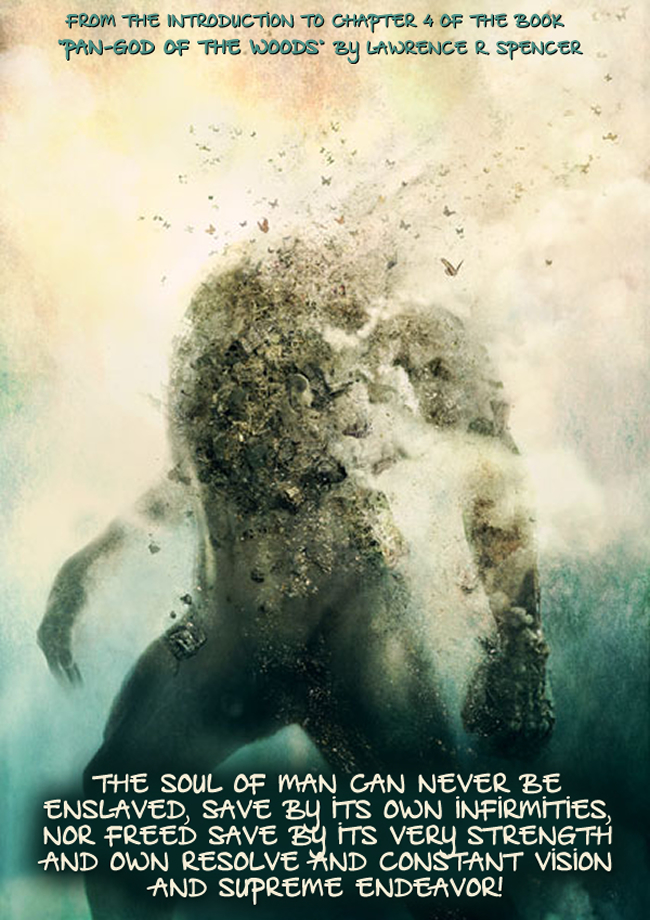
From the Introduction of Chapter IV of the book PAN – GOD OF THE WOODS, by Lawrence R. Spencer

“The soul of man can never be enslaved, save by its own infirmities, nor freed save by its very strength and own resolve and constant vision and supreme endeavor!

You will be free? Then, courage, o my brother!  O let the soul stand in the open door of life and death and knowledge and desire and see the peaks of thought kindle with sunrise!”

— from “Herakles” by George Cabot Lodge  (c. 1873 – 1909),  American poet