Tag Archives: sex

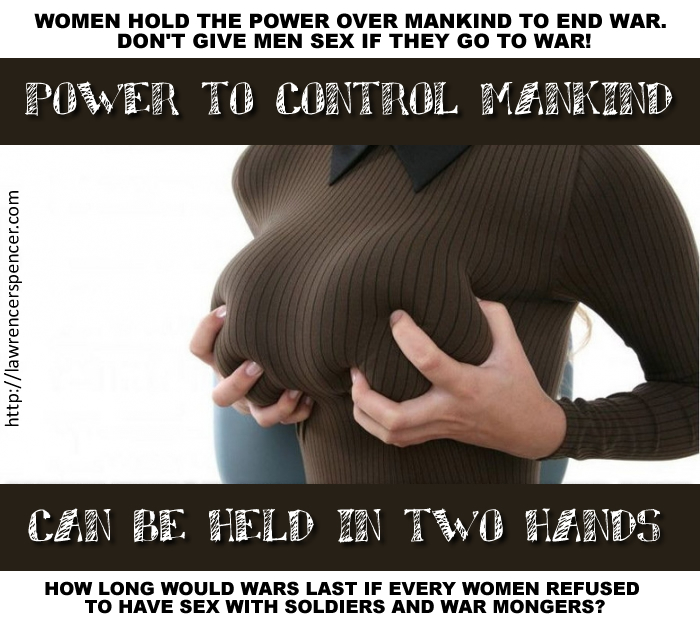
WITHHOLD A PIECE FOR PEACE, LADIES

Republished by Blog Post Promoter
A synopsis of the play “LYSISTRATA” by the Greek poet and play writer, Aristophanes ( 411 B.C.E.)

The Peloponnesian War has been dragging on for eighteen long years, and the beautiful Lysistrata, in common with the other wives of Athens, is heartily tired of the intermittent absence of their warrior husbands. She decides that it is time to bring an end to this situation. The only solution, she concludes, is a boycott to deprive the husbands of their wives’ love.

Lysistrata sets out to enlist the other women in the plan, but finds them somewhat reluctant. One thinks that to so punish their husbands would be punishing themselves; others offer similar excuses. Lysistrata tells them that they are cowards and that the poets’ jibes about women’s frailty are well deserved.

But she perseveres in her determination, and convinces the women at last that peace surely will come if they all dress, powder and perfume themselves irresistibly, then withhold their favors from their men unless they promise to take steps to end the war forthwith. The wives agree to try the scheme, and, for a start, seize the public funds. The old men of Athens try to burn them out of the treasury, but the embattled women retaliate with pitchers of water upon their heads. The President of the Senate arrives at this juncture, ordering the arrest of “that traitress,” Lysistrata.

The women win the scuffle that follows, the President admitting defeat; but he asks an explanation for the feminine onslaught upon the treasury. Lysistrata blandly explains their purpose: to save the public money so that the men won’t fight any wars over it. The President protests the absurdity of their fancy that the war is being fought over mere money. Lysistrata assures him that of course it is; that every war is for the sake of money–else why are politicians always manufacturing wars? Merely as an occasion to steal, she says.

Then Lysistrata announces that, from now on, things are going to be different: the men won’t be able to get any money for fighting because the women are going to take over the treasury. And why not? They manage the household finances. But household finances, the President tolerantly explains, are quite different; the public money is necessary for the fighting. To this Lysistrata readily agrees, but adds that the fighting itself is hardly necessary.

The listening women, weary of the argument by this time, seize the President, unclothe him and dress him as a woman. They tell him that they are going to take the state into their own hands, rescue it from the muddling of men, unravel the knots of war just as they straighten out a skein of wool, and unite all nations into a single thread of peace and good will.

But the President persists: war, after all, is the business of men, he says. Nothing of the kind, Lysistrata replies, it is the business of women–for who suffers most in the loss on the battlefields of sons and husbands? To end the debate, the women again seize the official and garb him as a corpse. He retreats in terror.

After a time, the wives of the enemy city of Sparta join in the boycott. The plan is a success: the husbands of both cities surrender to their wives, and, to recapture their love, agree to end the war. Here a male chorus observes that it was a wise philosopher who called women the paradoxical sex: you cannot live with them and you cannot live without them. A female chorus replies that, say what you will and do what you will, the women always have the last word, for theirs is the unanswerable argument. Together the choruses agree that there has been enough of idle quarrels: they urge that the discord cease.

Lysistrata is chosen as intermediary between the Athenian and Spartan envoys for formal termination of the conflict, and she lectures them soundly at the start of their conference. She is a woman, she says, but hopes that she is not without some sense; she reminds them that they are all of the same blood, the same gods and the same language. Why, then, do they kill each other? Why should they not come to terms? She agrees that it may be necessary for animals to fight, but certainly not for men–particularly for Greek men–to fight among themselves while barbarians are looking on.

A Spartan delegate announces that his side is ready to make peace if it gets what it wants, and an Athenian observes that what both the Spartans and Athenians want is to get their wives back again. Lysistrata sees some feasibility in this, but orders that first the former enemies must go off to a feast to repair their friendship. After that, she says, each warrior may take his woman home.

The warriors try Lysistrata’s program, and at length return as bosom friends. This accomplished, she bids them each take his woman, and all join in a dance of peace as the chorus pleads:A Spartan seconds this idea, proposing further, that they all get drunk–a suggestion not unpleasant to one Athenian who notes that people are surliest when most sober. If there were more drinking bouts among diplomats, he thinks, there would be no war; they would drown their quarrels in wine, have some singing together, and decide that, after all, an enemy could still be a good fellow.

“O let us prayTo the gods today
While in peace we eatOur bread and our meat.
That every fieldMay its harvest yield,
O Venus, arrayed in love, restore
The hopes and joys we have lost in the war…
Let the sword be forgotten for evermore.”

STILL GOT THE BLUES FOR YOU

Republished by Blog Post Promoter

This is one of the most powerful love songs ever written and performed. It communicates the beautiful pain of sexual desire and passion that conceives babies, and yet, leaves partners in heart break, longing, anguish and despair over the loss of a relationship that promised an eternity of overwhelming Ecstasy and Joy.

Sex without communication, seeks only sensation: no responsibility for the lover and no willingness TO BE THE OTHER. Sexual passion endures for a moment. The Child of Passion lives for a Life Time, depending on parents to nurse, to work, to sacrifice for them, in the Hope of fulfilling a Future for themselves, each other and for Mankind. The regret of losing the possibility of creating a  Life, and Living a Life, is the Pain of Death.

“Used to be so easy to give my heart away, But I found out the hard way, There’s a price you have to pay I found out that love was no friend of mine I should have known time after time So long, it was so long ago But I’ve still got the blues for you Used to be so easy to fall in love again But I found out the hard way It’s a road that leads to pain I found that love was more than just a game You’re playin’ to win But you lose just the same So long, it was so long ago But I’ve still got the blues for you So many years since I’ve seen your face Here in my heart, there’s an empty space Where you used to be So long, it was so long ago But I’ve still got the blues for you Though the days come and go There is one thing I know I’ve still got the blues for you.”

— lyrics to the song, ‘Still Got The Blues For You’, by Gary Moore

HEDONISM (PARTY-EAT-DRINK-SCREW-TILL-YOU-DIE-ISM)

Republished by Blog Post Promoter

thomas_couture-romans_of_the_decadence(painting by Thomas Couture: Romans of the decadence)

It’s hard to argue with the ages old philosophy of hedonism. http://en.wikipedia.org/wiki/Hedonism 

We are confronted on Earth with the reality that we are mortal. We inhabit a body of fragile flesh that will die. We live on a Prison Planet. We are surrounded by perpetual pain: death, taxes and with religious and scientific superstitions that ensure our perpetual stupidity.  The idea of “freedom” to which we feel entitled as a “natural right” of Caucasian Conquers of the “barbarians” of North America, Africa, the Middle East, etc., has been stolen from us by Rothschild Private Banks who own the private military / police force and politicians they control. We are the “peasants”.  We obey, we do the heavy lifting, we do the menial work, we pay taxes, we kill each other on battle fields of perpetual warfare, and we die a certain an eternal death.  As spiritual entities we have been given amnesia.  We do not remember Who We Really Are, or where we came from, or who brought us to this planet.  We are isolated and forgotten on a infinitesimally tiny speck of dust on the fringe of a remote galaxy.  We are lost….forever, and ever.  So, when faced the the brutal reality of our insignificantly abysmal existence, it seems that the only “logical” option is to “get drunk and screw and party till you die”.  (and start all over again when you are reincarnated as a “stinky baby”…..ad infinitum).

noun: hedonism

1) the pursuit of pleasure; sensual self-indulgence.
synonyms: self-indulgence, pleasure-seeking, self-gratification, lotus-eating, sybaritism;
intemperance, immoderation, extravagance, luxury, high living

2) the ethical theory that pleasure (in the sense of the satisfaction of desires) is the highest good and proper aim of human life.

PARTS OF A RELATIONSHIP

Republished by Blog Post Promoter

PARTS OF A RELATIONSHIP

Recently, I’ve thought a lot about the subject of “relationships”, in an attempt to live my own life on Earth.  One of the most joyful and agonizing experiences in existence is the successful creation and maintenance of a “relationship”.   It is easy enough to withdraw from relationships and simply give up on them because they can be painful, confusing, frustrating and a lot of hard work!   In human society it is very commonly the source of turmoil, destruction and unhappiness.  If anyone has any more ideas about how to have a successful relationship, I’d like to know….

Here are a few definitions that I think are the most important parts of a “relationship”, in relative order of importance:

RELATIONSHIP

noun:   a state of connectedness between people (especially an emotional connection)

COMMUNICATION

  • noun:   a connection allowing access between persons or places

UNDERSTANDING

  • noun:   an inclination to support or be loyal to or to agree with an opinion

  • noun:   the statement (oral or written) of an exchange of promise

  • adjective:   characterized by understanding based on comprehension and discernment and empathy

RESPONSIBILITY

  • noun:   a form of trustworthiness; the trait of being answerable to someone for something or being responsible for one’s conduct

  • noun:   the social force that binds you to your obligations and the courses of action demanded by that force

FREEDOM

  • noun:   the condition of being free; the power to act or speak or think without externally imposed restraints

  • noun:   immunity from an obligation or duty

WISDOM

  • noun:   accumulated knowledge or erudition or enlightenment

REALITY

  • noun:   the state of the world as it really is rather than as you might want it to be

LOVE

  • noun:   any object of warm affection or devotion

SEX

  • noun:   all of the feelings resulting from the urge to gratify sexual impulses

DRUGS, SEX AND INSURANCE

Republished by Blog Post Promoter

Every 3rd commercial you see on TV is for “dick pills”, or Life Insurance.  I’ve often wondered if all this expensive advertising is a conspiracy between women, the pharmaceutical industry and life insurance companies to cash in on sex as a way to boost sales.  Also, it’s a smart and legal way to get rid of the Old Man, and live happily ever after collecting on the Life Insurance policy when the old f*cker is dead, long, long after menopause and the total cessation of sexual desire.  By the way, my own father died of a heart attack at the age of 78 while having sex with my mother.  (true story.)

Here’s an advertisement I made up to warn men about my “Drugs, Sex and Insurance Conspiracy Theory”: